College of Engineering, Huaqiao University, Quanzhou 362021, China.
School of Medicine, Huaqiao University, Quanzhou 362021, China.
Comput Math Methods Med. 2020 Oct 1;2020:5894010. doi: 10.1155/2020/5894010. eCollection 2020.
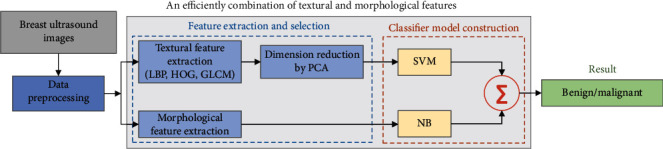
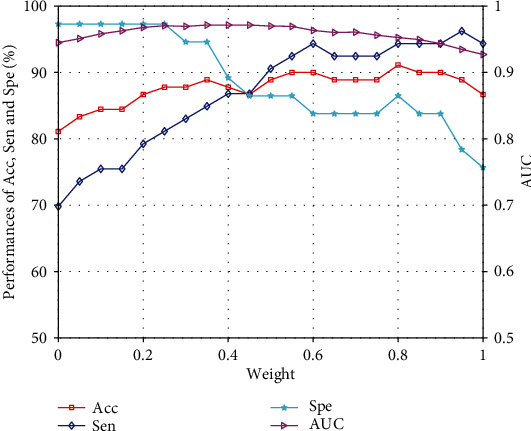
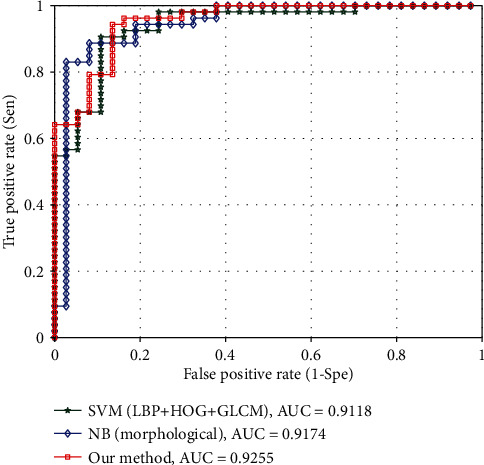
The classification of benign and malignant based on ultrasound images is of great value because breast cancer is an enormous threat to women's health worldwide. Although both texture and morphological features are crucial representations of ultrasound breast tumor images, their straightforward combination brings little effect for improving the classification of benign and malignant since high-dimensional texture features are too aggressive so that drown out the effect of low-dimensional morphological features. For that, an efficient texture and morphological feature combing method is proposed to improve the classification of benign and malignant. Firstly, both texture (i.e., (LBP), (HOG), and (GLCM)) and morphological (i.e., shape complexities) features of breast ultrasound images are extracted. Secondly, a (SVM) classifier working on texture features is trained, and a (NB) classifier acting on morphological features is designed, in order to exert the discriminative power of texture features and morphological features, respectively. Thirdly, the classification scores of the two classifiers (i.e., SVM and NB) are weighted fused to obtain the final classification result. The low-dimensional nonparameterized NB classifier is effectively control the parameter complexity of the entire classification system combine with the high-dimensional parametric SVM classifier. Consequently, texture and morphological features are efficiently combined. Comprehensive experimental analyses are presented, and the proposed method obtains a 91.11% accuracy, a 94.34% sensitivity, and an 86.49% specificity, which outperforms many related benign and malignant breast tumor classification methods.
基于超声图像的良性和恶性分类具有重要价值,因为乳腺癌是全世界女性健康的巨大威胁。尽管纹理和形态特征都是超声乳腺肿瘤图像的重要表示,但由于高维纹理特征过于激进,会淹没低维形态特征的效果,因此直接组合这两种特征对提高良性和恶性分类的效果不大。为此,提出了一种有效的纹理和形态特征组合方法来提高良性和恶性分类的效果。首先,提取乳腺超声图像的纹理(即 LBP、HOG 和 GLCM)和形态(即形状复杂度)特征。其次,训练基于纹理特征的支持向量机(SVM)分类器,并设计基于形态特征的朴素贝叶斯(NB)分类器,分别发挥纹理特征和形态特征的判别能力。然后,对两个分类器(SVM 和 NB)的分类得分进行加权融合,得到最终的分类结果。低维非参数化的 NB 分类器与高维参数化的 SVM 分类器相结合,可以有效地控制整个分类系统的参数复杂度。因此,可以有效地组合纹理和形态特征。进行了全面的实验分析,所提出的方法获得了 91.11%的准确率、94.34%的灵敏度和 86.49%的特异性,优于许多相关的良性和恶性乳腺肿瘤分类方法。