Polski Ashley, Xu Liya, Prabakar Rishvanth K, Kim Jonathan W, Shah Rachana, Jubran Rima, Kuhn Peter, Cobrinik David, Hicks James, Berry Jesse L
The Vision Center at Children's Hospital Los Angeles, Los Angeles, CA, USA.
USC Roski Eye Institute, Keck School of Medicine of the University of Southern California, Los Angeles, CA, USA.
Transl Vis Sci Technol. 2020 Sep 30;9(10):30. doi: 10.1167/tvst.9.10.30. eCollection 2020 Sep.
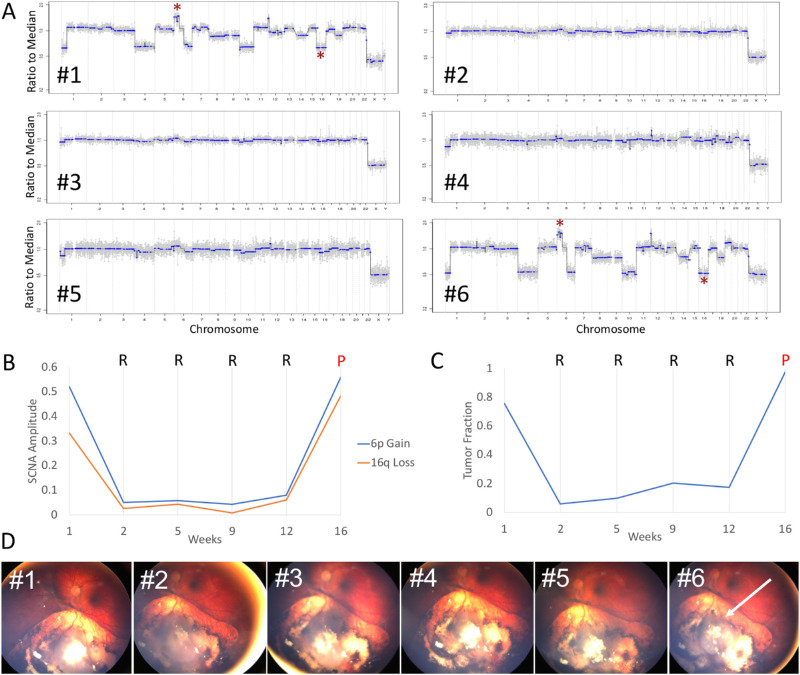
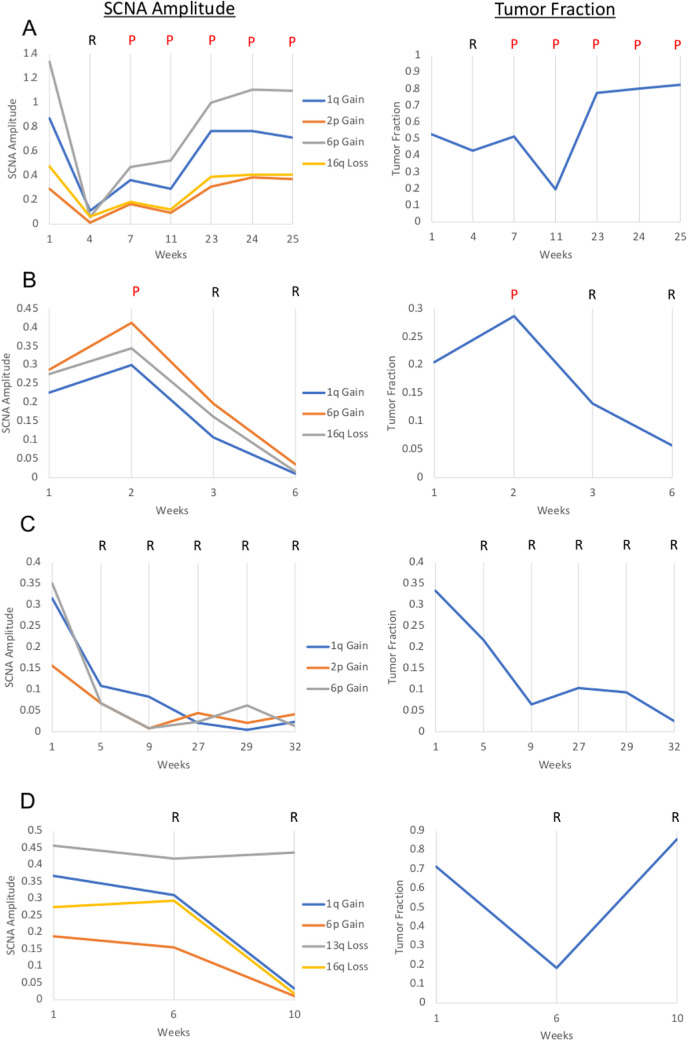
The aqueous humor (AH) liquid biopsy enables in vivo evaluation of tumor-derived cell-free DNA (cfDNA) from retinoblastoma (RB) eyes. Herein, we test our hypothesis that longitudinal dynamics of AH cfDNA-including tumor fraction (TFx) and somatic copy number alteration (SCNA) amplitude-correspond to therapeutic response.
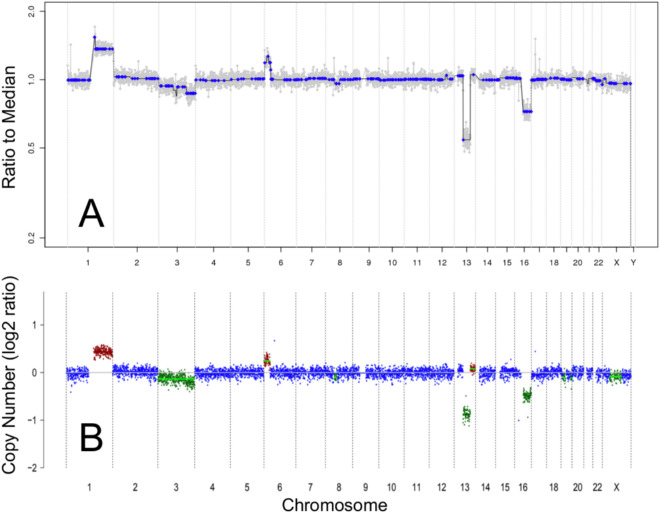
Eyes with ≥3 AH extractions during intravitreal chemotherapy (IVM) or at secondary enucleation between 2015 to 2019 were included. AH cfDNA was sequenced to assess RB SCNA amplitude; ichorCNA software was used to estimate TFx. Eyes without SCNAs or with TFx < 0.10 across all samples were excluded. Therapeutic responses for each eye were determined from clinical records. Statistical analyses included Mann-Whitney U and Pearson correlation tests.
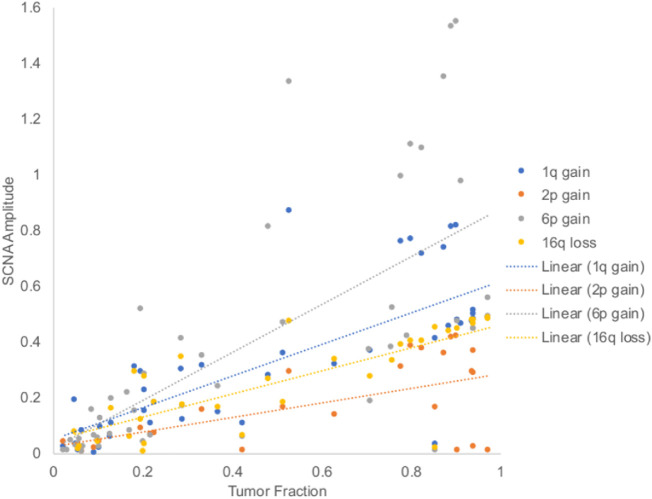
Twenty eyes of 20 patients underwent ≥3 AH extractions; 6 eyes lacked SCNAs or had TFx < 0.10 throughout sampling and were excluded. Clinical progression was associated with significantly higher SCNA amplitudes and TFx values than regression ( ≤ 0.04). Relative increases in TFx (ΔTFx 1.86 ± 2.22) were associated with disease progression, whereas relative decreases in TFx (ΔTFx 0.53 ± 0.36) were associated with disease regression ( < 0.00001). A ≥15% increase in TFx relative to baseline during treatment was associated with an over 90-fold increased likelihood of clinical progression (odds ratio = 90.67, 95% confidence interval = 8.30-990.16, = 0.0002). TFx and SCNA amplitude were significantly positively correlated throughout sampling ( ≤ 0.002).
Longitudinal changes in AH-derived cfDNA TFx and SCNA amplitude are concordant with clinical responses of intraocular RB during active therapy.
Longitudinal evaluation of AH cfDNA may provide an objective, quantitative way to monitor therapeutic response and disease burden in RB patients.
房水(AH)液体活检能够对视网膜母细胞瘤(RB)患眼中肿瘤来源的游离DNA(cfDNA)进行体内评估。在此,我们检验我们的假设,即AH cfDNA的纵向动态变化——包括肿瘤分数(TFx)和体细胞拷贝数改变(SCNA)幅度——与治疗反应相对应。
纳入2015年至2019年间在玻璃体内化疗(IVM)期间或二次眼球摘除时进行了≥3次AH抽取的眼睛。对AH cfDNA进行测序以评估RB的SCNA幅度;使用ichorCNA软件估计TFx。排除所有样本中无SCNAs或TFx<0.10的眼睛。根据临床记录确定每只眼睛的治疗反应。统计分析包括曼-惠特尼U检验和皮尔逊相关检验。
20例患者的20只眼睛进行了≥3次AH抽取;6只眼睛在整个采样过程中缺乏SCNAs或TFx<0.10,被排除。与病情缓解相比,临床进展与显著更高的SCNA幅度和TFx值相关(P≤0.04)。TFx的相对增加(ΔTFx 1.86±2.22)与疾病进展相关,而TFx的相对减少(ΔTFx 0.53±0.36)与疾病缓解相关(P<0.00001)。治疗期间TFx相对于基线增加≥15%与临床进展的可能性增加90倍以上相关(优势比=90.67,95%置信区间=8.30-990.16,P=0.0002)。在整个采样过程中,TFx与SCNA幅度显著正相关(P≤0.002)。
AH衍生的cfDNA的TFx和SCNA幅度的纵向变化与眼内RB在积极治疗期间的临床反应一致。
AH cfDNA的纵向评估可能为监测RB患者的治疗反应和疾病负担提供一种客观、定量的方法。