Liu Jinggong, Li Yongjin, Chen Song, Lin Yongpeng, Lai Haoqiang, Chen Bolai, Chen Tianfeng
Orthopedics Department, Guangdong Provincial Hospital of Traditional Chinese Medicine, The Second Affiliated Hospital of Guangzhou University of Chinese Medicine, Guangzhou, China.
Department of Chemistry, Jinan University, Guangzhou, China.
Front Chem. 2020 Sep 18;8:838. doi: 10.3389/fchem.2020.00838. eCollection 2020.
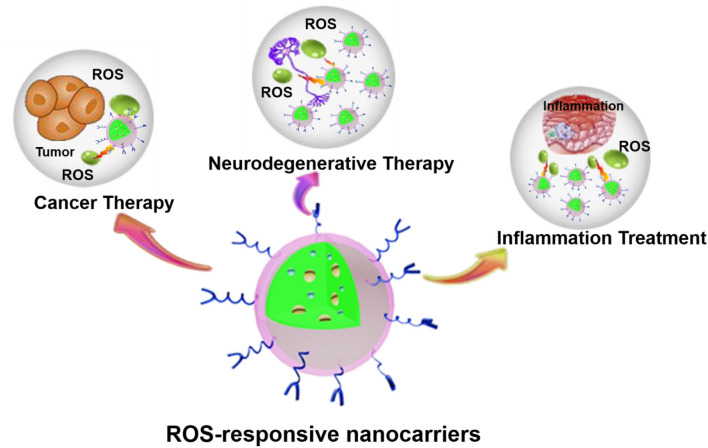
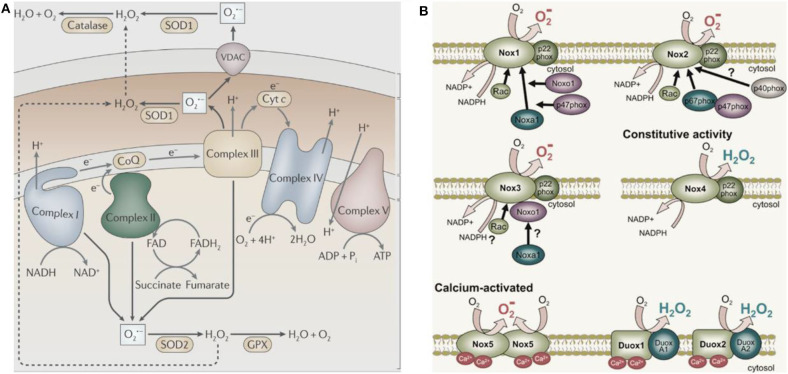
Numerous pathological conditions, including cancer, inflammatory diseases, and neurodegenerative diseases, are accompanied by overproduction of reactive oxygen species (ROS). This makes ROS vital flagging molecules in disease pathology. ROS-responsive drug delivery platforms have been developed. Nanotechnology has been broadly applied in the field of biomedicine leading to the progress of ROS-responsive nanoparticles. In this review, we focused on the production and physiological/pathophysiological impact of ROS. Particular emphasis is put on the mechanisms and effects of abnormal ROS levels on oxidative stress diseases, including cancer, inflammatory disease, and neurodegenerative diseases. Finally, we summarized the potential biomedical applications of ROS-responsive nanocarriers in these oxidative stress diseases. We provide insights that will help in the designing of new ROS-responsive nanocarriers for various applications.
许多病理状况,包括癌症、炎症性疾病和神经退行性疾病,都伴随着活性氧(ROS)的过量产生。这使得ROS成为疾病病理学中至关重要的标记分子。已经开发出了对ROS有响应的药物递送平台。纳米技术已广泛应用于生物医学领域,推动了对ROS有响应的纳米颗粒的发展。在本综述中,我们重点关注了ROS的产生及其对生理/病理生理的影响。特别强调了ROS水平异常对氧化应激疾病(包括癌症、炎症性疾病和神经退行性疾病)的作用机制和影响。最后,我们总结了对ROS有响应的纳米载体在这些氧化应激疾病中的潜在生物医学应用。我们提供的见解将有助于设计用于各种应用的新型对ROS有响应的纳米载体。