Department of Pharmaceutical and Pharmacological Sciences, KU Leuven, Leuven, Belgium.
Hospital Pharmacy, Erasmus University Medical Center, Molewaterplein 40, 3015 GD, Rotterdam, The Netherlands.
BioDrugs. 2020 Dec;34(6):797-808. doi: 10.1007/s40259-020-00440-z.
Despite the benefits biosimilars offer in terms of cost savings and patient access, healthcare professionals and patients have been reluctant to use them. Next to insufficient understanding of and trust in biosimilars, healthcare professionals and patients have questions about switching and the nocebo effect when using biosimilars in clinical practice. In addition, clear motivation to use biosimilars may be lacking among these stakeholders.
This study aims to provide recommendations on how to improve biosimilar use on both a clinical and a practical level based on insights from healthcare professionals (physicians, hospital pharmacists, nurses), patients (or their representatives), and regulators across Europe.
We conducted 44 semi-structured interviews with experts from five stakeholder groups across Europe: physicians, hospital pharmacists, nurses, regulators, and patients/representatives. Interviews were transcribed ad verbatim and transcripts analysed according to the thematic framework method.
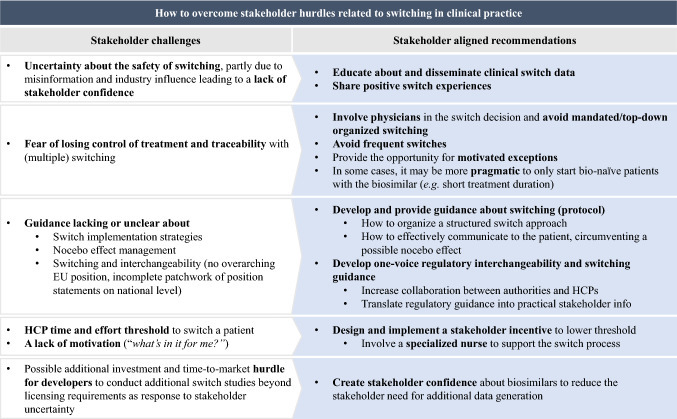
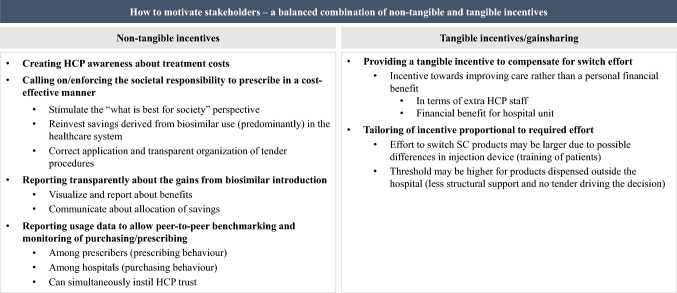
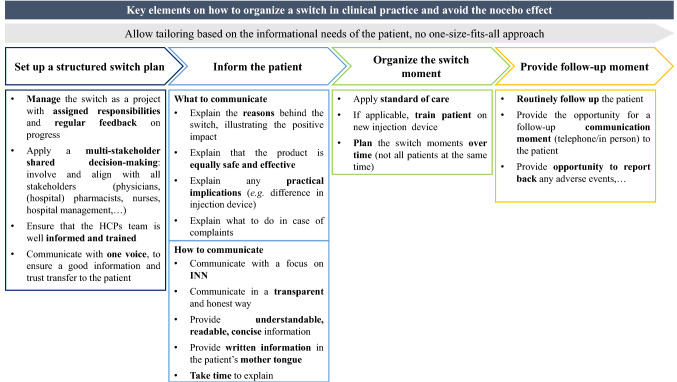
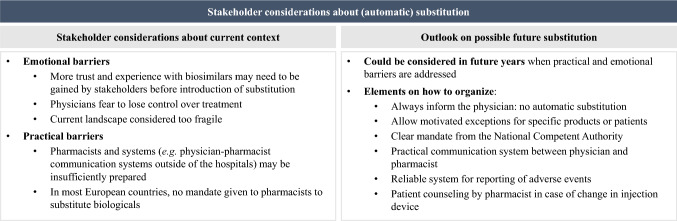
Based on the insights and considerations of the experts interviewed, we identified a number of recommendations to improve the use of biosimilars in clinical practice. Regarding switch implementation, the experts voiced support for the following actions: (1) disseminate evidence from and experience with (multiple) switching; (2) provide clear, one-voice regulatory guidance about the interchangeability of biosimilars and their reference product; (3) apply a multi-stakeholder implementation and communication protocol to guide switching in clinical practice; (4) apply a pragmatic approach when taking switch decisions; and (5) avoid mandated switching, allowing stakeholder communication and alignment. When discussing approaches to increase the willingness of stakeholders to use biosimilars, we concluded that actions should be centred on (1) communicating the benefits provided by biosimilars and the introduction of market competition, (2) increasing awareness among stakeholders about medicine prices and their societal responsibility to use medicines in a cost-effective manner, (3) transparent reporting about the allocation of savings, (4) sharing biosimilar usage data among hospitals and prescribers to allow peer-to-peer benchmarking, and (5) applying a balanced combination of tangible and non-tangible incentives that can be tailored to offset the time and effort expended by stakeholders when switching to a biosimilar.
This study proposes a number of strategic, practical, and overarching recommendations to support healthcare professionals and inform decision makers to improve the clinical use of biosimilars and the willingness of stakeholders to use them. The proposed solutions to fully realise the potential of biosimilars for healthcare systems and patients include developing practical switch guidance, being transparent about the gains from biosimilar use (and how savings are allocated), and developing a combination of non-tangible and tangible incentives for involved stakeholders.
尽管生物类似药在节省成本和增加患者可及性方面具有优势,但医疗保健专业人员和患者仍不愿使用生物类似药。除了对生物类似药的理解和信任不足外,医疗保健专业人员和患者还对在临床实践中使用生物类似药时的转换和反安慰剂效应存在疑问。此外,这些利益相关者可能缺乏使用生物类似药的明确动机。
本研究旨在根据来自欧洲各地的医疗保健专业人员(医生、医院药剂师、护士)、患者(或其代表)和监管机构的见解,就如何在临床和实践层面上提高生物类似药的使用提供建议。
我们对来自欧洲五个利益相关者群体的专家进行了 44 次半结构化访谈:医生、医院药剂师、护士、监管机构和患者/代表。访谈内容逐字记录,并根据主题框架方法进行分析。
根据接受采访的专家的意见和考虑,我们确定了一些建议,以改善生物类似药在临床实践中的使用。关于实施转换,专家们表示支持以下行动:(1)传播来自(多次)转换的证据和经验;(2)提供关于生物类似药及其参照产品可互换性的明确、一致的监管指导;(3)应用多利益相关者实施和沟通协议来指导临床实践中的转换;(4)在做出转换决策时采取务实的方法;(5)避免强制转换,允许利益相关者进行沟通和协调。在讨论提高利益相关者使用生物类似药意愿的方法时,我们得出的结论是,行动应集中于:(1)沟通生物类似药提供的益处和引入市场竞争;(2)提高利益相关者对药品价格及其以具有成本效益的方式使用药品的社会责任感的认识;(3)透明报告节省的分配情况;(4)在医院和处方医生之间共享生物类似药使用数据,以允许同行基准测试;(5)应用有形和无形激励措施的平衡组合,可以针对利益相关者在转换为生物类似药时所花费的时间和精力进行调整。
本研究提出了一些战略、实践和总体建议,以支持医疗保健专业人员并为决策者提供信息,以改善生物类似药的临床使用和利益相关者使用它们的意愿。为了充分发挥生物类似药对医疗保健系统和患者的潜力,提出的解决方案包括制定实用的转换指南、对生物类似药使用的收益(以及如何分配节省的费用)保持透明,并为相关利益相关者制定有形和无形激励措施的组合。