Alonso-Herranz Laura, Sahún-Español Álvaro, Paredes Ana, Gonzalo Pilar, Gkontra Polyxeni, Núñez Vanessa, Clemente Cristina, Cedenilla Marta, Villalba-Orero María, Inserte Javier, García-Dorado David, Arroyo Alicia G, Ricote Mercedes
Myocardial Pathophysiology Area, Centro Nacional de Investigaciones Cardiovasculares (CNIC), Madrid, Spain.
Vascular Pathophysiology Area, Centro Nacional de Investigaciones Cardiovasculares (CNIC), Madrid, Spain.
Elife. 2020 Oct 16;9:e57920. doi: 10.7554/eLife.57920.
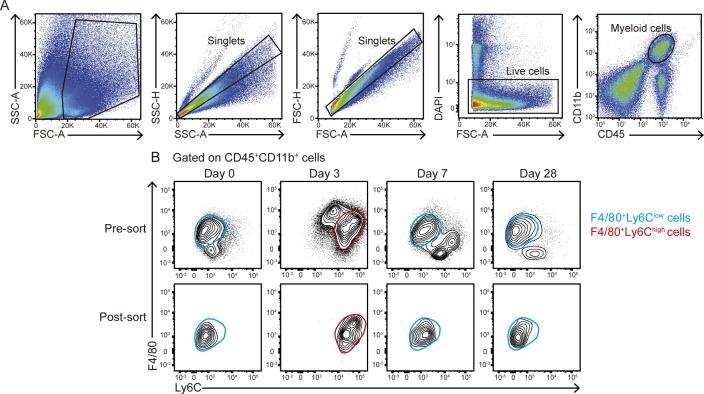
Macrophages (Mφs) produce factors that participate in cardiac repair and remodeling after myocardial infarction (MI); however, how these factors crosstalk with other cell types mediating repair is not fully understood. Here we demonstrated that cardiac Mφs increased the expression of (MT1-MMP) 7 days post-MI. We selectively inactivated the gene in Mφs using a genetic strategy (:-Cre). This conditional KO (MAC-Mmp14 KO) resulted in attenuated post-MI cardiac dysfunction, reduced fibrosis, and preserved cardiac capillary network. Mechanistically, we showed that MT1-MMP activates latent TGFβ1 in Mφs, leading to paracrine SMAD2-mediated signaling in endothelial cells (ECs) and endothelial-to-mesenchymal transition (EndMT). Post-MI MAC-Mmp14 KO hearts contained fewer cells undergoing EndMT than their wild-type counterparts, and -deficient Mφs showed a reduced ability to induce EndMT in co-cultures with ECs. Our results indicate the contribution of EndMT to cardiac fibrosis and adverse remodeling post-MI and identify Mφ MT1-MMP as a key regulator of this process.
巨噬细胞(Mφs)产生的因子参与心肌梗死(MI)后的心脏修复和重塑;然而,这些因子如何与介导修复的其他细胞类型相互作用尚不完全清楚。在这里,我们证明心肌梗死后7天,心脏Mφs中膜型基质金属蛋白酶1(MT1-MMP)的表达增加。我们使用基因策略(:-Cre)在Mφs中选择性地使该基因失活。这种条件性敲除(MAC-Mmp14 KO)导致心肌梗死后心脏功能障碍减轻、纤维化减少,并保留心脏毛细血管网络。从机制上讲,我们表明MT1-MMP激活Mφs中的潜伏转化生长因子β1(TGFβ1),导致内皮细胞(ECs)中旁分泌SMAD2介导的信号传导和内皮-间充质转化(EndMT)。心肌梗死后MAC-Mmp14 KO心脏中经历EndMT的细胞比野生型心脏少,并且Mmp14缺陷的Mφs在与ECs共培养时诱导EndMT的能力降低。我们的结果表明EndMT对心肌梗死后心脏纤维化和不良重塑的作用,并确定Mφ MT1-MMP是这一过程的关键调节因子。