Translational PKPD Research Group, Department of Pharmacy, Faculty of Pharmacy, Uppsala University, SE-751 23 Uppsala, Sweden.
Mol Pharm. 2020 Nov 2;17(11):4029-4039. doi: 10.1021/acs.molpharmaceut.0c00881. Epub 2020 Oct 16.
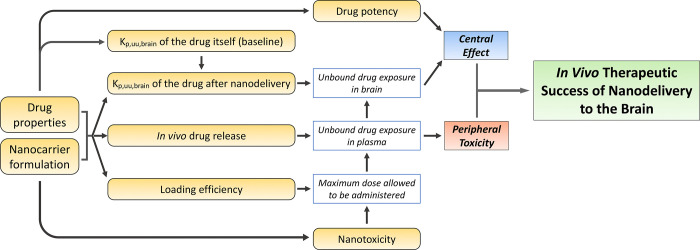
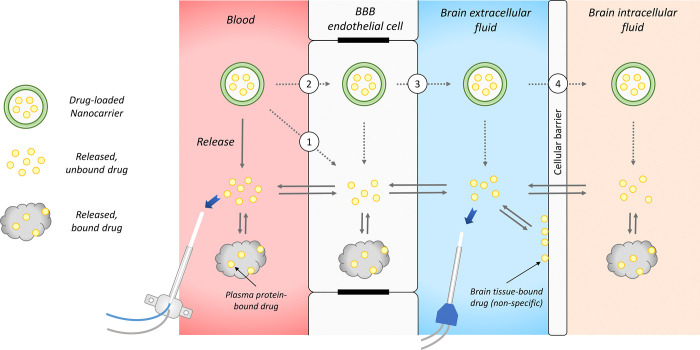
Nanocarriers (NCs) are promising tools to improve drug delivery across the blood-brain barrier (BBB) for more effective treatment of brain disorders, although there is a scarcity of clinical translation of brain-directed NCs. In order to drive the development of brain-oriented NCs toward clinical success, it is essential to understand the prerequisites for nanodelivery to be successful in brain treatment. In this Perspective, we present how pharmacokinetic/pharmacodynamic (PK/PD), formulation and nanotoxicity factors impact the therapeutic success of brain-specific nanodelivery. Properties including high loading efficiency, slow drug release, long systemic circulation, an increase in unbound brain-to-plasma concentration/exposure ratio (), high drug potency, and minimal nanotoxicity are prerequisites that should preferably be combined to maximize the therapeutic potential of a brain-targeted NC. The PK of brain-directed NCs needs to be evaluated in a more therapeutically relevant manner, focusing on the released, unbound drug. It is more crucial to increase the than to improve the ability of the NC to cross the BBB in its intact form. Brain-targeted NCs, which are mostly developed for treating brain tumors, including metastases, should aim to enhance drug delivery not just to tumor regions with disrupted BBB, but equally important to regions with intact BBB where the drugs themselves have problems reaching. This article provides critical insights into how a brain-targeted nanoformulation needs to be designed and optimized to achieve therapeutic success in the brain.
纳米载体 (NCs) 是一种有前途的工具,可改善药物穿越血脑屏障 (BBB) 的传递,从而更有效地治疗脑部疾病,但将脑部靶向 NCs 进行临床转化的情况却很少。为了推动脑部导向 NCs 的发展取得临床成功,了解纳米递药在脑部治疗中成功的前提条件至关重要。在本观点文章中,我们介绍了药代动力学/药效学 (PK/PD)、制剂和纳米毒性因素如何影响脑部特异性纳米递药的治疗成功。包括高载药量、缓慢的药物释放、长循环系统、增加未结合的脑-血浆浓度/暴露比 ()、高药物效力和最小的纳米毒性等特性,是将尽可能最大化脑部靶向 NC 的治疗潜力的前提条件。需要以更具治疗相关性的方式评估脑部靶向 NC 的 PK,重点关注释放的、未结合的药物。增加比提高 NC 以完整形式穿越 BBB 的能力更重要。脑部靶向 NC 主要用于治疗脑肿瘤,包括转移瘤,其目的应该是增强药物输送,不仅要输送到 BBB 破坏的肿瘤区域,而且同样重要的是要输送到 BBB 完整的区域,因为药物本身难以到达这些区域。本文提供了关于如何设计和优化脑部靶向纳米制剂以实现脑部治疗成功的重要见解。