Department of Respiratory, First Hospital of Yangtze University, Clinical Medical College, Yangtze University, Jingzhou, 434000, Hubei, China.
Zhongnan Hospital of Wuhan University, Wuhan, 430071, Hubei, China.
Intern Emerg Med. 2021 Jun;16(4):853-862. doi: 10.1007/s11739-020-02515-9. Epub 2020 Oct 16.
The worldwide spread of SARS-CoV-2 has infected millions of people leading to over 0.3 million mortalities. The disruption of sodium homeostasis, tends to be a common occurrence in patients with COVID-19.
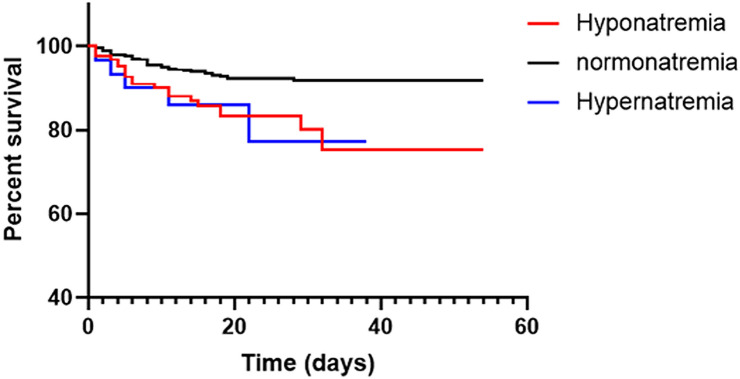
A total of 1,254 COVID-19 patients comprising 124 (9.9%) hyponatremic patients (under 135 mmol/L) and 30 (2.4%) hypernatremic patients (over 145 mmol/L) from three hospitals in Hubei, China, were enrolled in the study. The relationships between sodium balance disorders in COVID-19 patients, its clinical features, implications, and the underlying causes were presented. Hyponatremia patients were observed to be elderly, had more comorbidities, with severe pneumonic chest radiographic findings. They were also more likely to have a fever, nausea, higher leukocyte and neutrophils count, and a high sensitivity C-reactive protein (HS-CRP). Compared to normonatremia patients, renal insufficiency was common in both hyponatremia and hypernatremia patients. In addition, hyponatremia patients required extensive treatment with oxygen, antibiotics, and corticosteroids. The only significant differences between the hypernatremia and normonatremia patients were laboratory findings and clinical complications, and patients with hypernatremia were more likely to use traditional Chinese medicine for treatment compared to normonatremia patients. This study indicates that severity of the disease, the length of stay in the hospital of surviving patients, and mortality were higher among COVID-19 patients with sodium balance disorders.
Sodium balance disorder, particularly hyponatremia, is a common condition among hospitalized patients with COVID-19 in Hubei, China, and it is associated with a higher risk of severe illness and increased in-hospital mortality.
SARS-CoV-2 在全球范围内的传播已感染了数百万人,导致超过 0.3 万人死亡。钠平衡紊乱往往是 COVID-19 患者的常见现象。
本研究共纳入了来自中国湖北的三家医院的 124 名(9.9%)低钠血症患者(<135mmol/L)和 30 名(2.4%)高钠血症患者(>145mmol/L)的 1254 名 COVID-19 患者。研究呈现了 COVID-19 患者钠平衡紊乱与临床特征、意义及潜在病因之间的关系。低钠血症患者年龄较大,合并症较多,肺部影像学表现为严重肺炎。他们也更容易出现发热、恶心、白细胞和中性粒细胞计数较高,以及高敏 C 反应蛋白(hs-CRP)升高。与正常血钠患者相比,低钠血症和高钠血症患者均常见肾功能不全。此外,低钠血症患者需要广泛接受氧疗、抗生素和皮质激素治疗。高钠血症和正常血钠患者之间仅存在实验室检查和临床并发症的显著差异,且高钠血症患者较正常血钠患者更倾向于使用中药治疗。本研究表明,钠平衡紊乱,特别是低钠血症,是中国湖北住院 COVID-19 患者的常见病症,与疾病严重程度、住院时间和死亡率增加相关。
钠平衡紊乱,特别是低钠血症,是中国湖北住院 COVID-19 患者的常见病症,与疾病严重程度和住院死亡率增加相关。