Department of Genetics, Harvard Medical School, Boston, MA 02115, USA; Department of Human Evolutionary Biology, Harvard University, Cambridge, MA 02138, USA.
School of Archaeology and Anthropology, College of Arts and Social Sciences, The Australian National University, Canberra, ACT 2601, Australia; Vanuatu National Museum, Vanuatu Cultural Centre, Port Vila, Vanuatu.
Curr Biol. 2020 Dec 21;30(24):4846-4856.e6. doi: 10.1016/j.cub.2020.09.035. Epub 2020 Oct 15.
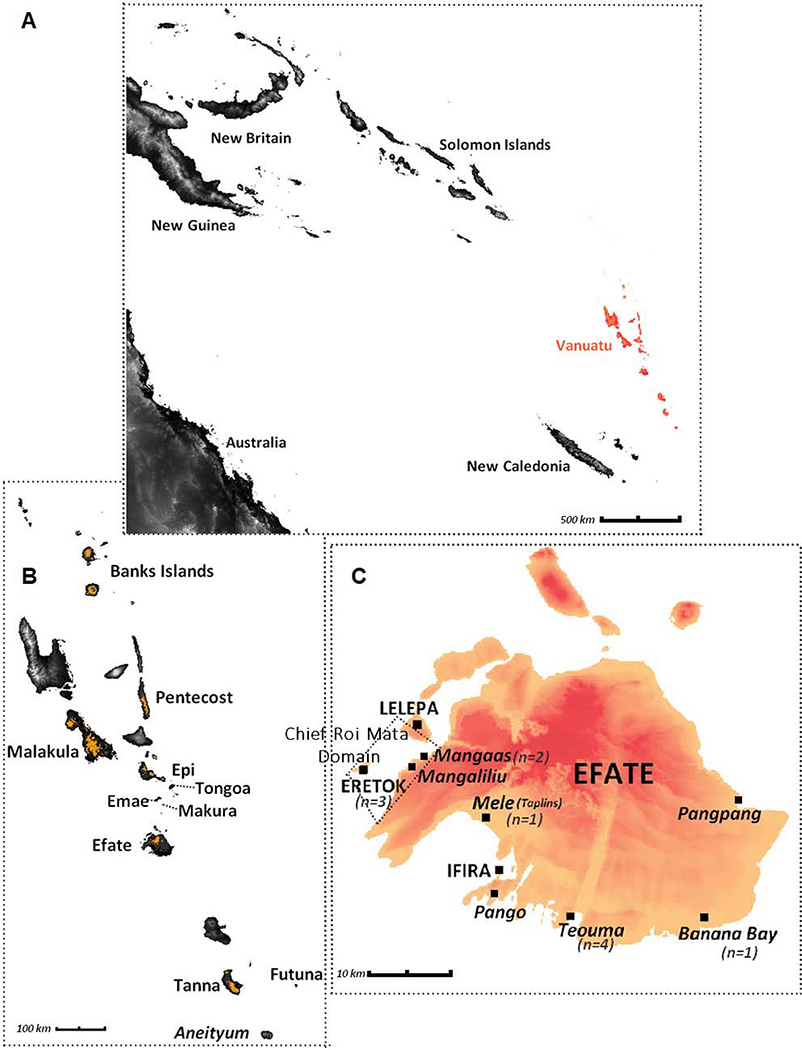
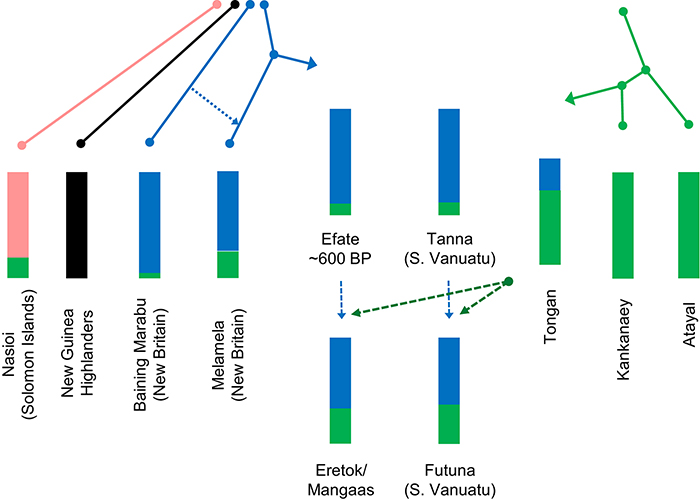
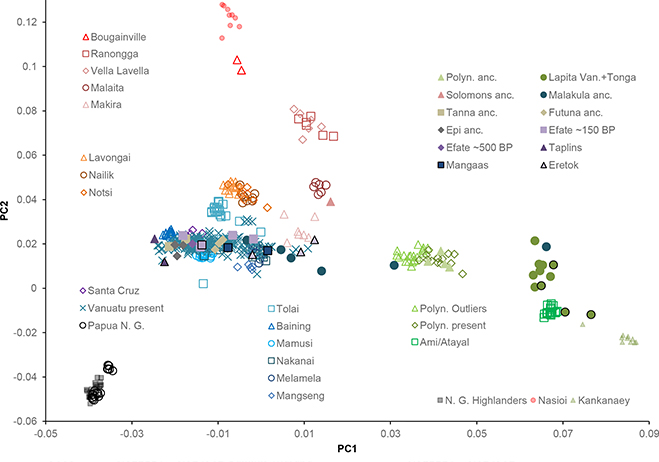
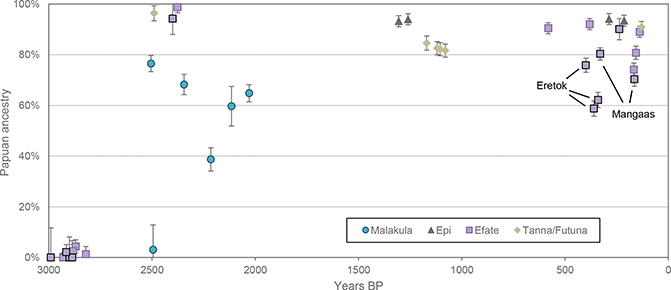
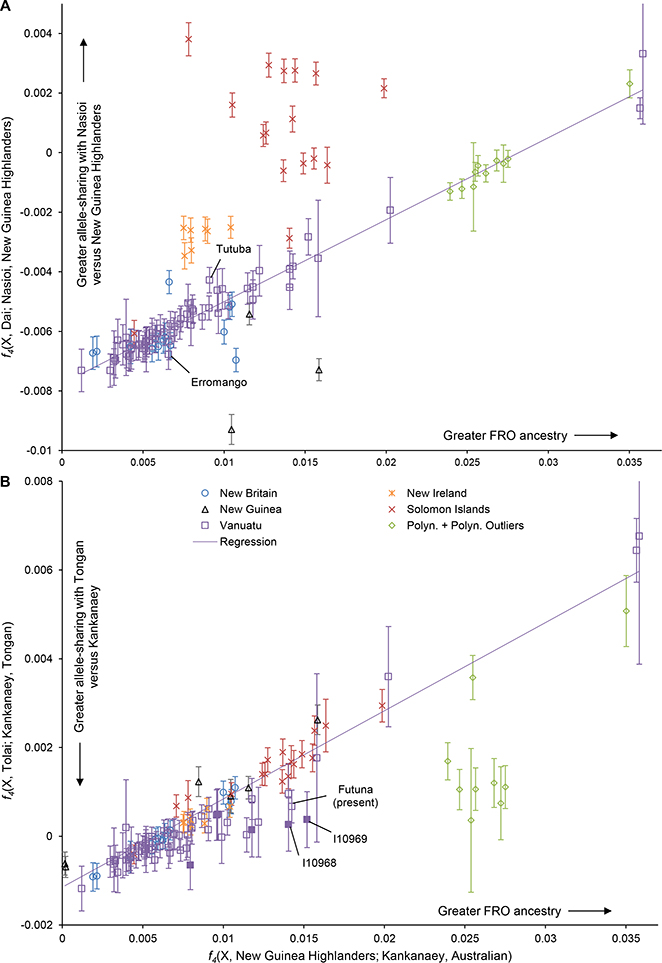
The archipelago of Vanuatu has been at the crossroads of human population movements in the Pacific for the past three millennia. To help address several open questions regarding the history of these movements, we generated genome-wide data for 11 ancient individuals from the island of Efate dating from its earliest settlement to the recent past, including five associated with the Chief Roi Mata's Domain World Heritage Area, and analyzed them in conjunction with 34 published ancient individuals from Vanuatu and elsewhere in Oceania, as well as present-day populations. Our results outline three distinct periods of population transformations. First, the four earliest individuals, from the Lapita-period site of Teouma, are concordant with eight previously described Lapita-associated individuals from Vanuatu and Tonga in having almost all of their ancestry from a "First Remote Oceanian" source related to East and Southeast Asians. Second, both the Papuan ancestry predominating in Vanuatu for the past 2,500 years and the smaller component of Papuan ancestry found in Polynesians can be modeled as deriving from a single source most likely originating in New Britain, suggesting that the movement of people carrying this ancestry to Remote Oceania closely followed that of the First Remote Oceanians in time and space. Third, the Chief Roi Mata's Domain individuals descend from a mixture of Vanuatu- and Polynesian-derived ancestry and are related to Polynesian-influenced communities today in central, but not southern, Vanuatu, demonstrating Polynesian genetic input in multiple groups with independent histories.
万那杜群岛在过去的三千年中一直是太平洋地区人类人口流动的交汇点。为了帮助解决有关这些流动历史的几个未解决的问题,我们对来自埃法特岛的 11 个古代个体进行了全基因组数据生成,这些个体的年代从最早的定居点到最近的过去,其中包括五个与 Chief Roi Mata 的 Domain 世界遗产区有关的个体,并将它们与来自万那杜和大洋洲其他地区的 34 个已发表的古代个体以及当今的人群进行了分析。我们的研究结果概述了三个不同的人口转变时期。首先,来自 Teouma 的拉皮塔时期遗址的四个最早的个体与此前在万那杜和汤加描述的八个与拉皮塔相关的个体一致,它们的祖先几乎全部来自与东亚和东南亚有关的“第一远洋”来源。其次,在过去的 2500 年中,在万那杜占主导地位的巴布亚血统和在波利尼西亚发现的较小巴布亚血统成分都可以被建模为源自一个单一的来源,最有可能起源于新不列颠,这表明携带这种血统的人的迁移与第一远洋人的迁移在时间和空间上密切相关。第三,Chief Roi Mata 的 Domain 个体来自万那杜和波利尼西亚血统的混合,与今天万那杜中部但不是南部受波利尼西亚影响的社区有关,这表明在具有独立历史的多个群体中,波利尼西亚的遗传输入。