Occupational Health & Safety Department, Faculty of Public Health, Universitas Indonesia, Depok 16424, Indonesia.
Faculty of Built Environment, UNSW Sydney, Sydney, NSW 2052, Australia.
Int J Environ Res Public Health. 2020 Oct 14;17(20):7462. doi: 10.3390/ijerph17207462.
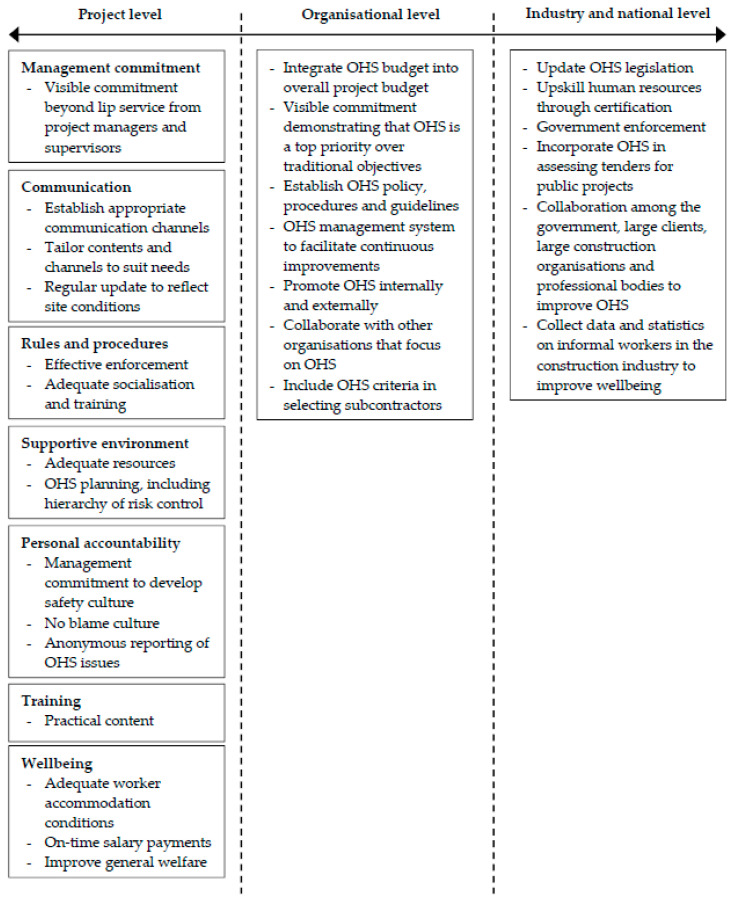
The Indonesian construction industry is the second largest in Asia and accounts for over 30% of all occupational injuries in the country. Despite the size of the industry, there is a lack of safety research in this context. This research, therefore, aims to assess safety climate and develop a framework to improve safety in the Indonesian construction industry. Quantitative and qualitative data were collected from 311 construction workers. The results show a moderately healthy safety climate but reflect numerous problems, particularly around perceived conflicts between production and safety logics, cost trade-offs being made against other competing project priorities, poor safety communication, poor working conditions, acceptance of poor safety as the norm, poor reporting and monitoring practices, poor training and a risky and unsupportive working environment which prevents workers from operating safely. Two new safety climate paradoxes are also revealed: contradictions between management communications and management practices; contradictions between worker concern for safety and their low sense of personal accountability and empowerment for acting to reduce these risks. A low locus of control over safety is also identified as a significant problem which is related to prevailing Indonesian cultural norms and poor safety policy implementation and potential conflicts between formal and informal safety norms, practices and procedures. Drawing on these findings, a new integrated framework of safety climate is presented to improve safety performance in the Indonesian construction industry.
印度尼西亚建筑业是亚洲第二大产业,占该国所有职业伤害的 30%以上。尽管该行业规模庞大,但在这方面缺乏安全研究。因此,这项研究旨在评估安全氛围,并制定一个框架来提高印度尼西亚建筑行业的安全性。从 311 名建筑工人那里收集了定量和定性数据。结果表明,安全氛围处于中等健康水平,但反映出许多问题,特别是在生产和安全逻辑之间存在明显冲突、在其他竞争项目优先级方面做出成本权衡、安全沟通不畅、工作条件差、接受不良安全为常态、报告和监测做法不佳、培训不足以及风险高且不支持的工作环境,这些因素阻止了工人安全作业。还揭示了两个新的安全氛围悖论:管理沟通与管理实践之间的矛盾;工人对安全的关注与他们对个人责任感和权力的低感之间的矛盾,无法采取行动来降低这些风险。对安全的控制程度低也是一个重大问题,这与普遍存在的印度尼西亚文化规范以及安全政策执行不力以及正式和非正式安全规范、实践和程序之间的潜在冲突有关。基于这些发现,提出了一个新的安全氛围综合框架,以提高印度尼西亚建筑行业的安全绩效。