Division of Pediatric Palliative Care, Department of Pediatrics, Children's Hospital and Medical Center, Omaha, Nebraska, USA.
Division of Pediatric Palliative Care, Department of Pediatrics, Children's Hospital and Medical Center, Omaha, Nebraska, USA.
J Pain Symptom Manage. 2021 May;61(5):1042-1051.e2. doi: 10.1016/j.jpainsymman.2020.10.010. Epub 2020 Oct 14.
The current upsurge in telehealth use in palliative and hospice care warrants consideration of patient, family caregiver, and interdisciplinary palliative perspectives on telehealth modality and communication experiences. Currently, telehealth experiences and encounters are being described but not yet extensively evaluated by palliative care teams.
To locate survey instruments available to assess telehealth interactions, to determine the content and constructs covered by the available instruments, and to describe the patient populations previously surveyed by the existing instruments.
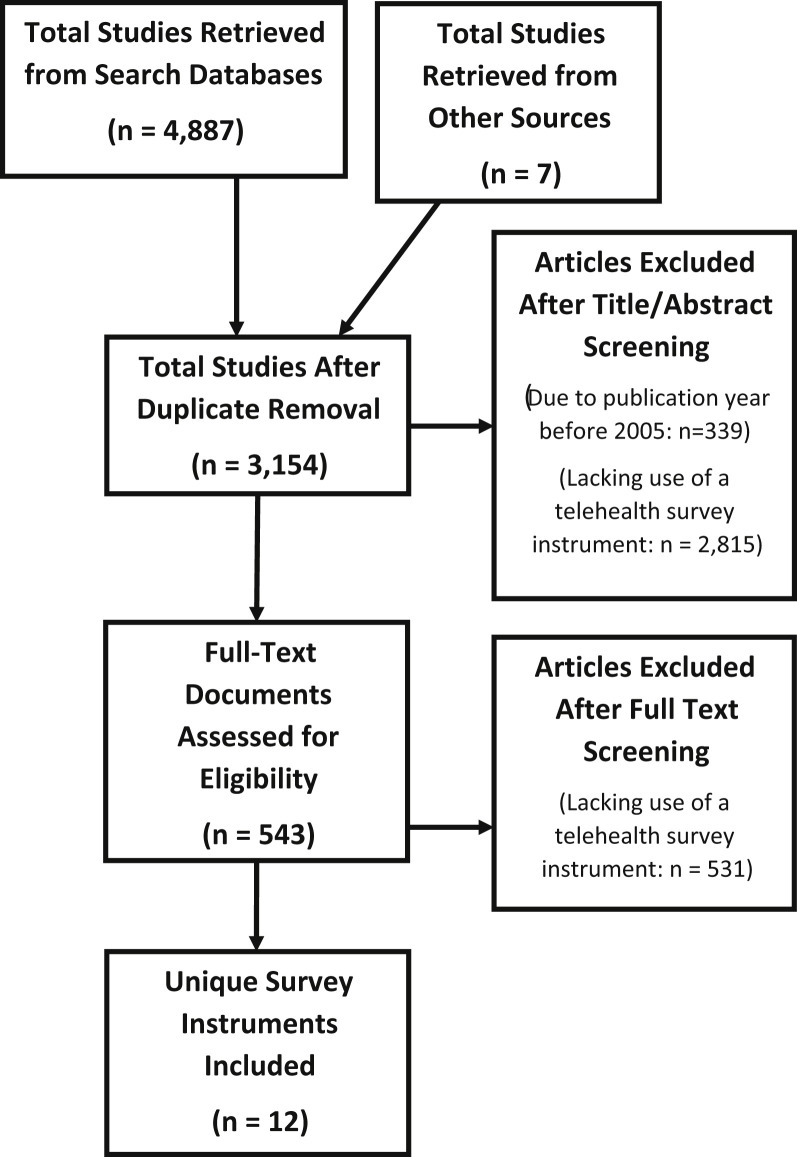
This study and its reporting followed Preferred Reporting Items for Systematic Reviews and Meta-Analyses (PRISMA) guidelines with the protocol registered in The International Prospective Register of Systematic Reviews. Three databases were searched with over 3100 articles analyzed for use of a telehealth survey instrument.
Twelve telehealth communication assessment instruments were identified with a mean length of 20 questions, primarily Likert-scale responses with one inclusive of free text and one qualitative inquiry survey. Three inquired only into modality, four queried communication, and five studied both modality and communication experience. Existing telehealth survey instruments are unidirectional in exploring patient or family experience, with two inclusive of provider perspectives. Participant demographics are notably underreported in telehealth experience studies with a frank lack of diversity in ethnic/racial, geographic, age, educational, and income representativeness in current telehealth survey instrument respondents.
Palliative care teams may consider familiarity with telehealth survey instrument as an essential component to progress from description of telehealth use to evaluation of telehealth encounters. Current survey instrument outcome reports do not represent inclusivity or diversity, although telehealth is now being clinically applied across settings.
姑息治疗和临终关怀中远程医疗使用的热潮要求从患者、家庭照顾者和姑息治疗跨学科团队的角度考虑远程医疗模式和沟通体验。目前,远程医疗体验和遭遇正在被描述,但尚未被姑息治疗团队广泛评估。
寻找可用于评估远程医疗交互的调查工具,确定现有工具涵盖的内容和结构,并描述以前由现有工具调查的患者人群。
本研究及其报告遵循系统评价和荟萃分析的首选报告项目(PRISMA)指南,该方案在国际前瞻性系统评价注册中心注册。对三个数据库进行了搜索,分析了 3100 多篇文章,以使用远程医疗调查工具。
确定了 12 种远程医疗沟通评估工具,平均长度为 20 个问题,主要是李克特量表的回答,其中一个包括自由文本,一个是定性查询调查。有三个只询问模式,四个询问沟通,五个研究模式和沟通体验。现有的远程医疗调查工具在探索患者或家庭体验方面是单向的,其中两个包括提供者的观点。参与者的人口统计学数据在远程医疗体验研究中明显报道不足,在当前远程医疗调查工具受访者中,种族/民族、地理位置、年龄、教育和收入代表性明显缺乏多样性。
姑息治疗团队可能会考虑熟悉远程医疗调查工具,这是从描述远程医疗使用进展到评估远程医疗遭遇的重要组成部分。尽管远程医疗现在正在各种环境中得到临床应用,但当前的调查工具结果报告并没有体现包容性或多样性。