Department of Clinical Laboratory, En Chu Kong Hospital, No. 399, Fuxing Rd., Sanxia Dist, New Taipei City, 23702, Taiwan.
Institute of Microbiology and Immunology, School of Life Science, National Yang-Ming University, No.155, Sec.2, Linong Street, Taipei, 112, Taiwan.
BMC Microbiol. 2020 Oct 17;20(1):315. doi: 10.1186/s12866-020-02010-3.
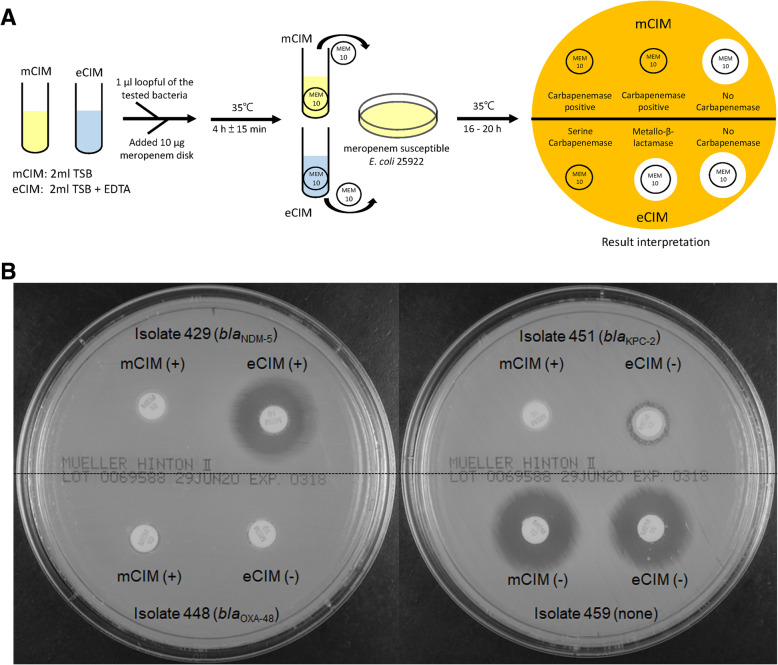
Carbapenemase-resistant Enterobacteriaceae (CRE) cause many serious infections resulting in increasing treatment cost, prolonged hospitalization, and mortality rate. Reduced expression and/or mutations of porins and the presence of carbapenemase promote Enterobacteriaceae survival under carbapenem treatments. Development of accurate methods for the detection of antimicrobial resistance is required not only for therapy but also to monitor the spread of resistant bacteria or resistance genes throughout the hospital and community. In this study, we aimed to evaluate the phenotypic methods, Modified Hodge test (MHT), modified carbapenem inactivation method (mCIM), and EDTA-CIM (eCIM) for the detection of carbapenemase-producing Enterobacteriaceae (CPE).
The results showed that mCIM had a sensitivity of 100% and a specificity of 100%, whereas the MHT had a sensitivity of 84.8% and a specificity of 97.8% for the 195 CRE isolates tested (105 CPE and 90 non-CPE isolates). The sensitivity of the mCIM/eCIM to detect metallo-carbapenemases in this study was 89.3% and the specificity was 98.7% as compared to the genotypic PCR detection.
These findings indicate that the mCIM combined with eCIM is useful for detecting and distinguishing different types of carbapenemase in Enterobacteriaceae.
耐碳青霉烯类肠杆菌科(CRE)导致许多严重感染,导致治疗费用增加、住院时间延长和死亡率上升。孔蛋白表达减少和/或突变以及碳青霉烯酶的存在促进肠杆菌科在碳青霉烯类药物治疗下存活。不仅需要开发准确的方法来检测抗生素耐药性,以进行治疗,还需要监测耐药细菌或耐药基因在整个医院和社区的传播。在这项研究中,我们旨在评估表型方法、改良 Hodge 试验(MHT)、改良碳青霉烯灭活法(mCIM)和 EDTA-CIM(eCIM)在检测产碳青霉烯酶肠杆菌科(CPE)中的作用。
结果表明,mCIM 的敏感性为 100%,特异性为 100%,而 MHT 的敏感性为 84.8%,特异性为 97.8%,用于检测 195 株 CRE 分离株(105 株 CPE 和 90 株非 CPE 分离株)。与基因 PCR 检测相比,mCIM/eCIM 检测金属碳青霉烯酶的敏感性为 89.3%,特异性为 98.7%。
这些发现表明,mCIM 联合 eCIM 可用于检测和区分肠杆菌科中不同类型的碳青霉烯酶。