Mutaf-Yıldız Belde, Sasanguie Delphine, De Smedt Bert, Reynvoet Bert
Brain and Cognition, Faculty of Psychology and Educational Sciences, KU Leuven, Leuven, Belgium.
Research Centre for Learning in Diversity, HOGENT, Ghent, Belgium.
Front Psychol. 2020 Sep 18;11:2074. doi: 10.3389/fpsyg.2020.02074. eCollection 2020.
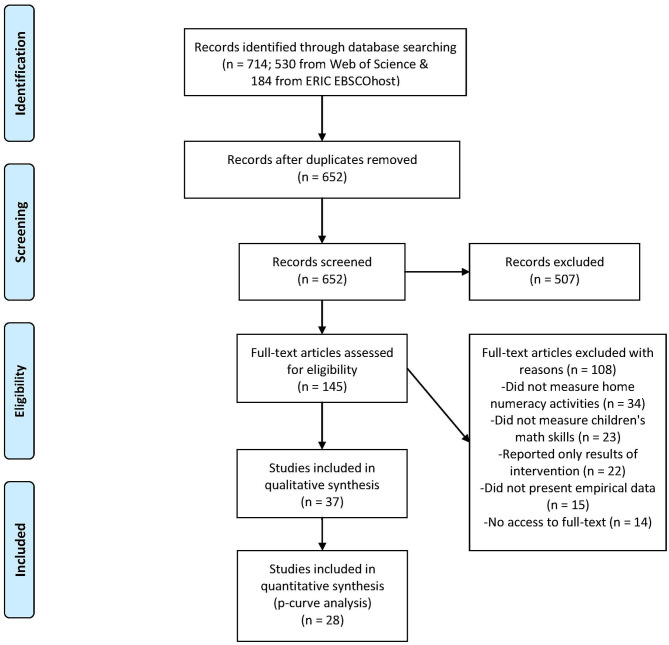
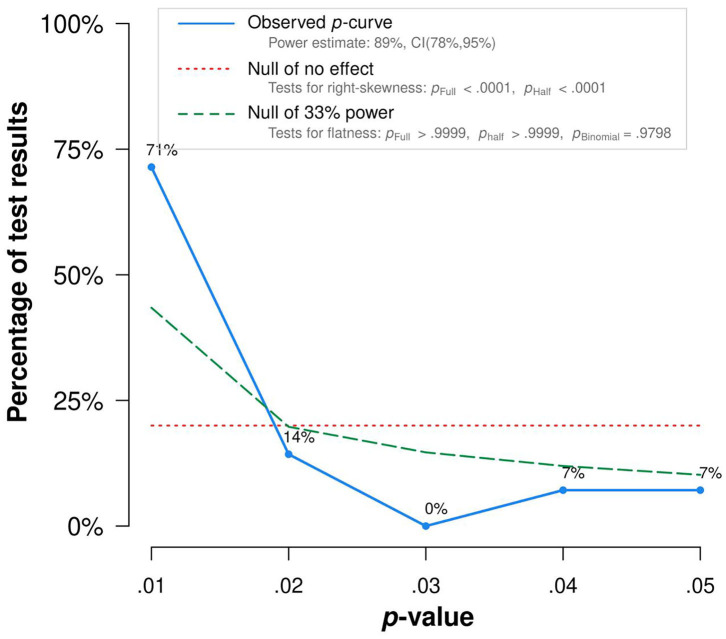
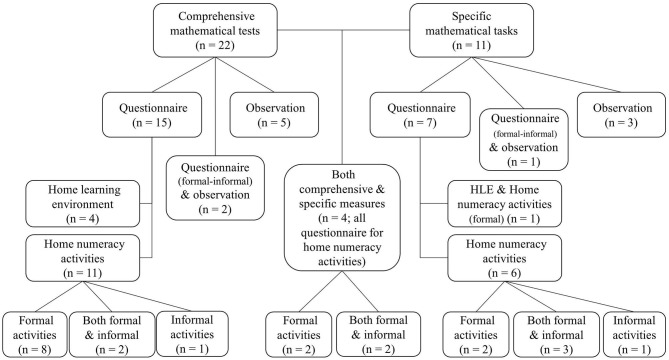
The concept of home numeracy has been defined as parent-child interactions with numerical content. This concept started to receive increasing attention since the last decade. Most of the studies indicated that the more parents and their children engage in numerical experiences, the better children perform in mathematical tasks. However, there are also contrasting results indicating that home numeracy does not play a role or that there is a negative association between the parent-child interactions and children's mathematics performance. To shed light on these discrepancies, a systematic review searching for available articles examining the relationship between home numeracy and mathematical skills was conducted. Thirty-seven articles were retained and a -curve analysis showed a true positive association between home numeracy and children's mathematical skills. A more qualitative investigation of the articles revealed five common findings: (1) Advanced home numeracy interactions but not basic ones are associated with children's mathematical skills. (2) Most participants in the studies were mothers, however, when both parents participated and were compared, only mothers' reports of formal home numeracy activities (i.e., explicit numeracy teaching) were linked to children's mathematical skill. (3) Formal home numeracy activities have been investigated more commonly than informal home numeracy activities (i.e., implicit numeracy teaching). (4) The number of studies that have used questionnaires to assess home numeracy is larger compared with the ones that have used observations. (5) The majority of the studies measured children's mathematical skills with comprehensive tests that index mathematical ability with one composite score rather than with specific numerical tasks. These five common findings might explain the contradictory results regarding the relationship between home numeracy and mathematical skills. Therefore, more research is necessary to draw quantitative conclusions about these five points.
家庭数字认知的概念被定义为亲子间涉及数字内容的互动。自上一个十年以来,这一概念开始受到越来越多的关注。大多数研究表明,父母与孩子参与数字体验的程度越高,孩子在数学任务中的表现就越好。然而,也有一些相反的结果表明,家庭数字认知并无作用,或者亲子互动与孩子的数学成绩之间存在负相关。为了阐明这些差异,我们进行了一项系统综述,搜索了有关家庭数字认知与数学技能之间关系的现有文章。共保留了37篇文章,曲线分析表明家庭数字认知与孩子的数学技能之间存在真正的正相关。对这些文章进行的更具定性的调查揭示了五个常见发现:(1)高级家庭数字认知互动而非基础互动与孩子的数学技能相关。(2)研究中的大多数参与者是母亲,然而,当父母双方都参与并进行比较时,只有母亲报告的正式家庭数字认知活动(即明确的数字教学)与孩子的数学技能相关。(3)对正式家庭数字认知活动的研究比非正式家庭数字认知活动(即隐性数字教学)更为普遍。(4)与使用观察法的研究相比,使用问卷来评估家庭数字认知的研究数量更多。(5)大多数研究用综合测试来衡量孩子的数学技能,该测试用一个综合分数来衡量数学能力,而非通过特定的数字任务。这五个常见发现可能解释了关于家庭数字认知与数学技能之间关系的矛盾结果。因此,有必要进行更多研究以就这五点得出定量结论。