Department of Pharmaceutical Sciences, University of Milan, Milan, Italy.
Front Endocrinol (Lausanne). 2020 Sep 18;11:572490. doi: 10.3389/fendo.2020.572490. eCollection 2020.
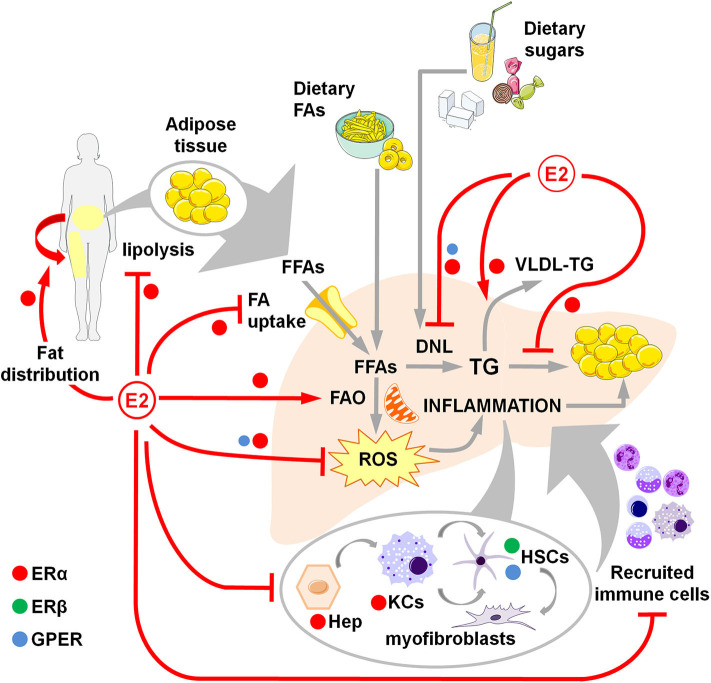
There is extensive evidence supporting the interplay between metabolism and immune response, that have evolved in close relationship, sharing regulatory molecules and signaling systems, to support biological functions. Nowadays, the disruption of this interaction in the context of obesity and overnutrition underlies the increasing incidence of many inflammatory-based metabolic diseases, even in a sex-specific fashion. During evolution, the interplay between metabolism and reproduction has reached a degree of complexity particularly high in female mammals, likely to ensure reproduction only under favorable conditions. Several factors may account for differences in the incidence and progression of inflammatory-based metabolic diseases between females and males, thus contributing to age-related disease development and difference in life expectancy between the two sexes. Among these factors, estrogens, acting mainly through Estrogen Receptors (ERs), have been reported to regulate several metabolic pathways and inflammatory processes particularly in the liver, the metabolic organ showing the highest degree of sexual dimorphism. This review aims to investigate on the interaction between metabolism and inflammation in the liver, focusing on the relevance of estrogen signaling in counteracting the development and progression of non-alcoholic fatty liver disease (NAFLD), a canonical example of metabolic inflammatory-based liver disease showing a sex-specific prevalence. Understanding the role of estrogens/ERs in the regulation of hepatic metabolism and inflammation may provide the basis for the development of sex-specific therapeutic strategies for the management of such an inflammatory-based metabolic disease and its cardio-metabolic consequences.
有大量证据支持代谢和免疫反应之间的相互作用,它们在进化过程中密切相关,共享调节分子和信号系统,以支持生物功能。如今,在肥胖和营养过剩的背景下,这种相互作用的破坏是许多以炎症为基础的代谢性疾病发病率增加的基础,甚至存在性别特异性。在进化过程中,代谢和生殖之间的相互作用在雌性哺乳动物中达到了特别高的复杂程度,这可能是为了确保只有在有利的条件下才进行生殖。有几个因素可以解释女性和男性之间以炎症为基础的代谢性疾病的发病率和进展的差异,从而导致与年龄相关的疾病发展和两性之间预期寿命的差异。在这些因素中,雌激素主要通过雌激素受体 (ERs) 发挥作用,据报道,它可以调节几种代谢途径和炎症过程,特别是在肝脏中,肝脏是表现出最高性别二态性的代谢器官。本综述旨在研究肝脏中代谢和炎症之间的相互作用,重点研究雌激素信号在对抗非酒精性脂肪性肝病 (NAFLD) 的发展和进展中的相关性,NAFLD 是一种以炎症为基础的代谢性肝病的典型例子,其发病率具有性别特异性。了解雌激素/ERs 在调节肝脏代谢和炎症中的作用可能为制定针对这种以炎症为基础的代谢性疾病及其心血管代谢后果的性别特异性治疗策略提供基础。