Sexton Danielle L, Tocheva Elitza I
Department of Microbiology & Immunology, Life Sciences Institute, The University of British Columbia, Vancouver, BC, Canada.
Front Microbiol. 2020 Sep 24;11:581135. doi: 10.3389/fmicb.2020.581135. eCollection 2020.
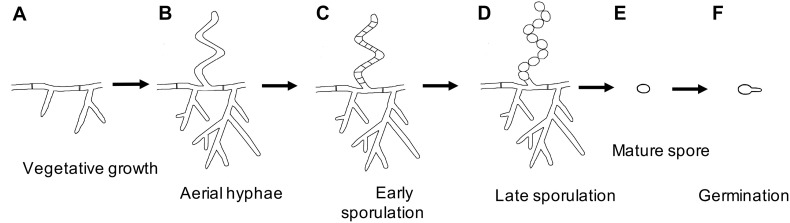
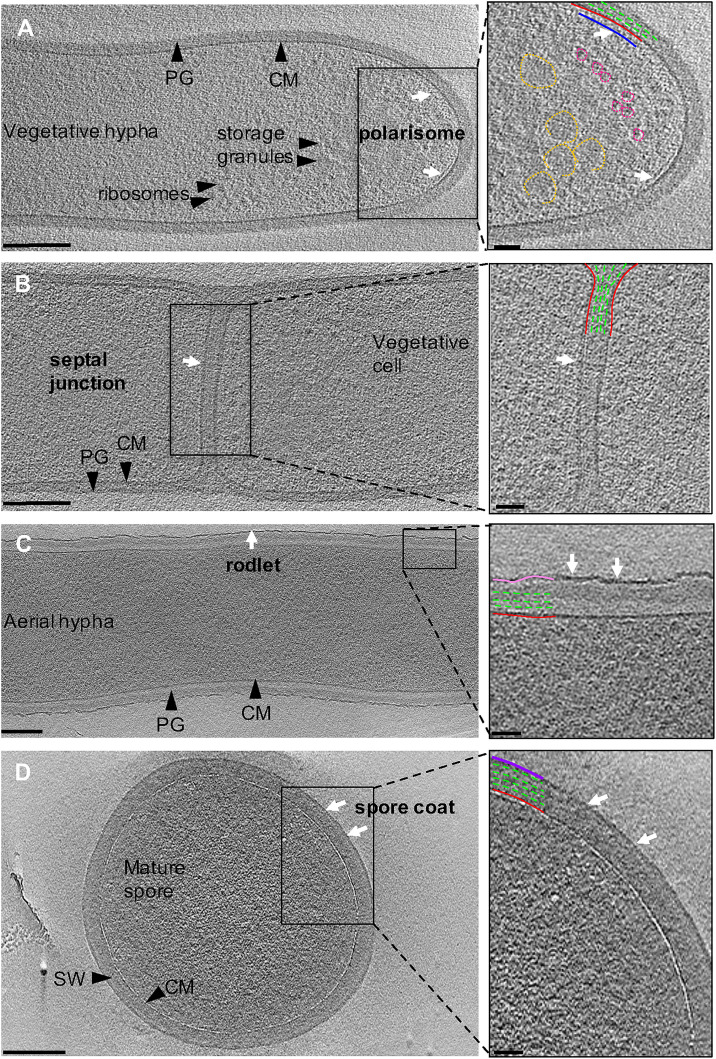
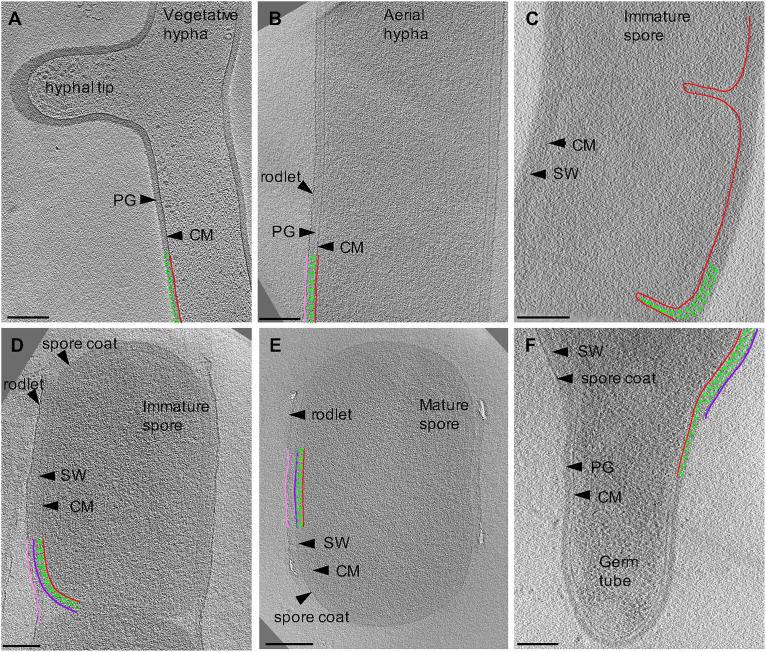
Many bacteria form spores in response to adverse environmental conditions. Several sporulation pathways have evolved independently and occur through distinctive mechanisms. Here, using cryo-electron tomography (cryo-ET), we examine all stages of growth and exospore formation in the model organism . Our data reveal the native ultrastructure of vegetative hyphae, including the likely structures of the polarisome and cytoskeletal filaments. In addition, we observed septal junctions in vegetative septa, predicted to be involved in protein and DNA translocation between neighboring cells. During sporulation, the cell envelope undergoes dramatic remodeling, including the formation of a spore wall and two protective proteinaceous layers. Mature spores reveal the presence of a continuous spore coat and an irregular rodlet sheet. Together, these results provide an unprecedented examination of the ultrastructure in and further our understanding of the structural complexity of exospore formation.
许多细菌会在不利的环境条件下形成孢子。几种孢子形成途径是独立进化的,并且通过独特的机制发生。在这里,我们使用冷冻电子断层扫描(cryo-ET)来研究模式生物生长和外生孢子形成的所有阶段。我们的数据揭示了营养菌丝的天然超微结构,包括极体和细胞骨架丝的可能结构。此外,我们在营养隔膜中观察到了隔膜连接,预计其参与相邻细胞之间的蛋白质和DNA转运。在孢子形成过程中,细胞包膜会经历剧烈的重塑,包括形成孢子壁和两层保护性蛋白质层。成熟的孢子显示出连续的孢子外壁和不规则的小杆层的存在。这些结果共同提供了对该生物超微结构前所未有的研究,并进一步加深了我们对外生孢子形成结构复杂性的理解。