Department of Pharmacology and Center for Lung and Vascular Biology, College of Medicine, University of Illinois, Chicago, IL, United States.
Front Immunol. 2020 Sep 18;11:2091. doi: 10.3389/fimmu.2020.02091. eCollection 2020.
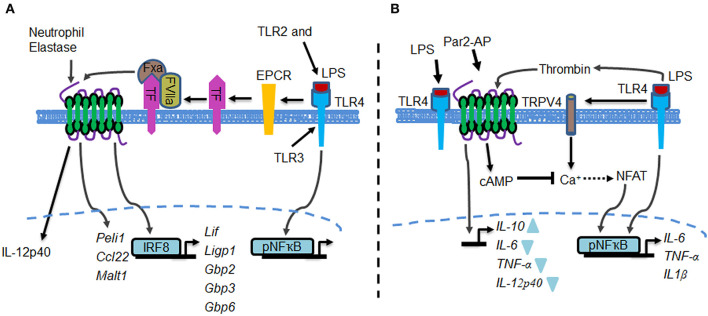
Macrophages play a central role in dictating the tissue response to infection and orchestrating subsequent repair of the damage. In this context, macrophages residing in the lungs continuously sense and discriminate among a wide range of insults to initiate the immune responses important to host-defense. Inflammatory tissue injury also leads to activation of proteases, and thereby the coagulation pathway, to optimize injury and repair post-infection. However, long-lasting inflammatory triggers from macrophages can impair the lung's ability to recover from severe injury, leading to increased lung vascular permeability and neutrophilic injury, hallmarks of Acute Lung Injury (ALI). In this review, we discuss the roles of toll-like receptor 4 (TLR4) and protease activating receptor 2 (PAR2) expressed on the macrophage cell-surface in regulating lung vascular inflammatory signaling.
巨噬细胞在决定组织对感染的反应以及协调随后的损伤修复方面发挥着核心作用。在这种情况下,驻留在肺部的巨噬细胞不断感知和区分广泛的损伤,从而启动对宿主防御至关重要的免疫反应。炎症性组织损伤也会导致蛋白酶的激活,从而激活凝血途径,以优化感染后的损伤和修复。然而,来自巨噬细胞的持久炎症触发因素会损害肺部从严重损伤中恢复的能力,导致肺血管通透性增加和中性粒细胞损伤,这是急性肺损伤(ALI)的标志。在这篇综述中,我们讨论了巨噬细胞表面表达的 Toll 样受体 4(TLR4)和蛋白酶激活受体 2(PAR2)在调节肺血管炎症信号中的作用。