Ward David, Schmitt Melissa H, Shrader Adrian M
Department of Biological Sciences Kent State University Kent OH USA.
South African Environmental Observation Network Ndlovu Node Phalaborwa South Africa.
Ecol Evol. 2020 Aug 30;10(19):10426-10439. doi: 10.1002/ece3.6698. eCollection 2020 Oct.
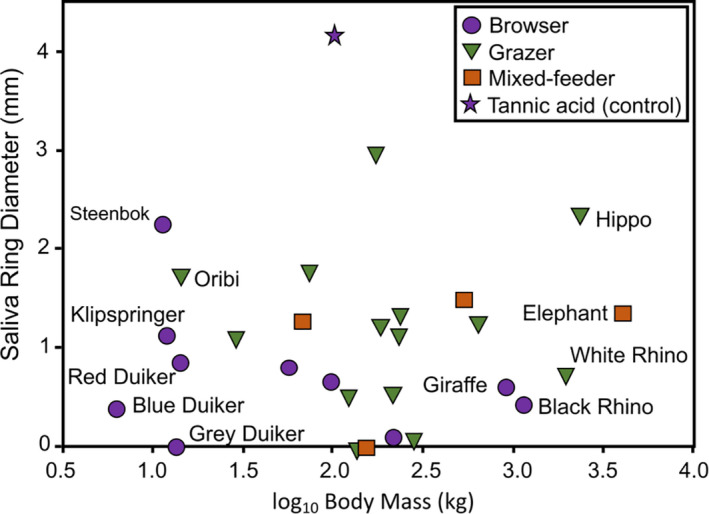
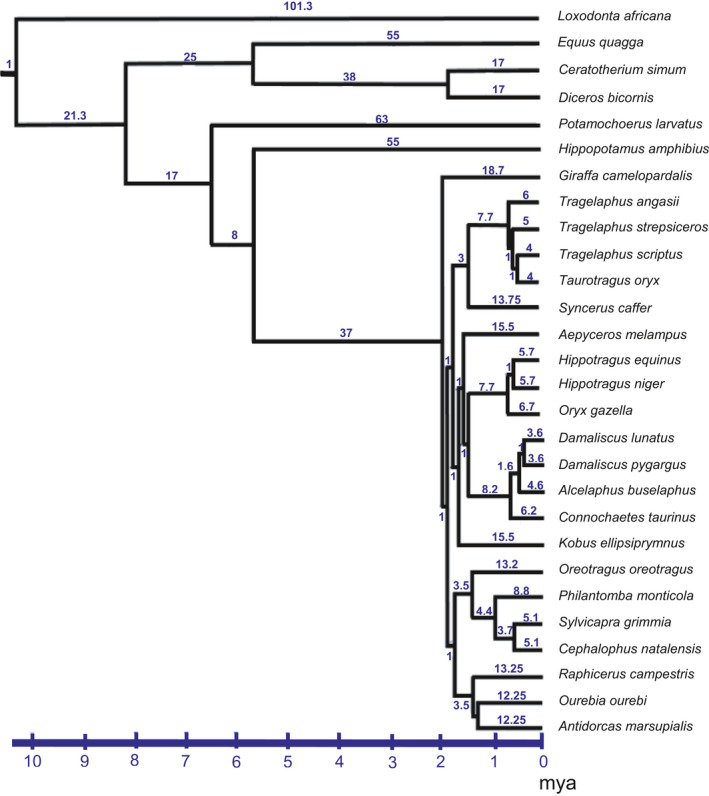
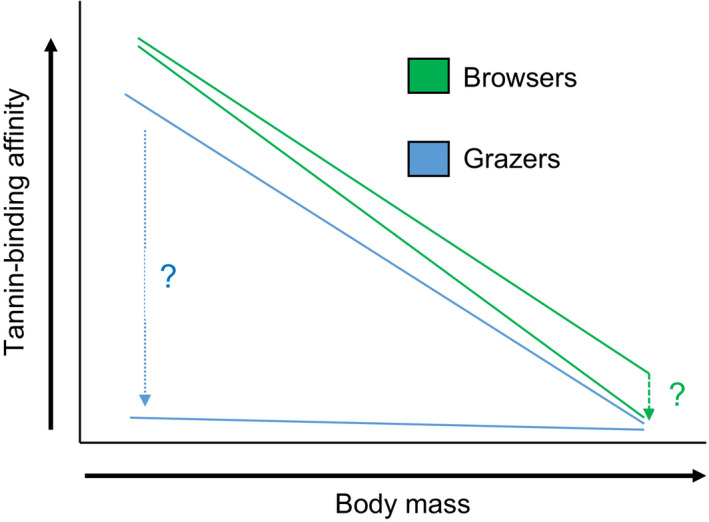
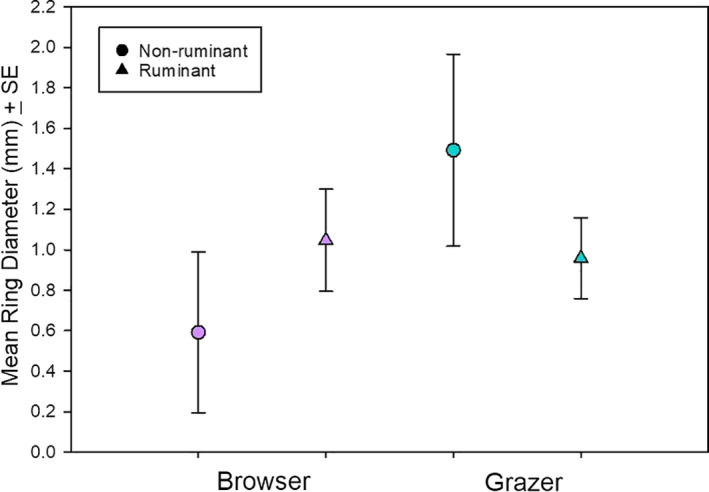
While feeding, mammalian browsers (primarily eat woody plants) encounter secondary metabolites such as tannins. Browsers may bind these tannins using salivary proteins, whereas mammalian grazers (primarily eat grasses that generally lack tannins) likely would not. Ruminant browsers rechew their food (ruminate) to increase the effectiveness of digestion, which may make them more effective at binding tannins than nonruminants. Few studies have included a sufficient number of species to consider possible scaling with body mass or phylogenetic effects on salivary proteins. Controlling for phylogeny, we ran inhibition radial diffusion assays of the saliva of 28 species of African herbivores that varied in size, feeding strategy, and digestive system. We could not detect the presence of salivary proline-rich proteins that bind tannins in any of these species. However, using the inhibition radial diffusion assay, we found considerable abilities to cope with tannins in all species, albeit to varying degrees. We found no differences between browsers and grazers in the effectiveness of their salivary proteins to bind to and precipitate tannins, nor between ruminants and nonruminants, or scaling with body mass. Three species bound all tannins, but their feeding niches included one browser (gray duiker), one mixed feeder (bush pig), and one grazer (red hartebeest). Five closely related species of small ruminant browsers were very effective in binding tannins. Megaherbivores, considered generalists on account of their large body size, were capable of binding tannins. However, the grazing white rhinoceros was almost as effective at binding tannins as the megaherbivore browsers. We conclude, contrary to earlier predictions, that there were no differences in the relative salivary tannin-binding capability that was related to common ancestry (phylogeny) or to differences in body size.
在进食时,食叶哺乳动物(主要食用木本植物)会接触到单宁等次生代谢物。食叶动物可能会利用唾液蛋白结合这些单宁,而食草哺乳动物(主要食用通常缺乏单宁的草)可能不会。反刍食叶动物会重新咀嚼食物(反刍)以提高消化效率,这可能使它们比非反刍动物更有效地结合单宁。很少有研究纳入足够数量的物种来考虑与体重相关的可能尺度效应或系统发育对唾液蛋白的影响。在控制系统发育的情况下,我们对28种非洲食草动物的唾液进行了抑制径向扩散试验,这些动物在体型、进食策略和消化系统方面各不相同。我们在这些物种中均未检测到能结合单宁的富含脯氨酸的唾液蛋白。然而,通过抑制径向扩散试验,我们发现所有物种都有相当的能力应对单宁,尽管程度不同。我们发现,食叶动物和食草动物的唾液蛋白结合并沉淀单宁的效果没有差异,反刍动物和非反刍动物之间也没有差异,也不存在与体重相关的尺度效应。有三个物种能结合所有单宁,但它们的食性生态位包括一种食叶动物(灰小羚羊)、一种混合食性动物(灌丛野猪)和一种食草动物(红麋羚)。五种亲缘关系密切的小型反刍食叶动物在结合单宁方面非常有效。巨型食草动物由于体型庞大被认为是泛食性动物,它们能够结合单宁。然而,食草的白犀牛在结合单宁方面几乎与巨型食草动物食叶动物一样有效。我们得出结论,与早期预测相反,与共同祖先(系统发育)或体型差异相关的相对唾液单宁结合能力没有差异。