Chang Hung-Yang, Chang Jui-Hsing, Chi Hsin, Hsu Chyong-Hsin, Lin Chia-Ying, Jim Wai-Tim, Peng Chun-Chih
Department of Pediatrics, MacKay Children's Hospital, Taipei, Taiwan.
Department of Medicine, MacKay Medical College, New Taipei City, Taiwan.
Front Pediatr. 2020 Sep 22;8:577673. doi: 10.3389/fped.2020.577673. eCollection 2020.
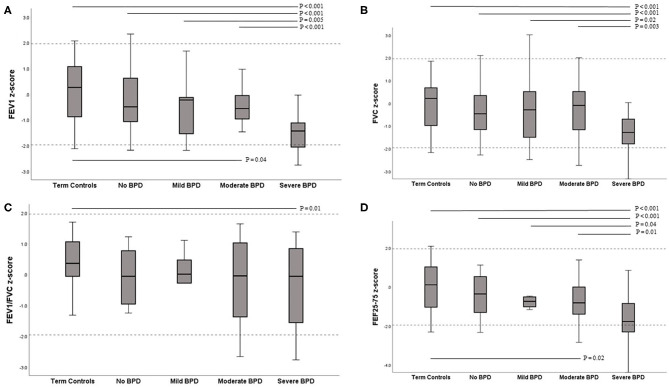
Survivors of preterm birth are at risk of long-term respiratory consequences. The objective of this prospective study was to assess pulmonary function at preschool age of former very low birth weight (VLBW) preterm children. Lung function of children born preterm and term controls aged 5-6 years were assessed by spirometry. The results were converted to z-scores. A questionnaire regarding respiratory symptoms was completed. Associations to gestational age (GA), birth weight (BW), bronchopulmonary dysplasia (BPD), and perinatal factors were assessed. In total, 85 VLBW preterm children and 29 term controls were studied. Of the preterm children, the mean GA was 28.6 ± 2.6 weeks and the mean BW was 1,047 ± 273 gm. Preterm children had significantly lower z-scores of forced expiratory volume in 1 s (FEV), FEV/forced vital capacity (FVC) ratio, and forced expiratory flow rate between 25-75% of FVC (FEF), compared with term controls (-0.73 vs. 0.04, = 0.002; -0.22 vs. 0.39, = 0.003; -0.93 vs. 0.0, < 0.001; respectively). Further segregation of the preterm group revealed significantly impaired FEV, FEF in children at earlier gestation (≤ 28 weeks, = 45), lighter at birth (≤ 1,000 g, = 38), or with BPD ( = 55) compared with term controls ( < 0.05). There were significant negative relationships between the severity of BPD with FEV, FVC, and FEF ( < 0.05). However, no correlation between lung function measurements and respiratory symptoms was found. VLBW preterm infants have reduced lung function at preschool age, especially among those with younger GA, lower BW, and BPD. Additional long-term follow-up of respiratory outcomes are needed for this vulnerable population.
早产幸存者面临长期呼吸问题的风险。这项前瞻性研究的目的是评估极低出生体重(VLBW)早产儿童学龄前的肺功能。通过肺活量测定法评估5至6岁早产儿童和足月对照儿童的肺功能。结果转换为z分数。完成了一份关于呼吸道症状的问卷。评估了与胎龄(GA)、出生体重(BW)、支气管肺发育不良(BPD)和围产期因素的关联。总共研究了85名VLBW早产儿童和29名足月对照儿童。早产儿童的平均GA为28.6±2.6周,平均BW为1047±273克。与足月对照儿童相比,早产儿童的1秒用力呼气量(FEV)、FEV/用力肺活量(FVC)比值和FVC的25%-75%之间的用力呼气流量(FEF)的z分数显著更低(分别为-0.73对0.04,P=0.002;-0.22对0.39,P=0.003;-0.93对0.0,P<0.001)。早产组的进一步分类显示,与足月对照儿童相比,妊娠早期(≤28周,n=45)、出生时体重较轻(≤1000克,n=38)或患有BPD(n=55)的儿童的FEV、FEF显著受损(P<0.05)。BPD的严重程度与FEV、FVC和FEF之间存在显著的负相关(P<0.05)。然而,未发现肺功能测量与呼吸道症状之间存在相关性。VLBW早产婴儿在学龄前肺功能降低,尤其是在GA较小、BW较低和患有BPD的婴儿中。需要对这一脆弱人群进行额外的呼吸结局长期随访。