Console Lara, Scalise Mariafrancesca, Mazza Tiziano, Pochini Lorena, Galluccio Michele, Giangregorio Nicola, Tonazzi Annamaria, Indiveri Cesare
Unit of Biochemistry and Molecular Biotechnology, Department DiBEST (Biologia, Ecologia, Scienze della Terra), University of Calabria, Arcavacata di Rende, Italy.
Institute of Biomembranes, Bioenergetics and Molecular Biotechnologies (IBIOM), National Research Council, Bari, Italy.
Front Cell Dev Biol. 2020 Sep 18;8:583850. doi: 10.3389/fcell.2020.583850. eCollection 2020.
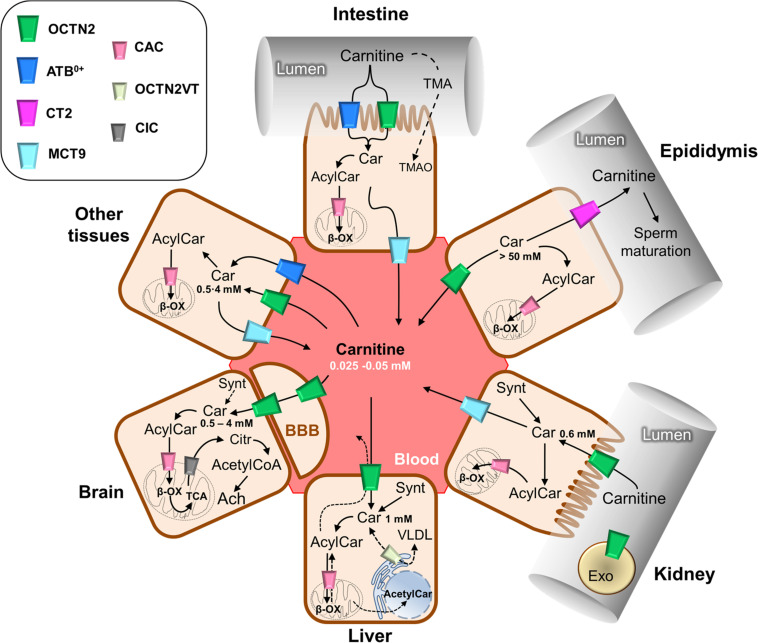
Metabolic flexibility is a peculiar hallmark of cancer cells. A growing number of observations reveal that tumors can utilize a wide range of substrates to sustain cell survival and proliferation. The diversity of carbon sources is indicative of metabolic heterogeneity not only across different types of cancer but also within those sharing a common origin. Apart from the well-assessed alteration in glucose and amino acid metabolisms, there are pieces of evidence that cancer cells display alterations of lipid metabolism as well; indeed, some tumors use fatty acid oxidation (FAO) as the main source of energy and express high levels of FAO enzymes. In this metabolic pathway, the cofactor carnitine is crucial since it serves as a "shuttle-molecule" to allow fatty acid acyl moieties entering the mitochondrial matrix where these molecules are oxidized via the β-oxidation pathway. This role, together with others played by carnitine in cell metabolism, underlies the fine regulation of carnitine traffic among different tissues and, within a cell, among different subcellular compartments. Specific membrane transporters mediate carnitine and carnitine derivatives flux across the cell membranes. Among the SLCs, the plasma membrane transporters OCTN2 (Organic cation transport novel 2 or SLC22A5), CT2 (Carnitine transporter 2 or SLC22A16), MCT9 (Monocarboxylate transporter 9 or SLC16A9) and ATB [Sodium- and chloride-dependent neutral and basic amino acid transporter B(0+) or SLC6A14] together with the mitochondrial membrane transporter CAC (Mitochondrial carnitine/acylcarnitine carrier or SLC25A20) are the most acknowledged to mediate the flux of carnitine. The concerted action of these proteins creates a carnitine network that becomes relevant in the context of cancer metabolic rewiring. Therefore, molecular mechanisms underlying modulation of function and expression of carnitine transporters are dealt with furnishing some perspective for cancer treatment.
代谢灵活性是癌细胞的一个独特标志。越来越多的观察结果表明,肿瘤能够利用多种底物来维持细胞存活和增殖。碳源的多样性不仅表明不同类型癌症之间存在代谢异质性,而且在具有共同起源的癌症中也存在这种异质性。除了对葡萄糖和氨基酸代谢变化的充分评估外,还有证据表明癌细胞的脂质代谢也发生了改变;事实上,一些肿瘤将脂肪酸氧化(FAO)作为主要能量来源,并高表达FAO酶。在这条代谢途径中,辅因子肉碱至关重要,因为它作为一种“穿梭分子”,使脂肪酸酰基部分进入线粒体基质,这些分子在线粒体基质中通过β-氧化途径被氧化。肉碱在细胞代谢中所起的这一作用以及其他作用,构成了不同组织之间以及细胞内不同亚细胞区室之间肉碱运输精细调控的基础。特定的膜转运蛋白介导肉碱和肉碱衍生物穿过细胞膜的通量。在溶质载体家族(SLCs)中,质膜转运蛋白OCTN2(有机阳离子转运蛋白新成员2或SLC22A5)、CT2(肉碱转运蛋白2或SLC22A16)、MCT9(单羧酸转运蛋白9或SLC16A9)和ATB [钠和氯依赖性中性和碱性氨基酸转运蛋白B(0+)或SLC6A14],以及线粒体膜转运蛋白CAC(线粒体肉碱/酰基肉碱载体或SLC25A20)是最被认可的介导肉碱通量的蛋白。这些蛋白质的协同作用形成了一个肉碱网络,在癌症代谢重编程的背景下变得至关重要。因此,本文探讨了肉碱转运蛋白功能和表达调控的分子机制,为癌症治疗提供了一些思路。