Console Lara, Scalise Mariafrancesca, Giangregorio Nicola, Tonazzi Annamaria, Barile Maria, Indiveri Cesare
Unit of Biochemistry and Molecular Biotechnology, Department DiBEST (Biologia, Ecologia, Scienze della Terra), University of Calabria, Rende, Italy.
CNR Institute of Biomembranes, Bioenergetics and Molecular Biotechnologies (IBIOM), Bari, Italy.
Front Physiol. 2020 Jul 9;11:794. doi: 10.3389/fphys.2020.00794. eCollection 2020.
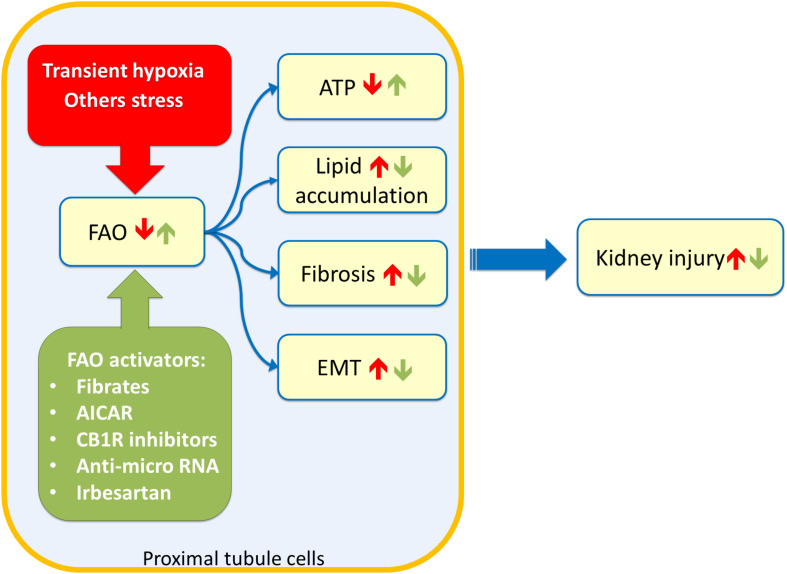
Renal proximal tubular cells are high energy-demanding cells mainly relying on fatty acid oxidation. In stress conditions, such as transient hypoxia, fatty acid oxidation (FAO) decreases and carbohydrate catabolism fails to compensate for the energy demand. In this scenario, the surviving tubular cells exhibit the peculiar phenotype associated with fibrosis that is the histological manifestation of a process culminating in chronic and end-stage kidney disease. Genome-wide transcriptome analysis revealed that, together with inflammation, FAO is the top dysregulated pathway in kidney diseases with a decreased expression of key FAO enzymes and regulators. Another evidence that links the derangement of FAO to fibrosis is the progressive decrease of the expression of peroxisome proliferator-activated receptor α (PPARα) in aged people, that triggers the age-associated renal fibrosis. To allow FAO completion, a coordinate network of enzymes and transport proteins is required. Indeed, the mitochondrial inner membrane is impermeable to fatty acyl-CoAs and a specialized system, well known as carnitine shuttle, is needed for translocating fatty acids moieties, conjugated with carnitine, into mitochondrial matrix for the β-oxidation. The first component of this system is the carnitine palmitoyltransferase 1 (CPT1) responsible for transfer acyl moieties to carnitine. Several studies indicated that the stimulation of CPT1 activity and expression has a protective effect against renal fibrosis. Therefore, the network of enzymes and transporters linked to FAO may represent potential pharmacological targets deserving further attention in the development of new drugs to attenuate renal dysfunction.
肾近端小管细胞是高能量需求细胞,主要依赖脂肪酸氧化。在应激条件下,如短暂缺氧,脂肪酸氧化(FAO)减少,碳水化合物分解代谢无法补偿能量需求。在这种情况下,存活的肾小管细胞表现出与纤维化相关的特殊表型,这是慢性和终末期肾病过程的组织学表现。全基因组转录组分析表明,与炎症一起,FAO是肾脏疾病中失调最严重的途径,关键FAO酶和调节因子的表达降低。另一个将FAO紊乱与纤维化联系起来的证据是,老年人过氧化物酶体增殖物激活受体α(PPARα)的表达逐渐降低,这引发了与年龄相关的肾纤维化。为了完成FAO,需要酶和转运蛋白的协调网络。事实上,线粒体内膜对脂肪酰辅酶A是不可渗透的,需要一个专门的系统,即众所周知的肉碱穿梭系统,将与肉碱结合的脂肪酸部分转运到线粒体基质中进行β氧化。该系统的第一个组成部分是肉碱棕榈酰转移酶1(CPT1),负责将酰基部分转移到肉碱上。多项研究表明,刺激CPT1活性和表达对肾纤维化具有保护作用。因此,与FAO相关的酶和转运蛋白网络可能代表了潜在的药理学靶点,在开发减轻肾功能障碍的新药方面值得进一步关注。