Sigdel Tara K, Piehowski Paul D, Roy Sudeshna, Liberto Juliane, Hansen Joshua R, Swensen Adam C, Zhao Rui, Zhu Ying, Rashmi Priyanka, Schroeder Andrew, Damm Izabella, Sur Swastika, Luo Jinghui, Yang Yingbao, Qian Wei-Jun, Sarwal Minnie M
Division of MultiOrgan Transplantation, Department of Surgery, University of California, San Francisco, San Francisco, CA, United States.
Pacific Northwest National Laboratory, Biological Sciences Division, Richland, WA, United States.
Front Med (Lausanne). 2020 Sep 17;7:499. doi: 10.3389/fmed.2020.00499. eCollection 2020.
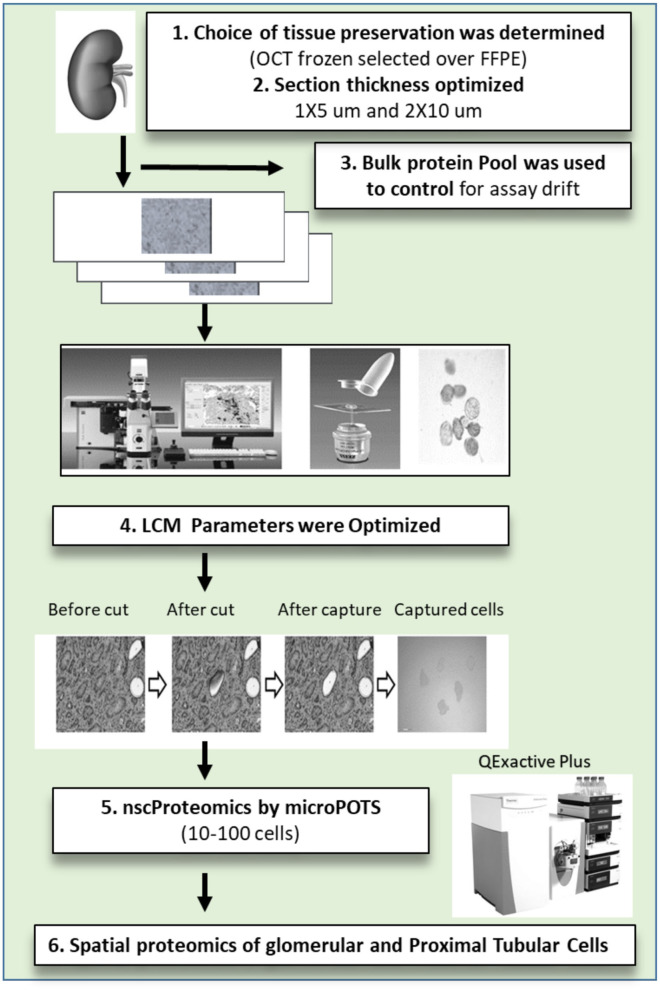
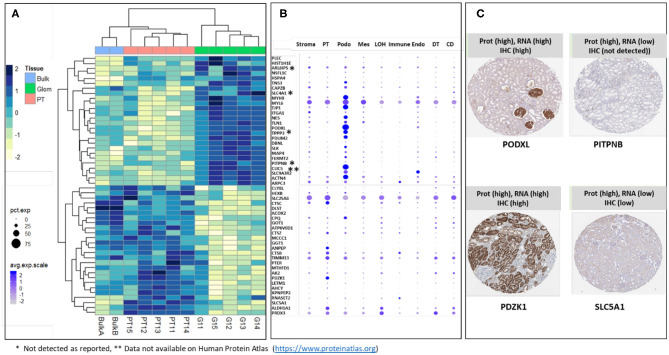
Molecular assessments at the single cell level can accelerate biological research by providing detailed assessments of cellular organization and tissue heterogeneity in both disease and health. The human kidney has complex multi-cellular states with varying functionality, much of which can now be completely harnessed with recent technological advances in tissue proteomics at a near single-cell level. We discuss the foundational steps in the first application of this mass spectrometry (MS) based proteomics method for analysis of sub-sections of the normal human kidney, as part of the Kidney Precision Medicine Project (KPMP). Using ~30-40 laser captured micro-dissected kidney cells, we identified more than 2,500 human proteins, with specificity to the proximal tubular (PT; = 25 proteins) and glomerular (Glom; = 67 proteins) regions of the kidney and their unique metabolic functions. This pilot study provides the roadmap for application of our near-single-cell proteomics workflow for analysis of other renal micro-compartments, on a larger scale, to unravel perturbations of renal sub-cellular function in the normal kidney as well as different etiologies of acute and chronic kidney disease.
单细胞水平的分子评估能够通过详细评估疾病和健康状态下的细胞组织及组织异质性,加速生物学研究。人类肾脏具有功能各异的复杂多细胞状态,借助近期在近单细胞水平的组织蛋白质组学技术进展,如今其中大部分状态已能得到充分利用。作为肾脏精准医学项目(KPMP)的一部分,我们讨论了基于质谱(MS)的蛋白质组学方法首次应用于分析正常人类肾脏亚区域的基础步骤。使用约30 - 40个经激光捕获显微切割的肾脏细胞,我们鉴定出了2500多种人类蛋白质,这些蛋白质对肾脏的近端小管(PT;25种蛋白质)和肾小球(Glom;67种蛋白质)区域具有特异性,并具有独特的代谢功能。这项初步研究为我们的近单细胞蛋白质组学工作流程在更大规模上应用于分析其他肾脏微区室提供了路线图,以揭示正常肾脏中肾亚细胞功能的扰动以及急性和慢性肾病的不同病因。