Colah Roshan B, Mehta Pallavi, Mukherjee Malay B
ICMR-National Institute of Immunohaematology, KEM Hospital Campus, Mumbai 400012, India.
Int J Neonatal Screen. 2018 Nov 13;4(4):31. doi: 10.3390/ijns4040031. eCollection 2018 Dec.
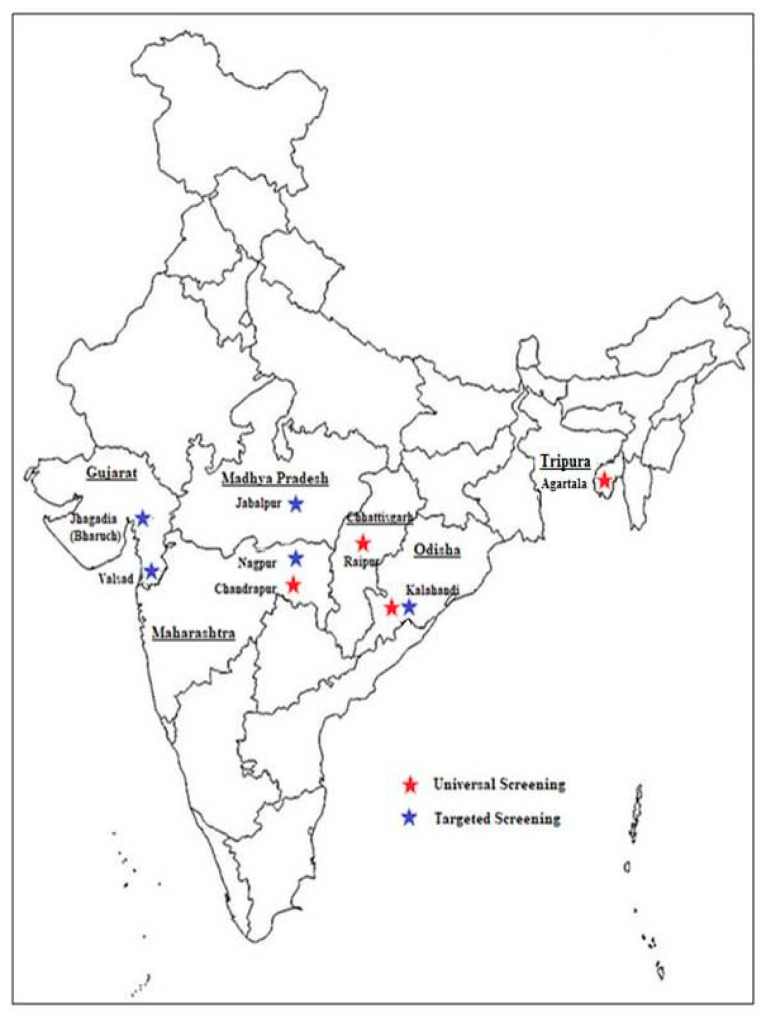
Sickle cell disease (SCD) is a major public health problem in India with the highest prevalence amongst the tribal and some non-tribal ethnic groups. The clinical manifestations are extremely variable ranging from a severe to mild or asymptomatic condition. Early diagnosis and providing care is critical in SCD because of the possibility of lethal complications in early infancy in pre-symptomatic children. Since 2010, neonatal screening programs for SCD have been initiated in a few states of India. A total of 18,003 babies have been screened by automated HPLC using either cord blood samples or heel prick dried blood spots and 2944 and 300 babies were diagnosed as sickle cell carriers and SCD respectively. A follow up of the SCD babies showed considerable variation in the clinical presentation in different population groups, the disease being more severe among non-tribal babies. Around 30% of babies developed serious complications within the first 2 to 2.6 years of life. These pilot studies have demonstrated the feasibility of undertaking newborn screening programs for SCD even in rural areas. A longer follow up of these babies is required and it is important to establish a national newborn screening program for SCD in all of the states where the frequency of the sickle cell gene is very high followed by the development of comprehensive care centers along with counselling and treatment facilities. This comprehensive data will ultimately help us to understand the natural history of SCD in India and also help the Government to formulate strategies for the management and prevention of sickle cell disease in India.
镰状细胞病(SCD)是印度一个主要的公共卫生问题,在部落和一些非部落族群中患病率最高。其临床表现差异极大,从严重到轻度或无症状状态不等。由于无症状儿童在婴儿早期有发生致命并发症的可能性,因此SCD的早期诊断和治疗至关重要。自2010年以来,印度的一些邦已启动了SCD新生儿筛查项目。共有18,003名婴儿通过使用脐带血样本或足跟采血干血斑的自动高效液相色谱法进行了筛查,分别有2944名和300名婴儿被诊断为镰状细胞携带者和SCD。对SCD婴儿的随访显示,不同人群的临床表现差异很大,非部落婴儿的病情更为严重。约30%的婴儿在生命的最初2至2.6年内出现了严重并发症。这些试点研究证明了即使在农村地区开展SCD新生儿筛查项目的可行性。需要对这些婴儿进行更长时间的随访,并且重要的是在所有镰状细胞基因频率非常高的邦建立全国性的SCD新生儿筛查项目,随后建立综合护理中心以及咨询和治疗设施。这些全面的数据最终将帮助我们了解印度SCD的自然病史,也有助于政府制定印度镰状细胞病的管理和预防策略。