Girotti Albert W, Fahey Jonathan M, Korytowski Witold
Department of Biochemistry, Medical College of Wisconsin, Milwaukee, WI 53226, USA.
Department of Biophysics, Jagiellonian University, Krakow 31-008, Poland.
Cancer Drug Resist. 2020;3(3):401-414. doi: 10.20517/cdr.2020.25. Epub 2020 Aug 21.
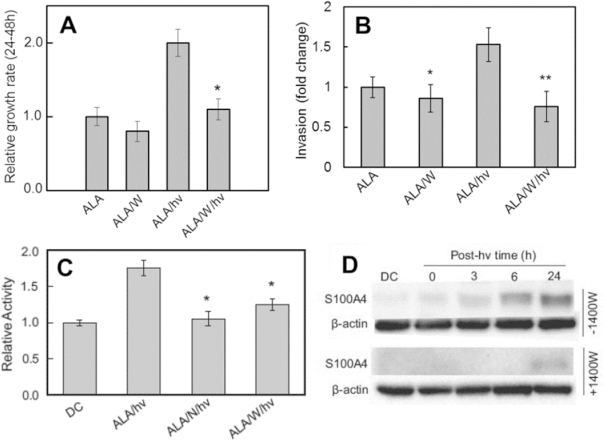
Glioblastoma multiforme is a highly aggressive primary brain malignancy that resists most conventional chemoand radiotherapeutic interventions. Nitric oxide (NO), a short lived free radical molecule produced by inducible NO synthase (iNOS) in glioblastomas and other tumors, is known to play a key role in tumor persistence, progression, and chemo/radiotherapy resistance. Site-specific and minimally invasive photodynamic therapy (PDT), based on oxidative damage resulting from non-ionizing photoactivation of a sensitizing agent, is highly effective against glioblastoma, but resistance also exists in this case. Studies in the authors' laboratory have shown that much of the latter is mediated by iNOS/NO. For example, when glioblastoma U87 or U251 cells sensitized in mitochondria with 5-aminolevulinic acid -induced protoporphyrin IX were exposed to a moderate dose of visible light, the observed apoptosis was strongly enhanced by an iNOS activity inhibitor or NO scavenger, indicating that iNOS/NO had increased cell resistance to photokilling. Moreover, cells that survived the photochallenge proliferated, migrated, and invaded more aggressively than controls, and these responses were also driven predominantly by iNOS/NO. Photostress-upregulated iNOS rather than basal enzyme was found to be responsible for all the negative effects described. Recognition of NO-mediated hyper-resistance/hyper-aggression in PDT-stressed glioblastoma has stimulated interest in how these responses can be prevented or at least minimized by pharmacologic adjuvants such as inhibitors of iNOS activity or transcription. Recent developments along these lines and their clinical potential for improving anti-glioblastoma PDT are discussed.
多形性胶质母细胞瘤是一种极具侵袭性的原发性脑恶性肿瘤,对大多数传统的化学和放射治疗干预均具有抗性。一氧化氮(NO)是一种由胶质母细胞瘤和其他肿瘤中的诱导型一氧化氮合酶(iNOS)产生的短寿命自由基分子,已知其在肿瘤持续存在、进展以及化学/放射治疗抗性中起关键作用。基于敏化剂的非电离光激活所产生的氧化损伤的位点特异性和微创光动力疗法(PDT)对胶质母细胞瘤高度有效,但在这种情况下也存在抗性。作者实验室的研究表明,后者的大部分是由iNOS/NO介导的。例如,当用5-氨基乙酰丙酸诱导的原卟啉IX在线粒体中敏化的胶质母细胞瘤U87或U251细胞暴露于中等剂量的可见光时,iNOS活性抑制剂或NO清除剂可强烈增强所观察到的细胞凋亡,这表明iNOS/NO增加了细胞对光杀伤的抗性。此外,在光刺激下存活的细胞比对照细胞增殖、迁移和侵袭更具侵袭性,并且这些反应也主要由iNOS/NO驱动。发现光应激上调的iNOS而非基础酶是造成上述所有负面影响的原因。认识到PDT应激的胶质母细胞瘤中NO介导的高抗性/高侵袭性激发了人们对如何通过诸如iNOS活性抑制剂或转录抑制剂等药物佐剂来预防或至少最小化这些反应的兴趣。本文讨论了沿着这些方向的最新进展及其在改善抗胶质母细胞瘤PDT方面的临床潜力。