Department of Centre for Advanced Research (CFAR), Faculty of Medicine, King George's Medical University (KGMU), Lucknow, India.
J Biomol Struct Dyn. 2022 Mar;40(4):1719-1735. doi: 10.1080/07391102.2020.1832577. Epub 2020 Oct 19.
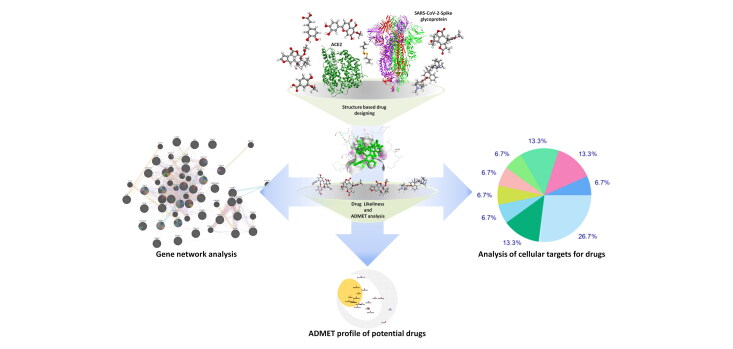
SARS-CoV-2 is the etiological agent of COVID-19 and responsible for more than 6 million cases globally, for which no vaccine or antiviral is available. Therefore, this study was planned to investigate the antiviral role of the active constituents against spike glycoprotein of SARS-CoV-2 as well as its host ACE2 receptor. Structure-based drug design approach has been used to elucidate the antiviral activity of active constituents present in traditional medicinal plants from Ayurveda. Further, parameters like drug-likeness, pharmacokinetics, and toxicity were determined to ensure the safety and efficacy of active constituents. Gene network analysis was performed to investigate the pathways altered during COVID-19. The prediction of drug-target interactions was performed to discover novel targets for active constituents. The results suggested that amarogentin, eufoliatorin, α-amyrin, caesalpinins, kutkin, β-sitosterol, and belladonnine are the top-ranked molecules have the highest affinity towards both the spike glycoprotein and ACE2. Most active constituents have passed the criteria of drug-likeness and demonstrated good pharmacokinetic profile with minimum predicted toxicity level. Gene network analysis confirmed that G-protein coupled receptor, protein kinase B signaling, protein secretion, peptidyl-serine phosphorylation, nuclear transport, apoptotic pathway, tumor necrosis factor, regulation of angiotensin level, positive regulation of ion transport, and membrane protein proteolysis were altered during COVID-19. The target prediction analysis revealed that most active constituents target the same pathways which are found to be altered during COVID-19. Collectively, our data encourages the use of active constituents as a potential therapy for COVID-19. However, further studies are ongoing to confirm its efficacy against disease. Communicated by Ramaswamy H. Sarma.
SARS-CoV-2 是 COVID-19 的病原体,在全球范围内导致超过 600 万例病例,目前尚无针对该病毒的疫苗或抗病毒药物。因此,本研究旨在研究针对 SARS-CoV-2 刺突糖蛋白及其宿主 ACE2 受体的抗病毒作用。采用基于结构的药物设计方法来阐明来自阿育吠陀的传统药用植物中活性成分的抗病毒活性。此外,还确定了药物相似性、药代动力学和毒性等参数,以确保活性成分的安全性和有效性。进行基因网络分析以研究 COVID-19 期间改变的途径。进行药物-靶标相互作用预测,以发现活性成分的新靶标。结果表明,amarogentin、eufoliatorin、α-amyrin、caesalpinins、kutkin、β-sitosterol 和 belladonnine 是排名最高的分子,它们对刺突糖蛋白和 ACE2 均具有最高的亲和力。大多数活性成分都通过了药物相似性标准,并表现出良好的药代动力学特征,预测毒性水平最低。基因网络分析证实,G 蛋白偶联受体、蛋白激酶 B 信号转导、蛋白质分泌、肽-丝氨酸磷酸化、核转运、细胞凋亡途径、肿瘤坏死因子、血管紧张素水平的调节、正离子转运的调节和膜蛋白水解在 COVID-19 期间发生改变。靶标预测分析表明,大多数活性成分针对 COVID-19 期间发现的相同途径。总的来说,我们的数据鼓励将活性成分用作 COVID-19 的潜在治疗方法。然而,正在进行进一步的研究以确认其对疾病的疗效。由 Ramaswamy H. Sarma 传达。