The Clinical Hospital of Chengdu Brain Science Institute, School of Life Science and Technology, University of Electronic Science and Technology of China, Chengdu, China.
MOE Key Laboratory for Neuroinformation, High-Field Magnetic Resonance Brain Imaging Key Laboratory of Sichuan Province, University of Electronic Science and Technology of China, Chengdu, China.
Hum Brain Mapp. 2021 Feb 1;42(2):412-426. doi: 10.1002/hbm.25231. Epub 2020 Oct 19.
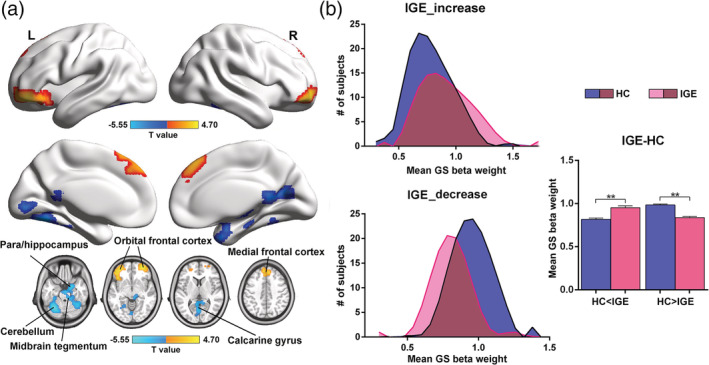
Epilepsy is a common brain network disorder associated with disrupted large-scale excitatory and inhibitory neural interactions. Recent resting-state fMRI evidence indicates that global signal (GS) fluctuations that have commonly been ignored are linked to neural activity. However, the mechanisms underlying the altered global pattern of fMRI spontaneous fluctuations in epilepsy remain unclear. Here, we quantified GS topography using beta weights obtained from a multiple regression model in a large group of epilepsy with different subtypes (98 focal temporal epilepsy; 116 generalized epilepsy) and healthy population (n = 151). We revealed that the nonuniformly distributed GS topography across association and sensory areas in healthy controls was significantly shifted in patients. Particularly, such shifts of GS topography disturbances were more widespread and bilaterally distributed in the midbrain, cerebellum, visual cortex, and medial and orbital cortex in generalized epilepsy, whereas in focal temporal epilepsy, these networks spread beyond the temporal areas but mainly remain lateralized. Moreover, we found that these abnormal GS topography patterns were likely to evolve over the course of a longer epilepsy disease. Our study demonstrates that epileptic processes can potentially affect global excitation/inhibition balance and shift the normal GS topological distribution. These progressive topographical GS disturbances in subcortical-cortical networks may underlie pathophysiological mechanisms of global fluctuations in human epilepsy.
癫痫是一种常见的大脑网络紊乱疾病,与兴奋性和抑制性神经相互作用的破坏有关。最近的静息态 fMRI 证据表明,通常被忽略的全局信号(GS)波动与神经活动有关。然而,癫痫中 fMRI 自发性波动的全局模式改变的潜在机制仍不清楚。在这里,我们使用多回归模型中的β权重来量化 GS 拓扑,该模型在不同亚型的癫痫患者(98 例局灶性颞叶癫痫;116 例全面性癫痫)和健康人群(n=151)中进行了分析。我们发现,健康对照组中与感觉相关的联合区域中 GS 拓扑的非均匀分布在患者中发生了显著变化。特别是,在全面性癫痫中,GS 拓扑紊乱的这种变化更为广泛,并且在中脑、小脑、视觉皮层以及内侧和眶额皮层中呈双侧分布,而在局灶性颞叶癫痫中,这些网络的分布范围超出了颞叶区域,但仍主要呈偏侧化。此外,我们发现这些异常的 GS 拓扑模式可能随着癫痫病程的延长而演变。我们的研究表明,癫痫过程可能会潜在地影响全局兴奋/抑制平衡,并改变正常的 GS 拓扑分布。这些皮质下-皮质网络中渐进性的 GS 干扰可能是人类癫痫中全局波动的病理生理机制的基础。