1st Chair and Department of Cardiology, Medical University of Warsaw, Warsaw, Poland.
Department of Pathophysiology, University of Split School of Medicine, Split, Croatia.
Cardiovasc Drugs Ther. 2021 Apr;35(2):215-229. doi: 10.1007/s10557-020-07084-9. Epub 2020 Oct 19.
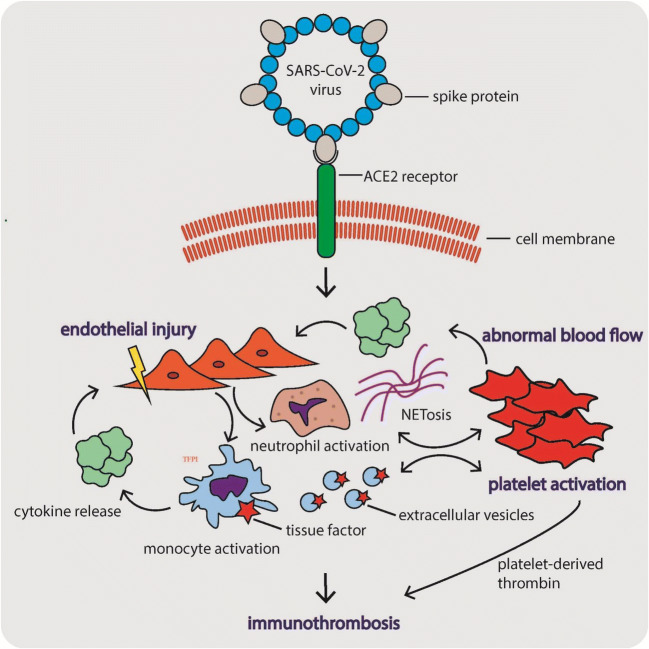
Emerging evidence points to an association between severe clinical presentation of COVID-19 and increased risk of thromboembolism. One-third of patients hospitalized due to severe COVID-19 develops macrovascular thrombotic complications, including venous thromboembolism, myocardial injury/infarction and stroke. Concurrently, the autopsy series indicate multiorgan damage pattern consistent with microvascular injury.
PROPHYLAXIS, DIAGNOSIS AND TREATMENT: COVID-19 associated coagulopathy has distinct features, including markedly elevated D-dimers concentration with nearly normal activated partial thromboplastin time, prothrombin time and platelet count. The diagnosis may be challenging due to overlapping features between pulmonary embolism and severe COVID-19 disease, such as dyspnoea, high concentration of D-dimers, right ventricle with dysfunction or enlargement, and acute respiratory distress syndrome. Both macro- and microvascular complications are associated with an increased risk of in-hospital mortality. Therefore, early recognition of coagulation abnormalities among hospitalized COVID-19 patients are critical measures to identify patients with poor prognosis, guide antithrombotic prophylaxis or treatment, and improve patients' clinical outcomes.
Most of the guidelines and consensus documents published on behalf of professional societies focused on thrombosis and hemostasis advocate the use of anticoagulants in all patients hospitalized with COVID-19, as well as 2-6 weeks post hospital discharge in the absence of contraindications. However, since there is no guidance for deciding the intensity and duration of anticoagulation, the decision-making process should be made in individual-case basis.
Here, we review the mechanistic relationships between inflammation and thrombosis, discuss the macrovascular and microvascular complications and summarize the prophylaxis, diagnosis and treatment of thromboembolism in patients affected by COVID-19.
新出现的证据表明,COVID-19 的严重临床表现与血栓栓塞风险增加之间存在关联。三分之一因严重 COVID-19 住院的患者会发生大血管血栓并发症,包括静脉血栓栓塞、心肌损伤/梗死和中风。同时,尸检系列表明存在多器官损伤模式,符合微血管损伤。
预防、诊断和治疗:COVID-19 相关的凝血功能障碍具有明显特征,包括 D-二聚体浓度显著升高,而活化部分凝血活酶时间、凝血酶原时间和血小板计数几乎正常。由于肺栓塞和严重 COVID-19 疾病之间存在重叠特征,如呼吸困难、D-二聚体浓度高、右心室功能障碍或扩大以及急性呼吸窘迫综合征,因此诊断可能具有挑战性。大血管和微血管并发症均与住院 COVID-19 患者的院内死亡率增加相关。因此,早期识别住院 COVID-19 患者的凝血异常是识别预后不良患者、指导抗血栓预防或治疗以及改善患者临床结局的关键措施。
代表专业协会发布的大多数指南和共识文件都主张在所有 COVID-19 住院患者中使用抗凝剂,并且在没有禁忌症的情况下,在出院后 2-6 周内使用抗凝剂。然而,由于没有决定抗凝强度和持续时间的指导,因此应根据具体情况做出决策。
在这里,我们回顾了炎症与血栓形成之间的机制关系,讨论了大血管和微血管并发症,并总结了 COVID-19 患者血栓栓塞的预防、诊断和治疗。