St. Mary's of Saginaw Hospital, Saginaw, MI, USA.
Central Michigan University College of Medicine, Saginaw, MI, USA.
Clin Appl Thromb Hemost. 2020 Jan-Dec;26:1076029620962853. doi: 10.1177/1076029620962853.
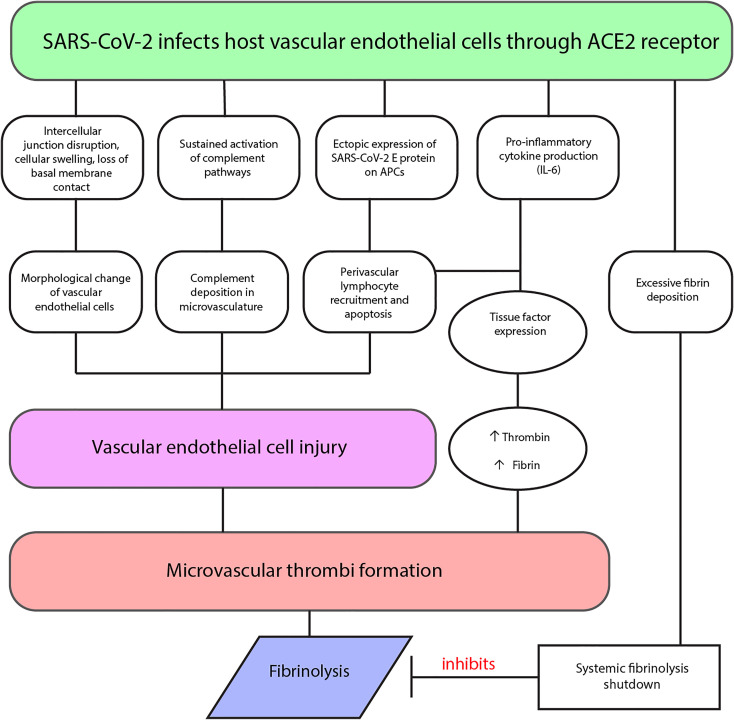
Thrombotic complications of the novel coronavirus (COVID-19) are a concerning aspect of the disease, due to the high incidence in critically ill patients and poor clinical outcomes. COVID-19 predisposes patients to a hypercoagulable state, however, the pathophysiology behind the thrombotic complications seen in this disease is not well understood. Several mechanisms have been proposed and the pathogenesis likely involves a host immune response contributing to vascular endothelial cell injury, inflammation, activation of the coagulation cascade via tissue factor expression, and shutdown of fibrinolysis. Treatments targeting these pathways may need to be considered to improve clinical outcomes and decrease overall mortality due to thrombotic complications. In this review, we will discuss the proposed pathophysiologic mechanisms for thrombotic complications in COVID-19, as well as treatment strategies for these complications based on the current literature available.
新型冠状病毒(COVID-19)的血栓并发症是该疾病令人关注的一个方面,因为重症患者的发病率高,临床结局较差。COVID-19 使患者易发生高凝状态,但该疾病中所见的血栓并发症的病理生理学机制尚不清楚。已经提出了几种机制,发病机制可能涉及宿主免疫反应导致血管内皮细胞损伤、炎症、通过组织因子表达激活凝血级联反应以及纤溶抑制。可能需要考虑针对这些途径的治疗方法,以改善临床结局并降低由于血栓并发症导致的总体死亡率。在这篇综述中,我们将讨论 COVID-19 中血栓并发症的拟议病理生理机制,以及基于现有文献的这些并发症的治疗策略。