Institut national de santé publique du Québec, Montreal, Quebec, Canada.
Department of Environmental and Occupational Health, School of Public Health, University of Montreal, Montreal, Canada.
Environ Health Perspect. 2020 Oct;128(10):107006. doi: 10.1289/EHP6920. Epub 2020 Oct 19.
Environmental factors may contribute to the development of Kawasaki disease in children, but prenatal environmental exposures are understudied.
We used a population-based cohort to investigate whether prenatal exposure to outdoor air pollution is associated with the incidence of Kawasaki disease in childhood.
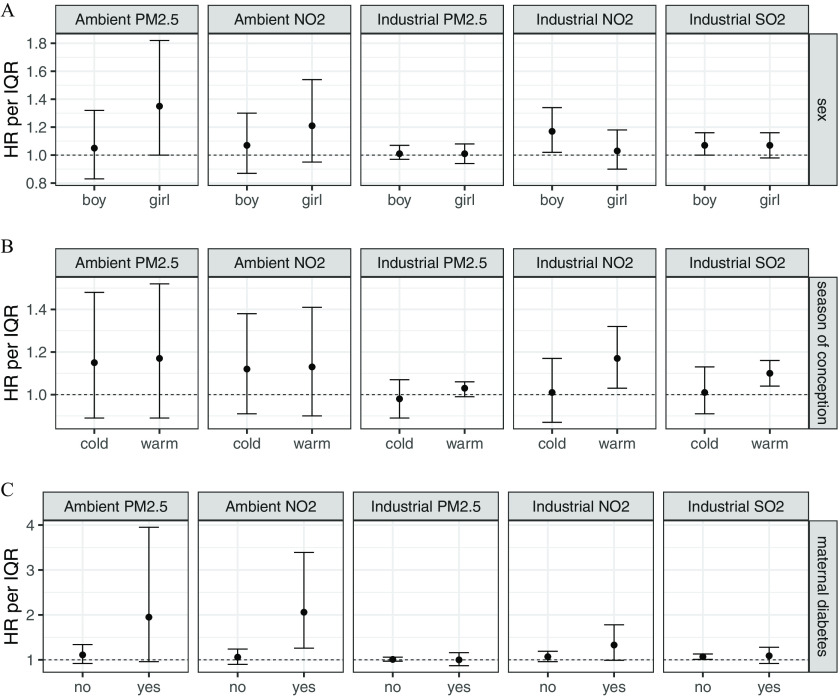
We performed a longitudinal cohort study of all children born in Quebec, Canada, between 2006 and 2012. Children were followed for Kawasaki disease from birth until 31 March 2018. We assigned prenatal air pollutant exposure according to the residential postal code at birth. The main exposure was annual average concentration of ambient fine particulate matter [PM in aerodynamic diameter () and nitrogen dioxide () from satellite-based estimates and land-use regression models. As secondary exposures, we considered industrial , , and sulfur dioxide () emissions estimated from dispersion models. We estimated hazard ratios (HRs) using Cox proportional hazards models, adjusted for maternal age, parity, sex, multiple birth, maternal smoking during pregnancy, socioeconomic status, birth year, and rural residence. We considered single and multipollutant models. We performed several sensitivity analyses, including assessing modifying effects of maternal comorbidities (e.g., diabetes, preeclampsia).
The cohort comprised 505,336 children, including 539 with Kawasaki disease. HRs for each interquartile range increase in ambient air pollution were 1.16 (95% CI: 0.96, 1.39) for and 1.12 (95% CI: 0.96, 1.31) for . For industrial air pollution, HRs were 1.07 (95% CI: 1.01, 1.13) for , 1.09 (95% CI: 0.99, 1.20) for , and 1.01 (95% CI: 0.97, 1.05) for . In multipollutant models, associations for ambient and (i.e., from all sources) were robust to adjustment for industrial pollution, and vice versa.
In this population-based cohort study, both prenatal exposure to ambient and industrial air pollution were associated with the incidence of Kawasaki disease in childhood. Further studies are needed to consolidate the observed associations. https://doi.org/10.1289/EHP6920.
环境因素可能导致儿童川崎病的发生,但产前环境暴露的研究较少。
我们使用基于人群的队列研究来调查儿童期川崎病的发生是否与产前暴露于室外空气污染有关。
我们对 2006 年至 2012 年期间在加拿大魁北克出生的所有儿童进行了一项纵向队列研究。从出生起,儿童就开始接受川崎病的随访,直至 2018 年 3 月 31 日。我们根据出生时的居住邮政编码分配产前空气污染物暴露情况。主要暴露是基于卫星估计和基于土地利用的回归模型的环境细颗粒物[PM 在空气动力学直径()和二氧化氮()的年平均浓度。作为次要暴露,我们考虑了来自分散模型的工业、、和二氧化硫()排放的估计值。我们使用 Cox 比例风险模型估计危险比 (HR),并进行了调整,以调整母亲的年龄、产次、性别、多胎妊娠、母亲怀孕期间吸烟、社会经济地位、出生年份和农村居住情况。我们考虑了单污染物和多污染物模型。我们进行了几次敏感性分析,包括评估母体合并症(如糖尿病、子痫前期)的修饰作用。
该队列包括 505336 名儿童,其中 539 名患有川崎病。每增加一个四分位间距的环境空气污染的 HR 分别为 1.16(95%CI:0.96,1.39),对于 为 1.12(95%CI:0.96,1.31)。对于工业空气污染,HR 分别为 1.07(95%CI:1.01,1.13),对于 为 1.09(95%CI:0.99,1.20),对于 为 1.01(95%CI:0.97,1.05)。在多污染物模型中,对于环境和(即来自所有来源)的关联在调整工业污染后仍然稳健,反之亦然。
在这项基于人群的队列研究中,产前暴露于环境和工业空气污染均与儿童川崎病的发病率有关。需要进一步的研究来证实观察到的关联。https://doi.org/10.1289/EHP6920.