Graduate Institute of Clinical Medicine, College of Medicine, Kaohsiung Medical University, Kaohsiung 807, Taiwan.
Division of Hematology and Oncology, Department of Internal Medicine, Kaohsiung Medical University Hospital, Kaohsiung Medical University, Kaohsiung 807, Taiwan.
Int J Mol Sci. 2020 Oct 15;21(20):7621. doi: 10.3390/ijms21207621.
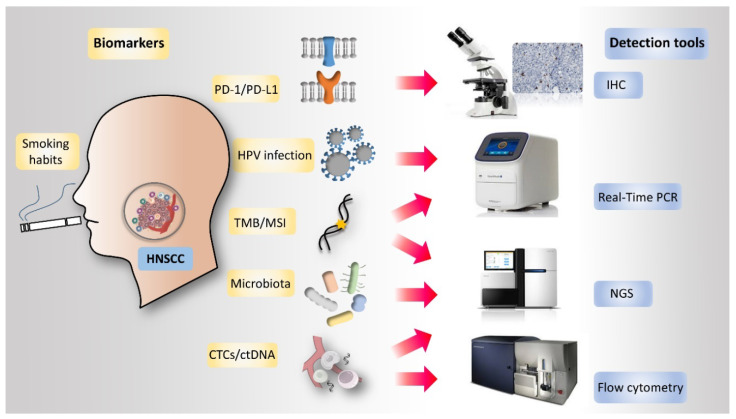
Recurrent locally advanced or metastatic head and neck squamous cell carcinoma (HNSCC) is associated with dismal prognosis because of its highly invasive behavior and resistance to conventional intensive chemotherapy. The combination of targeted therapy and conventional chemotherapy has significantly improved clinical outcomes. In recent years, the development of immunotherapies, such as immune checkpoint inhibitors (ICIs), has further increased treatment responses and prolonged survival. However, the limited response rate, risk of immunotherapy-related adverse effects and high cost of immunotherapy make the identification of predictive markers to optimize treatment efficacy a critical issue. Biomarkers are biological molecules that have been widely utilized to predict treatment response to certain treatments and clinical outcomes or to detect disease. An ideal biomarker should exhibit good predictive ability, which can guide healthcare professionals to achieve optimal treatment goals and bring clinical benefit to patients. In this review, we summarized the results of recent and important studies focused on HNSCC ICI immunotherapy and discussed potential biomarkers including their strengths and limitations, aiming to gain more insight into HNSCC immunotherapy in real world clinical practice.
复发性局部晚期或转移性头颈部鳞状细胞癌(HNSCC)因其侵袭性强和对常规强化化疗的耐药性而预后不良。靶向治疗与常规化疗的联合应用显著改善了临床结局。近年来,免疫疗法的发展,如免疫检查点抑制剂(ICIs),进一步提高了治疗反应和延长了生存时间。然而,免疫治疗相关不良反应的风险和免疫治疗的高成本限制了其应答率,使得确定预测标志物以优化治疗效果成为一个关键问题。生物标志物是广泛用于预测某些治疗方法治疗反应和临床结局或检测疾病的生物分子。理想的生物标志物应具有良好的预测能力,能够指导医疗保健专业人员实现最佳治疗目标,并为患者带来临床获益。在这篇综述中,我们总结了最近和重要的针对 HNSCC ICI 免疫治疗的研究结果,并讨论了潜在的生物标志物,包括它们的优势和局限性,旨在深入了解真实世界临床实践中的 HNSCC 免疫治疗。