Grosse Scott D, Ji Xu, Nichols Phyllis, Zuvekas Samuel H, Rice Catherine E, Yeargin-Allsopp Marshalyn
National Center on Birth Defects and Developmental Disabilities, Centers for Disease Control and Prevention (CDC), Atlanta (Grosse, Nichols, Yeargin-Allsopp); Department of Pediatrics, Emory University School of Medicine and Children's Healthcare of Atlanta, Atlanta (Ji); Center for Financing, Access and Cost Trends, Agency for Healthcare Research and Quality, Rockville, Maryland (Zuvekas); Department of Psychiatry and Behavioral Sciences, Emory University School of Medicine, Atlanta (Rice). This work was performed when Dr. Ji was a Prevention Effectiveness Fellow at the CDC.
Psychiatr Serv. 2021 Jan 1;72(1):16-22. doi: 10.1176/appi.ps.202000099. Epub 2020 Oct 20.
Rapid increases in the prevalence of autism spectrum disorder (ASD) and increased access to intensive behavioral interventions have likely increased health care spending. This study estimated recent changes in spending among privately insured children with and without current ASD.
A repeated cross-sections analysis of 2011-2017 claims data from large-employer-sponsored health plans assessed changes in annual expenditures by service type for children ages 3-7 enrolled for ≥1 year and with two or more claims with ASD billing codes within a calendar year and for all other children.
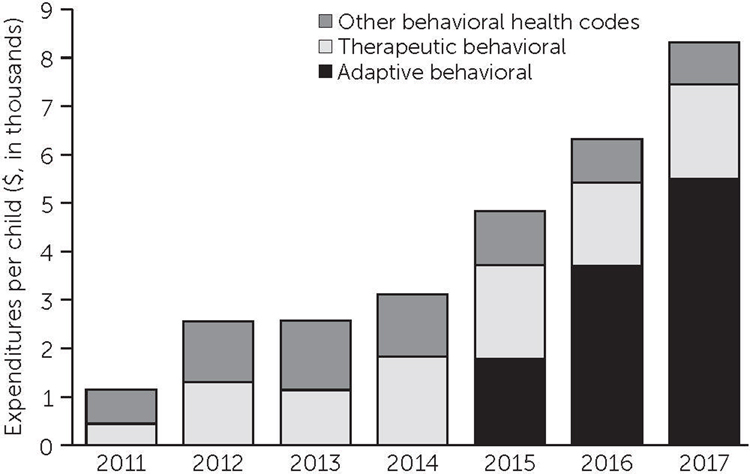
Mean spending per child with a current-year ASD diagnosis increased by 51% in 2017 U.S. dollars, from roughly $13,000 in 2011 to $20,000 in 2017. Among children who did not meet the current-year ASD case definition, per-child spending increased by 8%. Spending on children with ASD accounted for 41% of spending growth for children ages 3-7 during 2011-2017. Outpatient behavioral intervention-related spending per child with ASD increased by 376%, from $1,746 in 2011 to $8,317 in 2017; spending on all other services increased by 2%. Their share of behavioral intervention-related spending increased from 13.2% in 2011 to 41.7% in 2017. In 2011, 2.5% of children with current-year ASD diagnoses incurred ≥$20,000 in outpatient behavioral intervention-related spending, which increased to 14.4% in 2017.
During 2011-2017, spending increased six times as much for privately insured children ages 3-7 with current-year ASD as for children without ASD, largely from increased behavioral intervention-related spending. One in seven children received at least $20,000 in services in 2017.
自闭症谱系障碍(ASD)患病率的迅速上升以及强化行为干预手段的增加,可能导致了医疗保健支出的增加。本研究估算了近期有和没有当前ASD的私人保险儿童的支出变化情况。
对2011 - 2017年大型雇主赞助的健康计划的理赔数据进行重复横断面分析,评估3至7岁、参保≥1年且在一个日历年内有两个或更多带有ASD计费代码理赔记录的儿童以及所有其他儿童按服务类型划分的年度支出变化。
2017年,当年被诊断为ASD的儿童平均支出以2017年美元计算增长了51%,从2011年的约13,000美元增至2017年的20,000美元。在未达到当年ASD病例定义的儿童中,人均支出增长了8%。2011 - 2017年期间,3至7岁儿童的支出增长中,ASD儿童的支出占41%。患有ASD的儿童门诊行为干预相关支出人均增长了376%,从2011年的1,746美元增至2017年的8,317美元;所有其他服务的支出增长了2%。他们在行为干预相关支出中的占比从2011年的13.2%增至2017年的41.7%。2011年,2.5%的当年被诊断为ASD的儿童门诊行为干预相关支出≥20,000美元,这一比例在2017年增至14.4%。
在2011 - 2017年期间,有当前ASD的3至7岁私人保险儿童的支出增长是没有ASD儿童的六倍,主要原因是行为干预相关支出增加。2017年,七分之一的儿童接受了至少20,000美元的服务。