Sokoudjou Jean Baptiste, Atolani Olubunmi, Njateng Guy Sedar Singor, Khan Afsar, Tagousop Cyrille Ngoufack, Bitombo André Nehemie, Kodjio Norbert, Gatsing Donatien
Research Unit of Microbiology and Antimicrobial substances, Faculty of Science, University of Dschang, P.O. Box 67, Dschang, Cameroon.
Natural Products Chemistry Laboratory, Department of Chemistry, COMSATS University Islamabad, Abbottabad Campus-22060, Islamabad, Pakistan.
BMC Complement Med Ther. 2020 Oct 19;20(1):316. doi: 10.1186/s12906-020-03100-5.
Bacteria belonging to the Salmonella genus are major concern for health, as they are widely reported in many cases of food poisoning. The use of antibiotics remains a main stream control strategy for avian salmonellosis as well as typhoid and paratyphoid fevers in humans. Due to the growing awareness about drug resistance and toxicities, the use of antibiotics is being discouraged in many countries whilst advocating potent benign alternatives such as phyto-based medicine. The objective of this work was to isolate, characterise the bioactive compounds of Canarium schweinfurthii; and evaluate their anti-salmonellal activity.
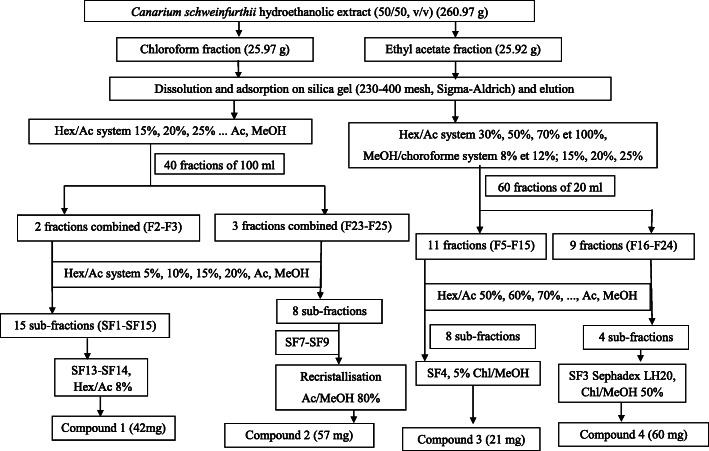
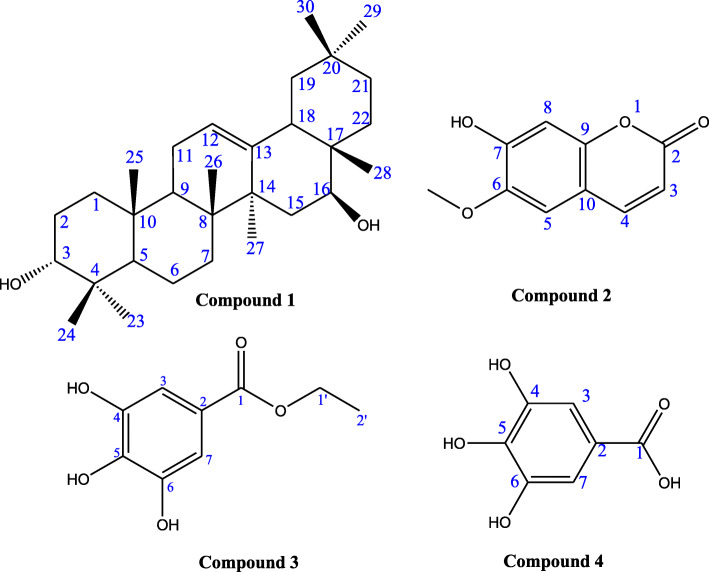
The hydro-ethanolic extract of Canarium schweinfurthii was fractionated and tested for their anti-salmonellal activity. The most active fractions (i.e. chloroform and ethyl acetate partition fractions) were then explored for their phytochemical constituents. Fractionation on normal phase silica gel column chromatography and size exclusion chromatography on Sephadex LH-20 led to the isolation of four compounds (maniladiol, scopoletin, ethyl gallate and gallic acid) reported for the first time in Canarium schweinfurthii.
Result indicated that scopoletin and gallic acid had greater activity than the crude extracts and partition fractions. Among the isolated compounds, scopoletin showed the highest inhibitory activity with a MIC of 16 μg/ml against Salmonella Typhimurium and Salmonella Enteritidis.
The overall results of this study indicates that the hydro-ethanolic extract as well as some of isolated compounds have interesting anti-salmonellal activities that could be further explored for the development of potent therapy for salmonellosis. Furthermore, the study adds credence to the folkloric applications of the plant.
沙门氏菌属细菌是主要的健康问题,因为它们在许多食物中毒案例中被广泛报道。抗生素的使用仍然是禽沙门氏菌病以及人类伤寒和副伤寒热的主要控制策略。由于人们对耐药性和毒性的认识不断提高,许多国家都不鼓励使用抗生素,同时提倡使用强效的良性替代品,如植物性药物。这项工作的目的是分离、鉴定 Schweinfurthii 橄榄(Canarium schweinfurthii)的生物活性化合物,并评估它们的抗沙门氏菌活性。
对 Schweinfurthii 橄榄的水乙醇提取物进行分离,并测试其抗沙门氏菌活性。然后对活性最高的馏分(即氯仿和乙酸乙酯分配馏分)进行植物化学成分研究。通过正相硅胶柱色谱法和 Sephadex LH - 20 尺寸排阻色谱法进行分离,得到了四种首次在 Schweinfurthii 橄榄中报道的化合物(马尼拉二醇、东莨菪素、没食子酸乙酯和没食子酸)。
结果表明,东莨菪素和没食子酸的活性高于粗提物和分配馏分。在分离出的化合物中,东莨菪素对鼠伤寒沙门氏菌和肠炎沙门氏菌表现出最高的抑制活性,MIC 为 16 μg/ml。
本研究的总体结果表明,水乙醇提取物以及一些分离出的化合物具有有趣的抗沙门氏菌活性,可进一步探索用于开发有效的沙门氏菌病治疗方法。此外,该研究为该植物的民间应用提供了可信度。