Department of Anesthesia and Perioperative Medicine, Medical University of South Carolina, Charleston, South Carolina, USA
Department of Anesthesia and Perioperative Medicine, Medical University of South Carolina, Charleston, South Carolina, USA.
BMJ Qual Saf. 2021 Apr;30(4):271-282. doi: 10.1136/bmjqs-2019-010740. Epub 2020 Oct 19.
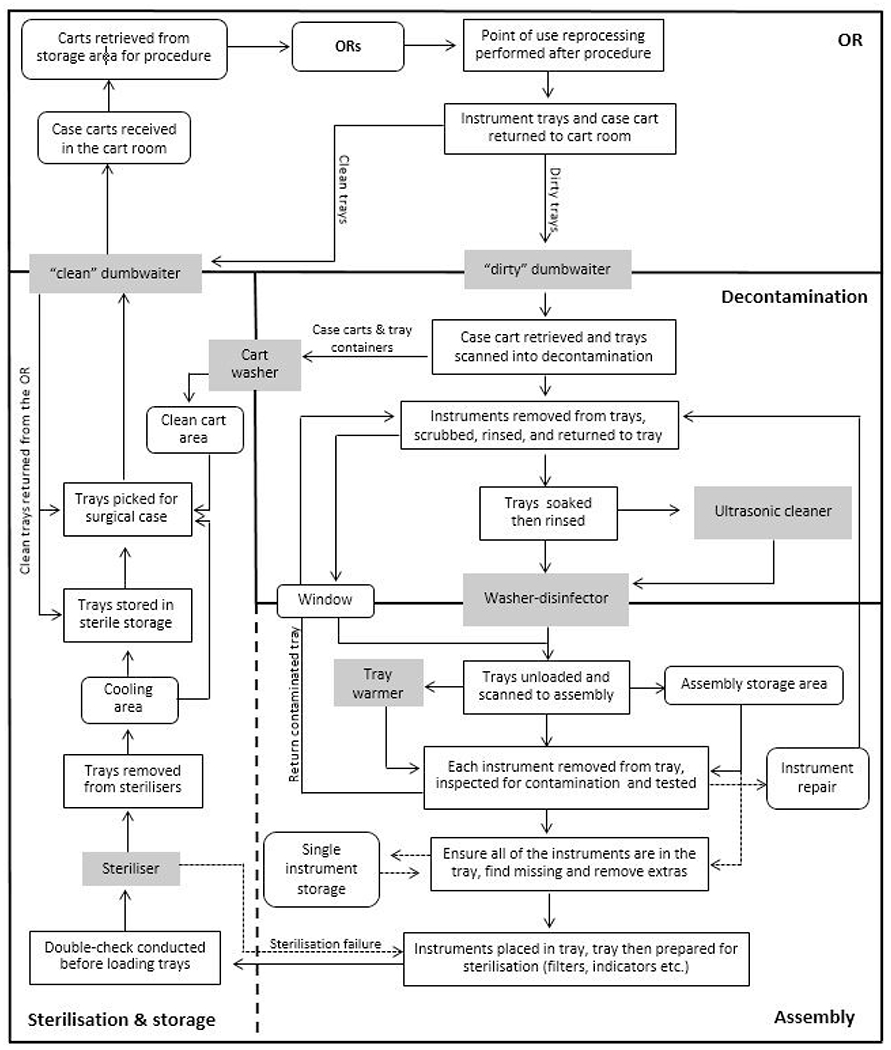
Sterile processing departments (SPDs) play a crucial role in surgical safety and efficiency. SPDs clean instruments to remove contaminants (decontamination), inspect and reorganise instruments into their correct trays (assembly), then sterilise and store instruments for future use (sterilisation and storage). However, broken, missing or inappropriately cleaned instruments are a frequent problem for surgical teams. These issues should be identified and corrected during the assembly phase.
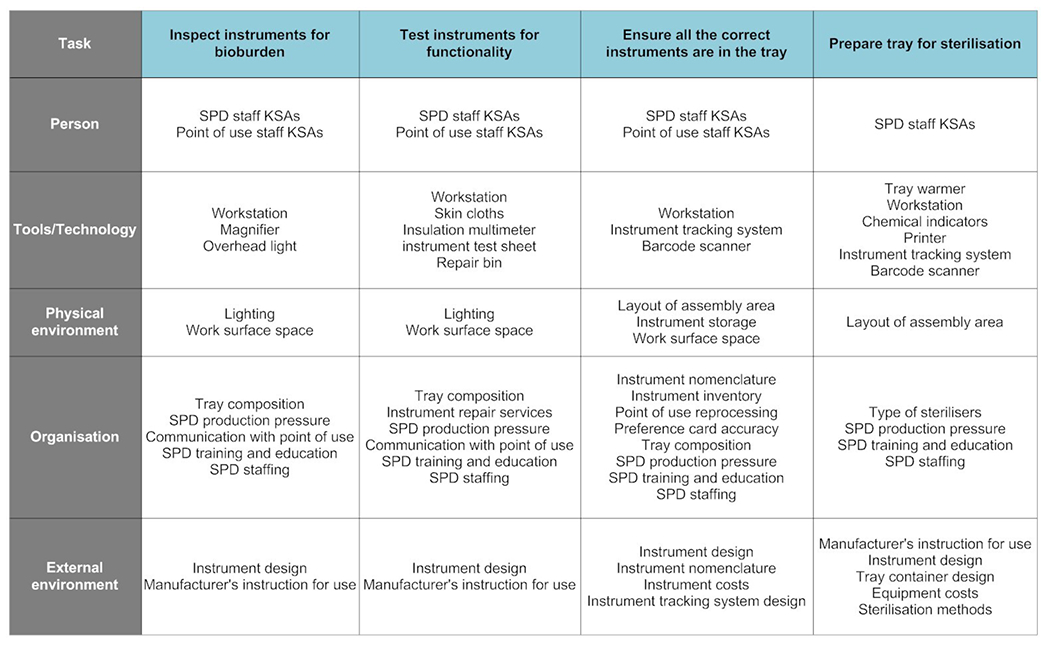
A work systems analysis, framed within the Systems Engineering Initiative for Patient Safety (SEIPS) model, was used to develop a comprehensive understanding of the assembly stage of reprocessing, identify the range of work challenges and uncover the inter-relationship among system components influencing reliable instrument reprocessing.
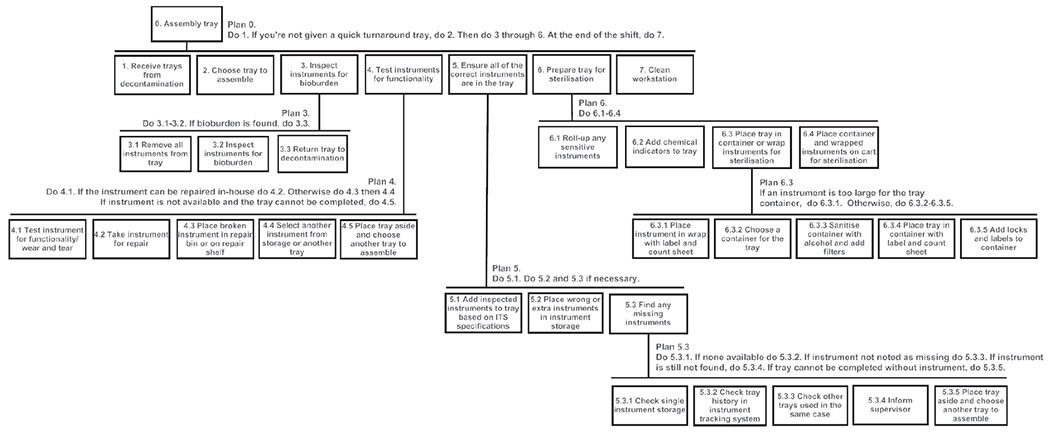
The study was conducted at a 700-bed academic hospital in the Southeastern United States with two reprocessing facilities from October 2017 to October 2018. Fifty-six hours of direct observations, 36 interviews were used to iteratively develop the work systems analysis. This included the process map and task analysis developed to describe the assembly system, the abstraction hierarchy developed to identify the possible performance shaping factors (based on SEIPS) and a variance matrix developed to illustrate the relationship among the tasks, performance shaping factors, failures and outcomes. Operating room (OR) reported tray defect data from July 2016 to December 2017 were analysed to identify the percentage and types of defects across reprocessing phases the most common assembly defects.
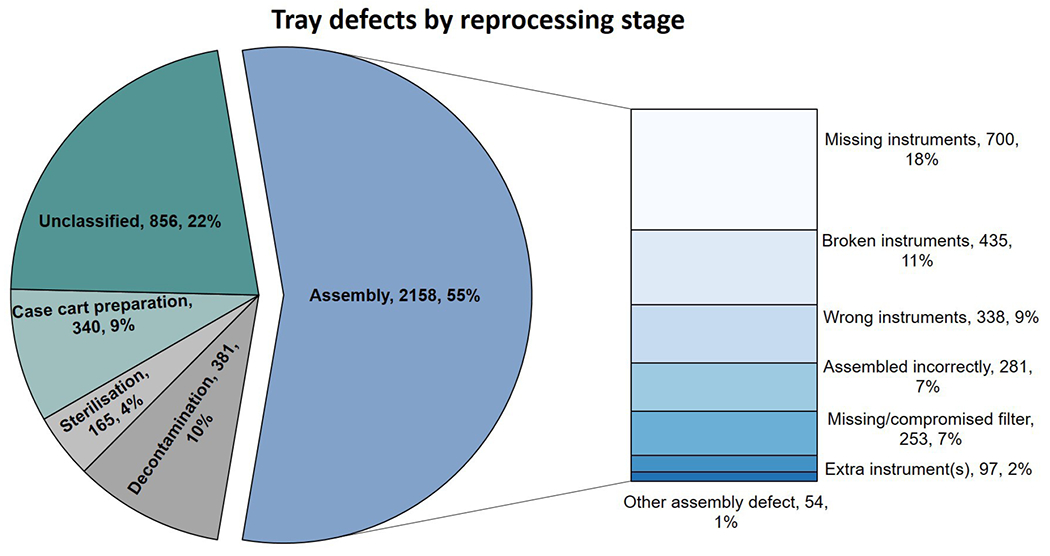
The majority of the 3900 tray defects occurred during the assembly phase; impacting 5% of surgical cases (n=41 799). Missing instruments, which could result in OR delays and increased surgical duration, were the most commonly reported assembly defect (17.6%, n=700). High variability was observed in the reassembling of trays with failures including adding incorrect instruments, omitting instruments and failing to remove damaged instrument. These failures were precipitated by technological shortcomings, production pressures, tray composition, unstandardised instrument nomenclature and inadequate SPD staff training.
Supporting patient safety, minimising tray defects and OR delays and improving overall reliability of instrument reprocessing require a well-designed instrument tracking system, standardised nomenclature, effective coordination of reprocessing tasks between SPD and the OR and well-trained sterile processing technicians.
消毒供应中心(SPD)在手术安全和效率方面发挥着关键作用。SPD 负责清洗器械以去除污染物(去污)、检查并将器械重新组装到正确的托盘(装配)中,然后对器械进行消毒和储存以备将来使用(消毒和储存)。然而,器械破损、缺失或清洗不当是外科团队经常面临的问题。这些问题应在装配阶段发现并纠正。
运用工作系统分析方法,基于患者安全系统工程倡议(SEIPS)模型,全面了解再处理的装配阶段,识别各种工作挑战,并揭示影响可靠器械再处理的系统组件之间的相互关系。
该研究于 2017 年 10 月至 2018 年 10 月在美国东南部一家 700 床的学术医院的两个再处理设施进行。通过 56 小时的直接观察和 36 次访谈,对工作系统分析进行了迭代开发。这包括用于描述装配系统的流程图和任务分析、基于 SEIPS 识别可能的绩效塑造因素(PSFs)的抽象层次结构,以及用于说明任务、绩效塑造因素、故障和结果之间关系的方差矩阵。对 2016 年 7 月至 2017 年 12 月期间手术室(OR)报告的托盘缺陷数据进行分析,以确定再处理各阶段缺陷的百分比和类型(影响 5%的手术病例,n=41799)。最常见的装配缺陷是器械缺失,这可能导致 OR 延迟和手术时间延长(17.6%,n=700)。在重新组装托盘时,发现了很高的变异性,包括添加错误的器械、遗漏器械和未能去除损坏的器械。这些故障是由技术缺陷、生产压力、托盘组成、不标准的器械命名法和 SPD 员工培训不足引起的。
支持患者安全、最大限度地减少托盘缺陷和 OR 延迟以及提高器械再处理的整体可靠性,需要一个设计良好的器械跟踪系统、标准化的命名法、SPD 和 OR 之间再处理任务的有效协调以及经过良好培训的消毒处理技术人员。