Skin Integrity Research Institute, School of Biomedical Sciences, University of Western Australia, Crawley, Western Australia, Australia
School of Occupational Therapy, Social Work and Speech Pathology, Curtin University Faculty of Health Sciences, Perth, Western Australia, Australia.
BMJ Open. 2020 Oct 19;10(10):e035727. doi: 10.1136/bmjopen-2019-035727.
Caesarean delivery is steadily becoming one of the more common surgical procedures in Australia with over 100 000 caesarean sections performed each year. Over the last 10 years in Australia, the caesarean section rate has increased from 28% in 2003 to 33% in 2013. On the international stage, the Australian caesarean delivery rates are higher than the average for the Organisation for Economic Co-operation and Development, Australia ranked as 8 out of 33 and is second to the USA. Postoperative surgical site infections (SSIs) and wound complications are the most common and costly event following a caesarean section. Globally, complication rates following a caesarean delivery vary from 4.9% to 9.8%. Complications such as infection and wound breakdown affect the postpartum mother's health and well-being, and contribute to healthcare costs for clinical management that often spans the acute, community and primary healthcare settings. Published level one studies using advanced wound dressings in the identified 'at-risk' population prior to surgery for prophylactic intervention are yet to be forthcoming.
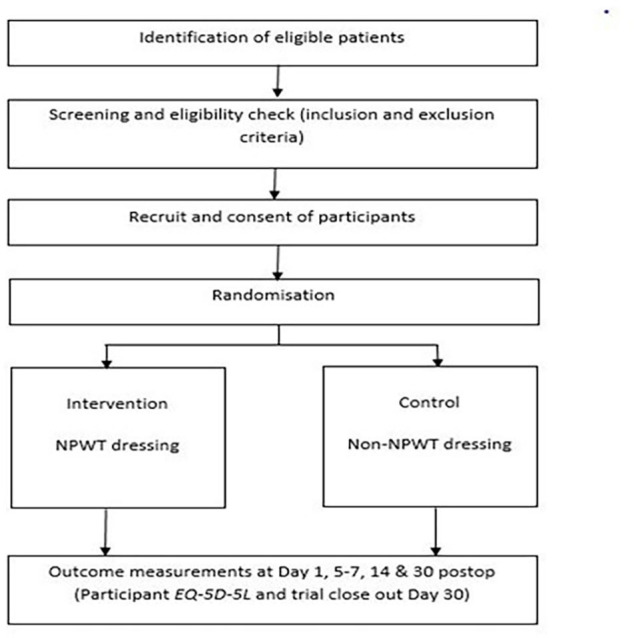
A parallel group randomised control trial of 448 patients will be conducted across two metropolitan hospitals in Perth, Western Australia, which provide obstetric and midwifery services. We will recruit pregnant women in the last trimester, prior to their admission into the healthcare facility for delivery of their child. We will use a computer-generated block sequence to randomise the 448 participants to either the interventional (negative pressure wound therapy (NPWT) dressing, n=224) or comparator arm (non-NPWT dressing, n=224). The primary outcome measure is the occurrence of surgical wound dehiscence (SSWD) or SSI. The Centres for Disease Control reporting definition of either superficial or deep infection at 30 days will be used as the outcome measure definition. SWD will be classified as per the World Union of Wound Healing Societies grading system (grade I-IV). We will assess recruitment rate, and adherence to intervention and follow-up. We will assess the potential effectiveness of NPWT in the prevention of postpartum surgical wound complications at three time points during the study; postoperative days 5, 14 and 30, after which the participant will be closed out of the trial. We will use statistical methods to determine efficacy, and risk stratification will be conducted to determine the SWD risk profile of the participant. Follow-up at day 30 will assess superficial and deep infection, and wound dehiscence (grade I-IV) and the core outcome data set for wound complications. This study will collect health-related quality of life (European Quality of Life 5-Dimensions 5-Level Scale), mortality and late complications such as further surgery with a cost analysis conducted. The primary analysis will be by intention-to-treat. This clinical trial protocol follows the Standard Protocol Items: Recommendations for Interventional Trials (SPIRIT) and the Consolidated Standards of Reporting Trials guidelines.
Ethics approval was obtained through St John of God Health Care (HREC1409), Western Australia Department of Health King Edward Memorial Hospital (HREC3111). Study findings will be published in peer-reviewed journals and presented at international conferences. We used the SPIRIT checklist when writing our study protocol.
Australian and New Zealand Clinical Trials Registry (ACTRN12618002006224p).
剖宫产术在澳大利亚已成为越来越常见的手术之一,每年有超过 10 万例剖宫产术。在过去的 10 年中,澳大利亚的剖宫产率从 2003 年的 28%上升到 2013 年的 33%。在国际舞台上,澳大利亚的剖宫产率高于经济合作与发展组织的平均水平,澳大利亚在 33 个国家中排名第 8,仅次于美国。术后手术部位感染(SSI)和伤口并发症是剖宫产术后最常见和最昂贵的事件。全球范围内,剖宫产术后并发症发生率从 4.9%到 9.8%不等。感染和伤口破裂等并发症会影响产后母亲的健康和幸福感,并导致医疗保健成本增加,这些成本通常跨越急性、社区和初级保健环境。尚未公布在术前针对“高危”人群使用高级伤口敷料进行的一级研究。
将在西澳大利亚州珀斯的两家大都市医院进行一项针对 448 名患者的平行组随机对照试验,这些医院提供产科和助产服务。我们将招募怀孕晚期的孕妇,在她们入院分娩之前。我们将使用计算机生成的块序列将 448 名参与者随机分为干预组(负压伤口治疗(NPWT)敷料,n=224)或对照组(非 NPWT 敷料,n=224)。主要结局指标是手术伤口裂开(SSWD)或 SSI 的发生。将使用疾病控制与预防中心的报告定义来衡量 30 天时的任何浅表或深部感染,作为结局测量定义。SWD 将按照世界伤口愈合协会的分类系统(I-IV 级)进行分类。我们将评估招募率、对干预措施和随访的依从性。我们将在研究期间的三个时间点评估 NPWT 在预防产后手术伤口并发症方面的潜在有效性;术后第 5、14 和 30 天,此后参与者将退出试验。我们将使用统计方法确定疗效,并进行风险分层以确定参与者的 SWD 风险状况。第 30 天的随访将评估浅表和深部感染以及伤口裂开(I-IV 级)和伤口并发症的核心结局数据。该研究将收集与健康相关的生活质量(欧洲生活质量 5 维度 5 水平量表)、死亡率和进一步手术等晚期并发症,并进行成本分析。主要分析将采用意向治疗。本临床试验方案遵循标准干预试验建议(SPIRIT)和临床试验报告标准指南。
西澳大利亚州圣约翰健康护理(HREC1409)和西澳大利亚州卫生部国王爱德华纪念医院(HREC3111)已获得伦理批准。研究结果将发表在同行评议的期刊上,并在国际会议上发表。我们在撰写研究方案时使用了 SPIRIT 清单。
澳大利亚和新西兰临床试验注册(ACTRN12618002006224p)。