Department of Neonatal and Paediatric Critical Care, Azienda Ospedaliera Universitaria Integrata Verona, Verona, Italy
Paediatric Anesthesia and Intensive Care, Policlinico Universitario Agostino Gemelli, Roma, Italy.
BMJ Open. 2020 Oct 19;10(10):e038780. doi: 10.1136/bmjopen-2020-038780.
Some evidence indicates that exogenous surfactant therapy may be effective in infants with acute viral bronchiolitis, even though more confirmatory data are needed. To date, no large multicentre trials have evaluated the effectiveness and safety of exogenous surfactant in severe cases of bronchiolitis requiring invasive mechanical ventilation (IMV).
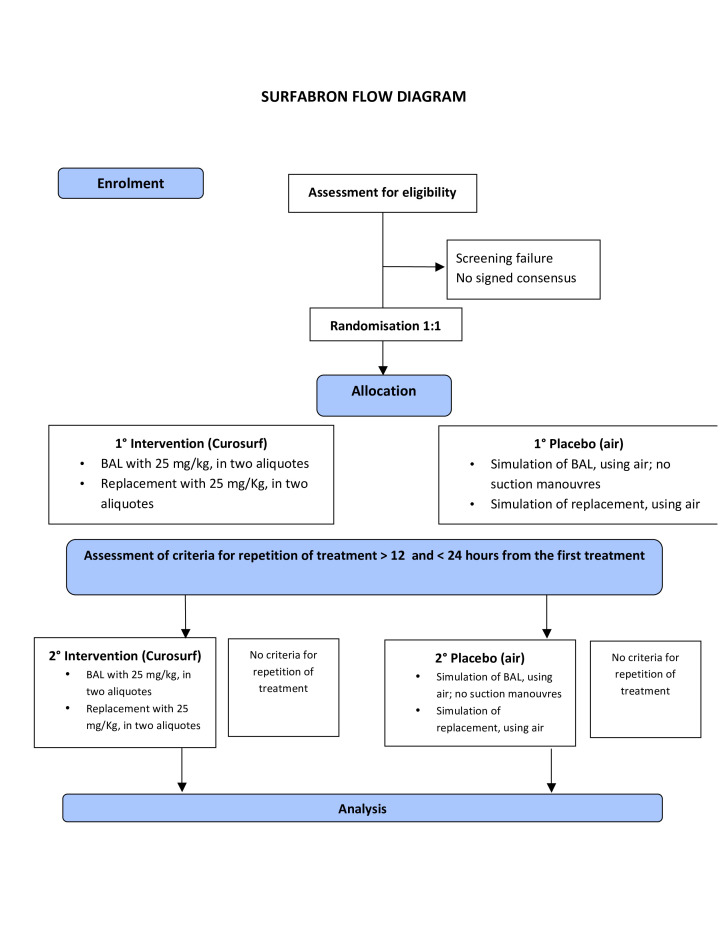
This is a multicentre randomised, placebo-controlled, double-blind study, performed in 19 Italian paediatric intensive care units (PICUs). Eligible participants are infants under the age of 12 months hospitalised in a PICU, suffering from severe acute hypoxaemic bronchiolitis, requiring IMV. We adopted a more restrictive definition of bronchiolitis, including only infants below 12 months of age, to maintain the population as much homogeneous as possible. The primary outcome is to evaluate whether exogenous surfactant therapy (Curosurf, Chiesi Pharmaceuticals, Italy) is effective compared with placebo (air) in reducing the duration of IMV in the first 14 days of hospitalisation, in infants suffering from acute hypoxaemic viral bronchiolitis. Secondary outcomes are duration of non-invasive mechanical ventilation in the post-extubation phase, number of cases requiring new intubation after previous extubation within 14 days from randomisation, PICU and hospital length of stay (LOS), duration of oxygen dependency, effects on oxygenation and ventilatory parameters during invasive mechanical respiratory support, need for repeating treatment within 24 hours of first treatment, use of other interventions (eg, high-frequency oscillatory ventilation, nitric oxide, extracorporeal membrane oxygenation), mortality within the first 14 days of PICU stay and before hospital discharge, side effects and serious adverse events.
The trial design and protocol have received approval by the Italian National Agency for Drugs (AIFA) and by the Regional Ethical Committee of Verona University Hospital (1494CESC). Findings will be disseminated through publication in peer-reviewed journals, conference/meeting presentations and media.
Clinicaltrials.gov, issue date 22 May 2019. NCT03959384.
有证据表明,外源性表面活性剂治疗可能对急性病毒性细支气管炎的婴儿有效,尽管需要更多的确认性数据。迄今为止,尚无大型多中心试验评估过外源性表面活性剂在需要有创机械通气(IMV)的严重毛细支气管炎病例中的有效性和安全性。
这是一项在意大利 19 家儿科重症监护病房(PICU)进行的多中心随机、安慰剂对照、双盲研究。合格的参与者是在 PICU 住院的 12 个月以下的婴儿,患有严重的急性低氧性细支气管炎,需要 IMV。我们采用了更严格的毛细支气管炎定义,仅包括 12 个月以下的婴儿,以使人群尽可能同质。主要结局是评估外源性表面活性剂治疗(Curosurf,Chiesi Pharmaceuticals,意大利)与安慰剂(空气)相比,是否能缩短急性低氧性病毒性毛细支气管炎婴儿住院期间前 14 天的 IMV 持续时间。次要结局是在拔管后阶段非侵入性机械通气的持续时间、在随机分组后 14 天内再次插管的病例数、PICU 和住院时间(LOS)、氧依赖持续时间、对侵入性机械通气支持期间氧合和通气参数的影响、在首次治疗后 24 小时内重复治疗的需要、在 24 小时内重复治疗的需要、其他干预措施(如高频振荡通气、一氧化氮、体外膜氧合)的使用、PICU 住院和出院前 14 天内的死亡率、副作用和严重不良事件。
该试验的设计和方案已获得意大利国家药物管理局(AIFA)和维罗纳大学医院区域伦理委员会(1494CESC)的批准。研究结果将通过发表在同行评议期刊、会议/会议报告和媒体上进行传播。
Clinicaltrials.gov,日期为 2019 年 5 月 22 日。NCT03959384。