Department of Obstetrics and Gynecology, Feinberg School of Medicine, Northwestern University, Chicago, IL, USA.
Northwestern University Atomic and Nanoscale Characterization Experimental (NUANCE) Center, Northwestern University, Evanston, IL, USA.
Aging Cell. 2020 Nov;19(11):e13259. doi: 10.1111/acel.13259. Epub 2020 Oct 20.
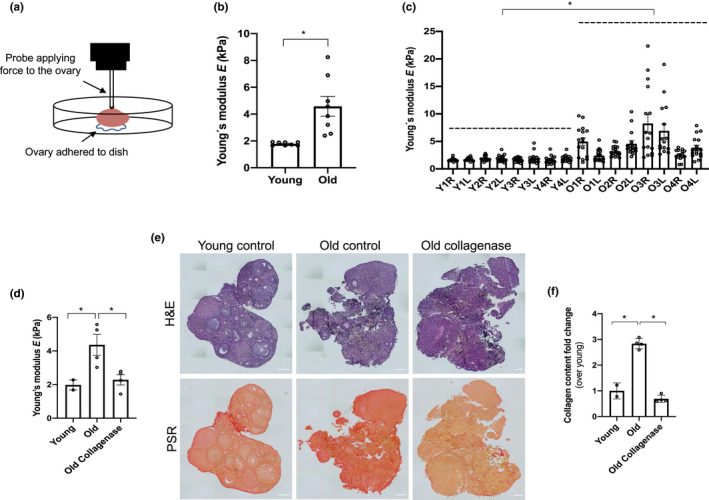
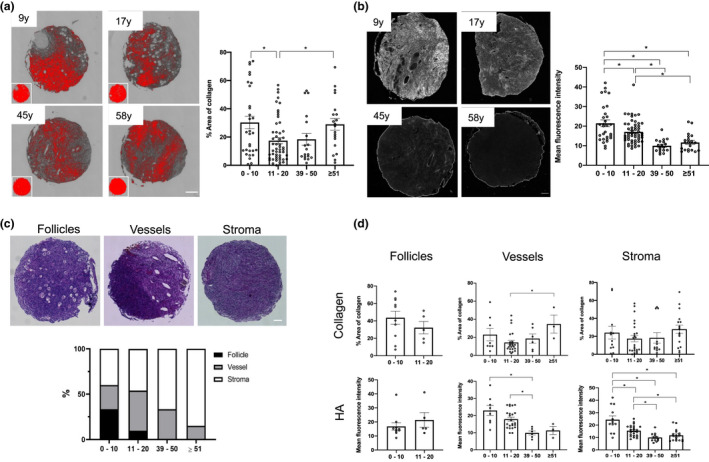
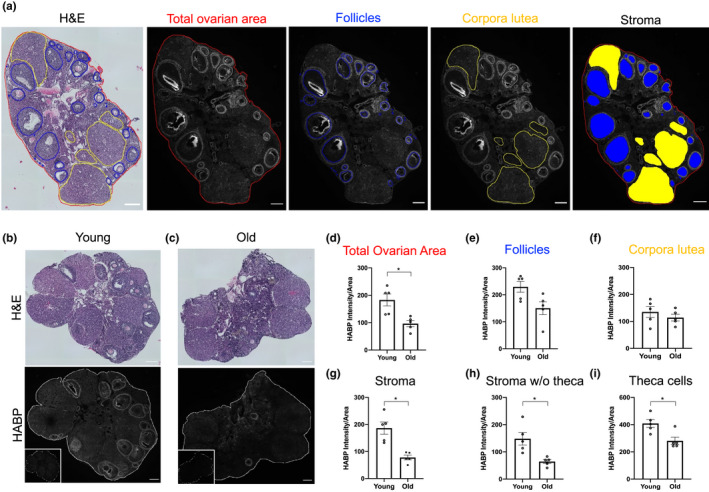
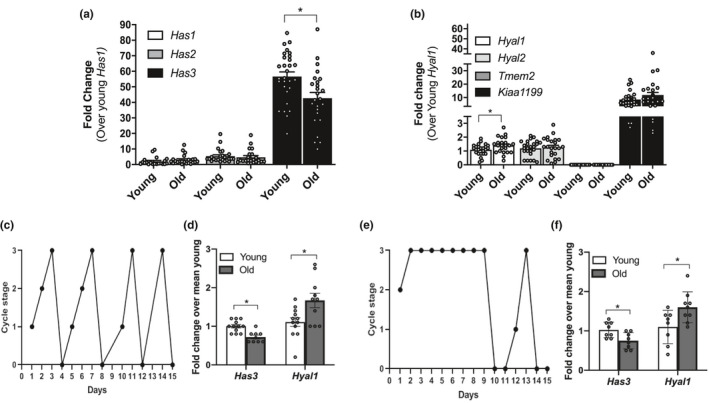
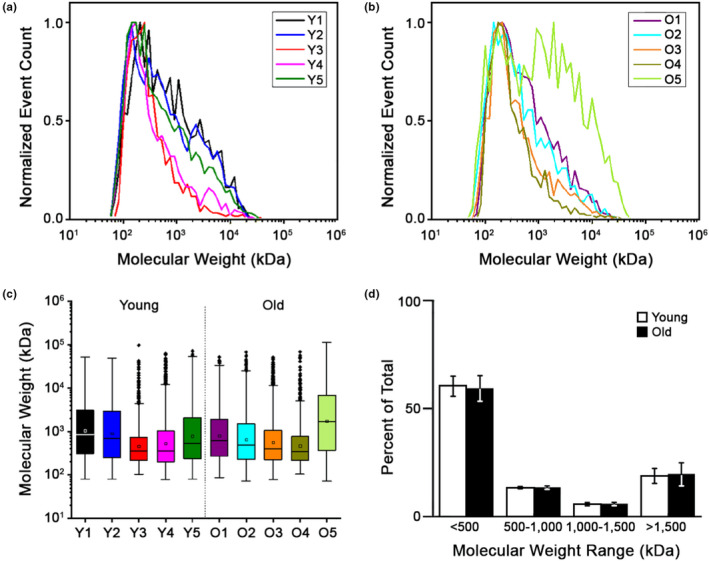
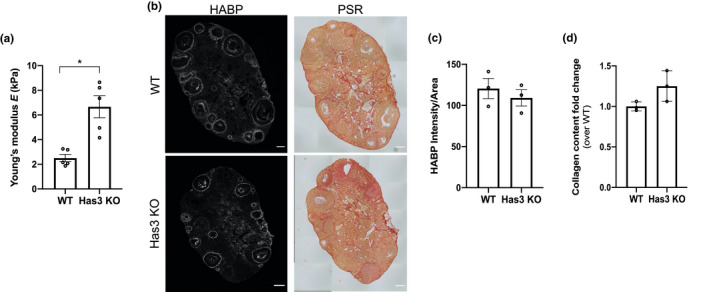
Fibrosis is a hallmark of aging tissues which often leads to altered architecture and function. The ovary is the first organ to show overt signs of aging, including increased fibrosis in the ovarian stroma. How this fibrosis affects ovarian biomechanics and the underlying mechanisms are unknown. Using instrumental indentation, we demonstrated a quantitative increase in ovarian stiffness, as evidenced by an increase in Young's modulus, when comparing ovaries from reproductively young (6-12 weeks) and old (14-17 months) mice. This ovarian stiffness was dependent on collagen because ex vivo enzyme-mediated collagen depletion in ovaries from reproductively old mice restored their collagen content and biomechanical properties to those of young controls. In addition to collagen, we also investigated the role of hyaluronan (HA) in regulating ovarian stiffness. HA is an extracellular matrix glycosaminoglycan that maintains tissue homeostasis, and its loss can change the biomechanical properties of tissues. The total HA content in the ovarian stroma decreased with age, and this was associated with increased hyaluronidase (Hyal1) and decreased hyaluronan synthase (Has3) expression. These gene expression differences were not accompanied by changes in ovarian HA molecular mass distribution. Furthermore, ovaries from mice deficient in HAS3 were stiffer compared to age-matched WT mice. Our results demonstrate that the ovary becomes stiffer with age and that both collagen and HA matrices are contributing mechanisms regulating ovarian biomechanics. Importantly, the age-associated increase in collagen and decrease in HA are conserved in the human ovary and may impact follicle development and oocyte quality.
纤维化是衰老组织的一个标志,它通常导致组织结构和功能的改变。卵巢是第一个表现出明显衰老迹象的器官,包括卵巢基质中纤维化的增加。这种纤维化如何影响卵巢生物力学以及潜在的机制尚不清楚。我们使用仪器压痕法证明了卵巢硬度的定量增加,这表现为比较生殖期年轻(6-12 周)和年老(14-17 个月)小鼠的卵巢时,杨氏模量增加。这种卵巢硬度取决于胶原蛋白,因为生殖期老年小鼠卵巢中体外酶介导的胶原蛋白耗竭会恢复其胶原蛋白含量和生物力学特性,使其接近年轻对照组。除了胶原蛋白,我们还研究了透明质酸(HA)在调节卵巢硬度中的作用。HA 是一种细胞外基质糖胺聚糖,它维持组织的内稳态,其损失会改变组织的生物力学特性。卵巢基质中的总 HA 含量随年龄增长而减少,这与透明质酸酶(Hyal1)的增加和透明质酸合成酶(Has3)的表达减少有关。这些基因表达差异并不伴随着卵巢 HA 分子量分布的变化。此外,与年龄匹配的 WT 小鼠相比,Has3 基因缺失的小鼠的卵巢更硬。我们的结果表明,随着年龄的增长,卵巢会变得更硬,胶原蛋白和 HA 基质都是调节卵巢生物力学的机制。重要的是,人类卵巢中也存在与年龄相关的胶原蛋白增加和 HA 减少,这可能会影响卵泡发育和卵母细胞质量。