Department of Molecular Pneumology, Universitätsklinikum Erlangen, Friedrich-Alexander-Universität Erlangen-Nürnberg, Erlangen, Germany.
Department of Allergy and Pneumology, Children's Hospital, Universitätsklinikum Erlangen, Friedrich-Alexander-Universität (FAU) Erlangen-Nürnberg, Erlangen, Germany.
Immun Inflamm Dis. 2020 Dec;8(4):704-712. doi: 10.1002/iid3.360. Epub 2020 Oct 20.
We recently described increased NFATc1, IRF4, and NIP45 messenger RNA (mRNA) expression in peripheral blood mononuclear cells (PBMCs) of asthmatic children and adults with multiple allergies.
NFATc2 has been described to associate with IRF4 to induce interleukin-4, and to be inhibited by T-bet. Here, we analyzed the role of NFATc2 in asthmatic children and adults.
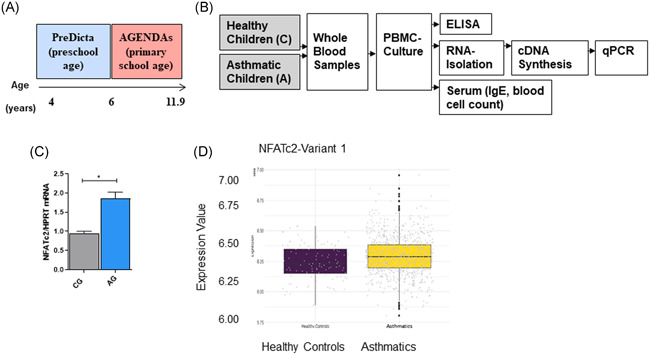
PBMCs were isolated from the blood of control of asthmatics subjects. Some PBMCs were analyzed untreated and some cultured with and without phytohemagglutinin. Then, RNA was extracted from the cells and cytokines were measured in the supernatants via enzyme-linked immunosorbent assay or multiplex analysis. RNA was then reverse-transcribed and NFATc1, NFATC2, IRF4, and T-bet mRNA were analyzed by real-time polymerase chain reaction. In addition, in peripheral blood cells, NFATc2 expression was analyzed, in a population of asthmatic children and adults from the Asthma BRIDGE study.
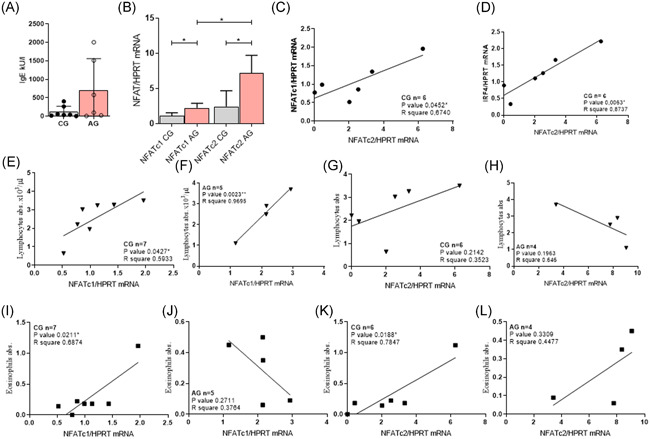
In addition to NFATc1 and NIP45, also NFATc2 was found upregulated in PBMCs and peripheral blood cells from asthmatic children and adults with allergic asthma. Moreover, NFATc1 directly correlated with lymphocytes number whereas NFATc2 correlated with peripheral eosinophilia in asthma.
In addition to NFATc1 and NIP45, NFATc2 was found upregulated in asthma. Moreover, NFATc1 mRNA correlated with lymphocytes both in control and asthma, and NFATC1 and NFATc2 mRNA showed a direct correlation with eosinophils in controls but not in asthma, indicating that NFATc1 is associated with lymphocytes and not eosinophils in asthma.
Targeting NFATc2 in T lymphocytes might ameliorate the allergic phenotype in asthmatic subjects.
我们最近描述了哮喘患儿和成人多发性过敏患者外周血单个核细胞(PBMC)中 NFATc1、IRF4 和 NIP45 信使 RNA(mRNA)表达增加。
已描述 NFATc2 与 IRF4 结合诱导白细胞介素 4,并受 T-bet 抑制。在此,我们分析了 NFATc2 在哮喘患儿和成人中的作用。
从对照哮喘患者和哮喘患者的血液中分离 PBMC。部分 PBMC 未经处理进行分析,部分 PBMC 在有或没有植物血凝素的情况下进行培养。然后,从细胞中提取 RNA,并通过酶联免疫吸附试验或多重分析测量上清液中的细胞因子。然后,通过实时聚合酶链反应分析 NFATc1、NFATC2、IRF4 和 T-bet mRNA。此外,在哮喘 BRIDGE 研究的哮喘患儿和成人的外周血细胞中分析 NFATc2 的表达。
除 NFATc1 和 NIP45 外,还发现过敏性哮喘患儿和成人的 PBMC 和外周血细胞中 NFATc2 上调。此外,NFATc1 与淋巴细胞数量直接相关,而 NFATc2 与哮喘中的外周嗜酸性粒细胞相关。
除 NFATc1 和 NIP45 外,还发现 NFATc2 在哮喘中上调。此外,NFATc1 mRNA 与对照和哮喘患者的淋巴细胞均相关,而 NFATC1 和 NFATc2 mRNA 在对照中与嗜酸性粒细胞直接相关,但在哮喘中没有,这表明 NFATc1 与哮喘中的淋巴细胞相关,而不是嗜酸性粒细胞。
靶向 T 淋巴细胞中的 NFATc2 可能改善哮喘患者的过敏表型。