Cheng Yu-Chen, Lu Cheng-Nan, Hu Wen-Long, Hsu Chung Y, Su Yuan-Chih, Hung Yu-Chiang
Department of Chinese Medicine, Kaohsiung Chang Gung Memorial Hospital, Chang Gung University College of Medicine.
Fooyin University College of Nursing.
Medicine (Baltimore). 2020 Oct 16;99(42):e22654. doi: 10.1097/MD.0000000000022654.
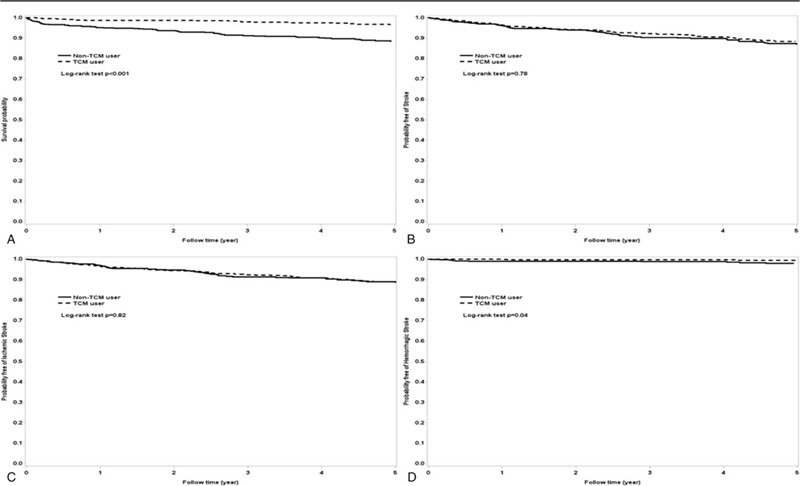
Both ischemic heart disease (IHD) and stroke are major causes of death worldwide. We investigated the effects of combined Traditional Chinese medicine (TCM) and western medicine (WM) on stroke risk in IHD patients.Taiwanese patients with IHD were enrolled in the TCM study during their outpatient visit. Stroke events after TCM or non-TCM treatment were examined. Chi-square tests and Student t-tests were used to examine differences between patients using and not using TCM. The Cox proportional hazards regression model was used to estimate hazard ratios (HRs). Sex, age, and comorbidities were included in a multivariable Cox model to estimate the adjusted HR (aHR). The survival probability and the probability free of stroke were calculated by the Kaplan-Meier method.There were 733 IHD patients using TCM and 733 using non-TCM treatment, with the same proportion of sex and age within each cohort. Using single Chinese herb such as Dan Shen, San Qi, or Chuan Xiong would have lower stroke events and lower aHR than non-TCM in IHD patients. There was 0.3-fold lower stroke risk in IHD patients with combination TCM and non-TCM treatment (95% CI = 0.11-0.84, P = .02). Moreover, the survival rate was higher (P < .001) and the incidence of hemorrhagic stroke was significantly lower (P = .04) in IHD patients with TCM treatment.IHD patients using combined TCM and WM had a higher survival rate and lower risk of new onset stroke, especially hemorrhagic stroke than those who did not use TCM treatment.
缺血性心脏病(IHD)和中风都是全球主要的死亡原因。我们研究了中西医结合治疗对IHD患者中风风险的影响。台湾IHD患者在门诊就诊时被纳入中医研究。对接受中医或非中医治疗后的中风事件进行了检查。采用卡方检验和学生t检验来检验使用和未使用中医的患者之间的差异。采用Cox比例风险回归模型来估计风险比(HRs)。性别、年龄和合并症被纳入多变量Cox模型以估计调整后的HR(aHR)。采用Kaplan-Meier方法计算生存概率和无中风概率。
有733例IHD患者使用中医治疗,733例使用非中医治疗,每个队列中性别和年龄比例相同。在IHD患者中,使用丹参、三七或川芎等单一中药的中风事件和aHR低于非中医治疗。IHD患者采用中西医结合治疗的中风风险降低0.3倍(95%CI = 0.11 - 0.84,P = 0.02)。此外,接受中医治疗的IHD患者生存率更高(P < 0.001),出血性中风的发生率显著更低(P = 0.04)。
与未使用中医治疗的患者相比,使用中西医结合治疗的IHD患者生存率更高,新发中风尤其是出血性中风的风险更低。