Olar Rodica, Badea Mihaela, Maxim Cătălin, Grumezescu Alexandru Mihai, Bleotu Coralia, Măruţescu Luminiţa, Chifiriuc Mariana Carmen
Department of Inorganic Chemistry, Faculty of Chemistry, University of Bucharest, 90-92 Panduri Str., 050663 Bucharest, Romania.
Department of Science and Engineering of Oxidic Materials and Nanomaterials, Faculty of Applied Chemistry and Materials Science, University Politehnica of Bucharest, 1-7 Polizu Street, 011061 Bucharest, Romania.
Materials (Basel). 2020 Oct 17;13(20):4640. doi: 10.3390/ma13204640.
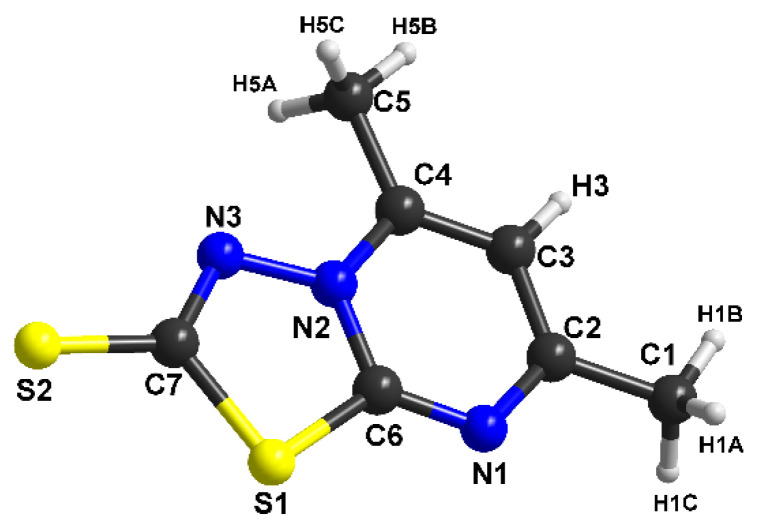
The derivatives 5,7-dimethyl[1,3,4]thiadiazolo[3,2-]pyrimidin-4-ium-2-thiolate () and 7-methyl-5-phenyl[1,3,4]thiadiazolo[3,2-]pyrimidin-4-ium-2-thiolate () were fully characterized by single-crystal X-ray diffraction. Their supramolecular structure is built through both π-π stacking and C=S-π interactions for both compounds. The embedment of the tested compounds into FeO@C core-shell nanocoatings increased the protection degree against biofilms on the catheter surface, suggesting that these bioactive nanocoatings could be further developed as non-cytotoxic strategies for fighting biofilm-associated fungal infections.
衍生物5,7-二甲基[1,3,4]噻二唑并[3,2 - ]嘧啶-4-鎓-2-硫醇盐()和7-甲基-5-苯基[1,3,4]噻二唑并[3,2 - ]嘧啶-4-鎓-2-硫醇盐()通过单晶X射线衍射进行了全面表征。两种化合物的超分子结构均通过π-π堆积和C = S-π相互作用构建。将测试化合物嵌入FeO@C核壳纳米涂层中提高了对导管表面生物膜的保护程度,这表明这些生物活性纳米涂层可进一步开发为对抗生物膜相关真菌感染的无细胞毒性策略。