Division of Nephrology and Hypertension, University of North Carolina, Chapel Hill, North Carolina.
Department of Renal Medicine, Cork University Hospital Group, Cork, Ireland.
Clin J Am Soc Nephrol. 2020 Dec 7;15(12):1749-1761. doi: 10.2215/CJN.05900420. Epub 2020 Oct 20.
Infections contribute to patient morbidity and mortality in glomerular disease. We sought to describe the incidence of, and identify risk factors for, infection-related acute care events among Cure Glomerulonephropathy Network (CureGN) study participants.
DESIGN, SETTING, PARTICIPANTS, & MEASUREMENTS: CureGN is a prospective, multicenter, cohort study of children and adults with biopsy sample-proven minimal change disease, FSGS, membranous nephropathy, or IgA nephropathy/vasculitis. Risk factors for time to first infection-related acute care events (hospitalization or emergency department visit) were identified using multivariable Cox proportional hazards regression.
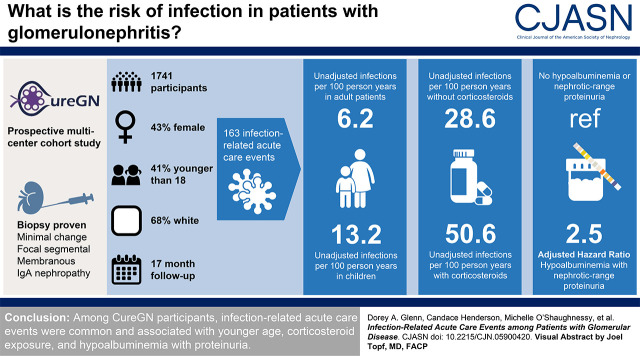
Of 1741 participants (43% female, 41% <18 years, 68% White), 163 (9%) experienced infection-related acute care events over a median follow-up of 17 months (interquartile range, 9-26 months). Unadjusted incidence rates of infection-related acute care events were 13.2 and 6.2 events per 100 person-years among pediatric and adult participants, respectively. Among participants with versus without corticosteroid exposure at enrollment, unadjusted incidence rates were 50.6 and 28.6 per 100 person-years, respectively, during the first year of follow-up (adjusted hazard ratio for time to first infection, 1.31; 95% CI, 0.89 to 1.93), and 4.1 and 1.1 per 100 person-years, respectively, after 1 year of follow-up (hazard ratio, 2.99; 95% CI, 1.54 to 5.79). Hypoalbuminemia combined with nephrotic-range proteinuria (serum albumin ≤2.5 g/dl and urinary protein-creatinine ratio >3.5 mg/mg), compared with serum albumin >2.5 g/dl and urinary protein-creatinine ratio ≤3.5 mg/mg, was associated with higher risk of time to first infection (adjusted hazard ratio, 2.49; 95% CI, 1.51 to 4.12).
Among CureGN participants, infection-related acute care events were common and associated with younger age, corticosteroid exposure, and hypoalbuminemia with proteinuria.
感染是导致肾小球疾病患者发病率和死亡率增加的原因。本研究旨在描述 Cure 肾小球疾病网络(CureGN)研究参与者中与感染相关的急性医疗事件的发生率,并确定其相关的危险因素。
CureGN 是一项前瞻性、多中心、队列研究,纳入了经活检证实为微小病变性肾病、局灶节段性肾小球硬化症、膜性肾病或 IgA 肾病/血管炎的儿童和成人患者。使用多变量 Cox 比例风险回归分析确定首次与感染相关的急性医疗事件(住院或急诊就诊)的时间风险因素。
在 1741 名参与者中(43%为女性,41%<18 岁,68%为白人),中位随访 17 个月(9-26 个月)期间,有 163 名(9%)经历了与感染相关的急性医疗事件。未校正的感染相关急性医疗事件发生率分别为儿童和成年参与者的 13.2 和 6.2 例/100 人年。在入组时接受与未接受皮质类固醇治疗的参与者中,在随访的第一年,未校正的感染相关急性医疗事件发生率分别为 50.6 和 28.6 例/100 人年(校正后的感染时间风险比,1.31;95%CI,0.89 至 1.93),在随访 1 年后,分别为 4.1 和 1.1 例/100 人年(风险比,2.99;95%CI,1.54 至 5.79)。与血清白蛋白>2.5 g/dl 且尿蛋白肌酐比≤3.5 mg/mg 相比,血清白蛋白≤2.5 g/dl 且尿蛋白肌酐比>3.5 mg/mg 与首次感染时间风险增加相关(校正后的风险比,2.49;95%CI,1.51 至 4.12)。
在 CureGN 参与者中,与感染相关的急性医疗事件很常见,与年龄较小、皮质类固醇暴露以及白蛋白减少伴蛋白尿相关。