
与脯氨酸类似物 L-氮杂环丁烷-2-羧酸的化学-遗传相互作用。
Chemical-Genetic Interactions with the Proline Analog L-Azetidine-2-Carboxylic Acid in .
机构信息
Department of Biochemistry, The University of Western Ontario, London, Canada
Department of Biochemistry, The University of Western Ontario, London, Canada.
出版信息
G3 (Bethesda). 2020 Dec 3;10(12):4335-4345. doi: 10.1534/g3.120.401876.
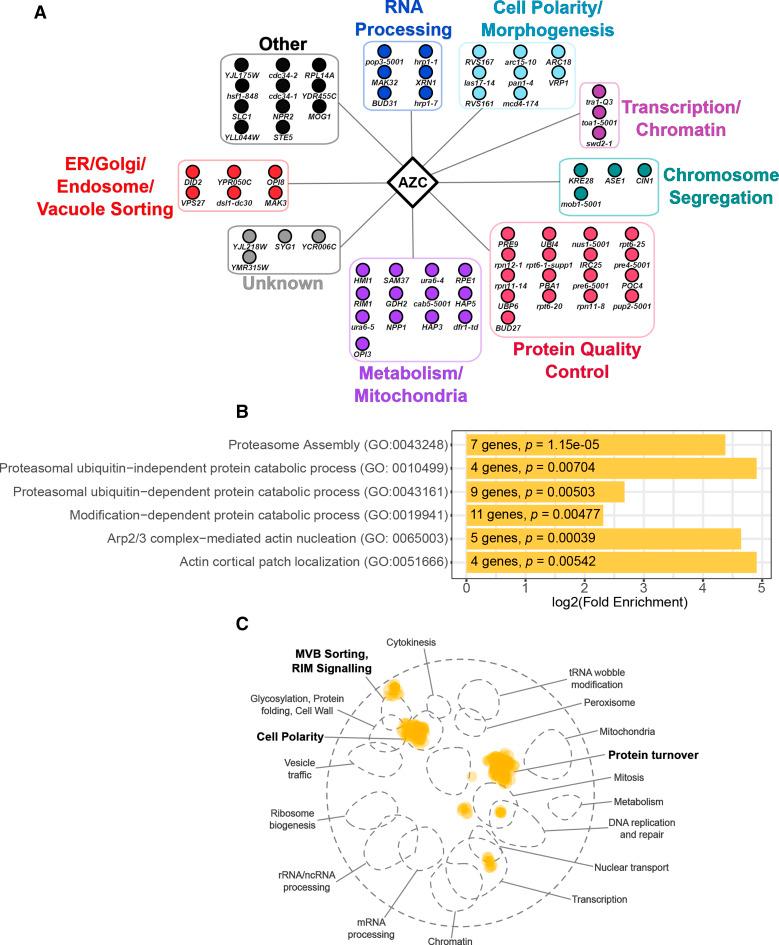
Non-proteinogenic amino acids, such as the proline analog L-azetidine-2-carboxylic acid (AZC), are detrimental to cells because they are mis-incorporated into proteins and lead to proteotoxic stress. Our goal was to identify genes that show chemical-genetic interactions with AZC in and thus also potentially define the pathways cells use to cope with amino acid mis-incorporation. Screening the yeast deletion and temperature sensitive collections, we found 72 alleles with negative chemical-genetic interactions with AZC treatment and 12 alleles that suppress AZC toxicity. Many of the genes with negative chemical-genetic interactions are involved in protein quality control pathways through the proteasome. Genes involved in actin cytoskeleton organization and endocytosis also had negative chemical-genetic interactions with AZC. Related to this, the number of actin patches per cell increases upon AZC treatment. Many of the same cellular processes were identified to have interactions with proteotoxic stress caused by two other amino acid analogs, canavanine and thialysine, or a mistranslating tRNA variant that mis-incorporates serine at proline codons. Alleles that suppressed AZC-induced toxicity functioned through the amino acid sensing TOR pathway or controlled amino acid permeases required for AZC uptake. Further suggesting the potential of genetic changes to influence the cellular response to proteotoxic stress, overexpressing many of the genes that had a negative chemical-genetic interaction with AZC suppressed AZC toxicity.
非蛋白氨基酸,如脯氨酸类似物 L-氮杂环丁烷-2-羧酸(AZC),对细胞是有害的,因为它们会错误地掺入蛋白质中,导致蛋白毒性应激。我们的目标是鉴定与 中的 AZC 表现出化学遗传相互作用的基因,从而也有可能定义细胞用于应对氨基酸错误掺入的途径。通过筛选酵母缺失和温度敏感的集合,我们发现了 72 个与 AZC 处理呈负化学遗传相互作用的等位基因和 12 个抑制 AZC 毒性的等位基因。许多与负化学遗传相互作用的基因都参与通过蛋白酶体的蛋白质质量控制途径。参与肌动蛋白细胞骨架组织和胞吞作用的基因也与 AZC 呈负化学遗传相互作用。与此相关,AZC 处理后每个细胞中的肌动蛋白斑数量增加。许多相同的细胞过程被鉴定与两种其他氨基酸类似物,即-canavanine 和 thialysine,或误将丝氨酸掺入脯氨酸密码子的错译 tRNA 变体引起的蛋白毒性应激具有相互作用。抑制 AZC 诱导毒性的等位基因通过氨基酸感应 TOR 途径或控制 AZC 摄取所需的氨基酸渗透酶发挥作用。进一步表明遗传变化有可能影响细胞对蛋白毒性应激的反应,过表达与 AZC 呈负化学遗传相互作用的许多基因可抑制 AZC 毒性。




 Zotero 插件