Hong Kyung U, Doll Mark A, Lykoudi Angeliki, Salazar-González Raúl A, Habil Mariam R, Walls Kennedy M, Bakr Alaa F, Ghare Smita S, Barve Shirish S, Arteel Gavin E, Hein David W
Department of Pharmacology & Toxicology, Center for Hepatobiology & Toxicology, University of Louisville School of Medicine, Louisville, KY, USA.
Departments of Medicine and Pharmacology & Toxicology, Center for Hepatobiology & Toxicology, University of Louisville School of Medicine, Louisville, KY, USA.
Toxicol Rep. 2020 Sep 28;7:1319-1330. doi: 10.1016/j.toxrep.2020.09.011. eCollection 2020.
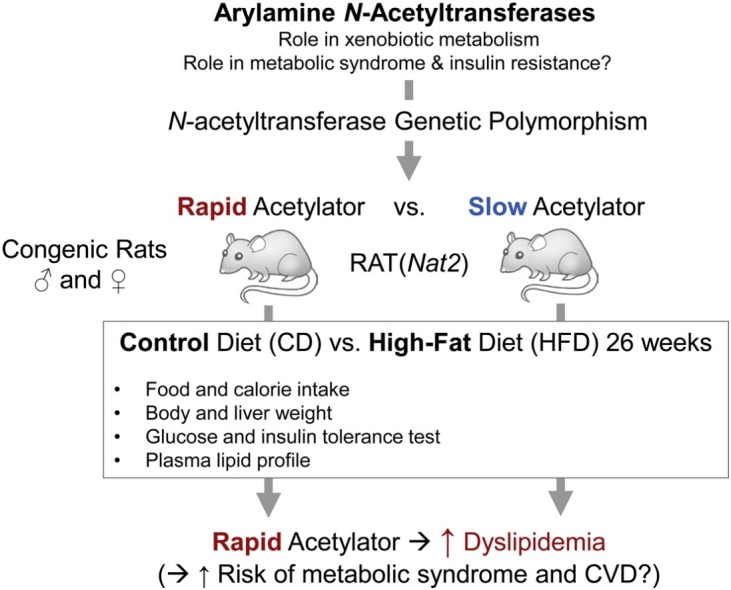
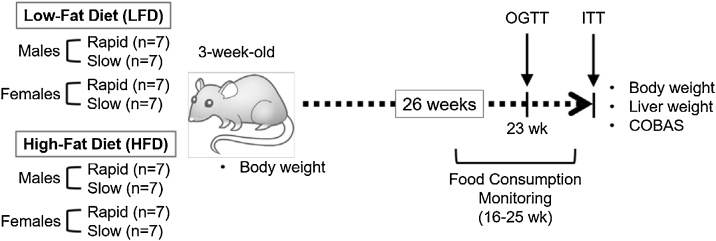
Recent reports suggest that arylamine -acetyltransferases (NAT1 and/or NAT2) serve important roles in regulation of energy utility and insulin sensitivity. We investigated the interaction between diet (control vs. high-fat diet) and acetylator phenotype (rapid vs. slow) using previously established congenic rat lines (in F344 background) that exhibit rapid or slow Nat2 (orthologous to human NAT1) acetylator genotypes. Male and female rats of each genotype were fed control or high-fat (Western-style) diet for 26 weeks. We then examined diet- and acetylator genotype-dependent changes in body and liver weights, systemic glucose tolerance, insulin sensitivity, and plasma lipid profile. Male and female rats on the high fat diet weighed approximately 10% more than rats on the control diet and the percentage liver to body weight was consistently higher in rapid than slow acetylator rats. Rapid acetylator rats were more prone to develop dyslipidemia overall (i.e., higher triglyceride; higher LDL; and lower HDL), compared to slow acetylator rats. Total cholesterol (TC)-to-HDL ratios were significantly higher and HDL-to-LDL ratios were significantly lower in rapid acetylator rats. Our data suggest that rats with rapid systemic Nat2 (NAT1 in humans) genotype exhibited higher dyslipidemia conferring risk for metabolic syndrome and cardiovascular dysfunction.
最近的报告表明,芳基胺 - 乙酰转移酶(NAT1和/或NAT2)在能量利用调节和胰岛素敏感性方面发挥着重要作用。我们使用先前建立的同基因大鼠品系(F344背景)研究了饮食(对照饮食与高脂饮食)与乙酰化表型(快速与缓慢)之间的相互作用,这些品系表现出快速或缓慢的Nat2(与人类NAT1同源)乙酰化基因型。每种基因型的雄性和雌性大鼠分别喂食对照饮食或高脂(西式)饮食26周。然后,我们检查了饮食和乙酰化基因型依赖性的体重、肝脏重量、全身葡萄糖耐量、胰岛素敏感性和血浆脂质谱的变化。高脂饮食的雄性和雌性大鼠比对照饮食的大鼠体重约重10%,快速乙酰化大鼠的肝脏与体重百分比始终高于缓慢乙酰化大鼠。与缓慢乙酰化大鼠相比,快速乙酰化大鼠总体上更容易出现血脂异常(即甘油三酯更高、低密度脂蛋白更高、高密度脂蛋白更低)。快速乙酰化大鼠的总胆固醇(TC)与高密度脂蛋白(HDL)之比显著更高,高密度脂蛋白与低密度脂蛋白之比显著更低。我们的数据表明,具有快速全身Nat2(人类NAT1)基因型的大鼠表现出更高的血脂异常,增加了代谢综合征和心血管功能障碍的风险。