Wolf Denise M, Yau Christina, Wulfkuhle Julia, Brown-Swigart Lamorna, Gallagher Rosa I, Magbanua Mark Jesus M, O'Grady Nick, Hirst Gillian, Asare Smita, Tripathy Debu, Berry Don, Esserman Laura, Chien A Jo, Petricoin Emanuel F, van 't Veer Laura
University of California, San Francisco, San Francisco, CA USA.
George Mason University, Fairfax, VA USA.
NPJ Breast Cancer. 2020 Oct 2;6:48. doi: 10.1038/s41523-020-00189-2. eCollection 2020.
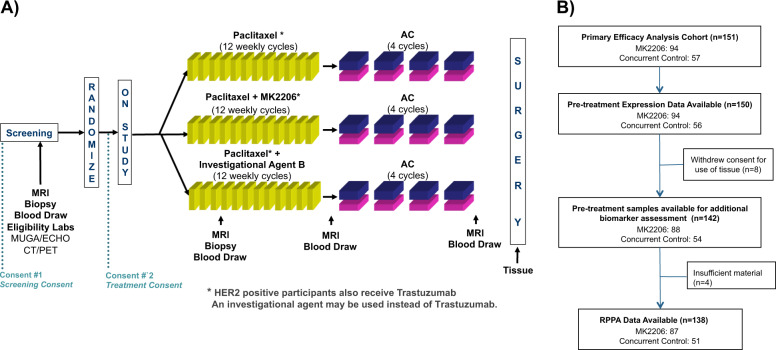
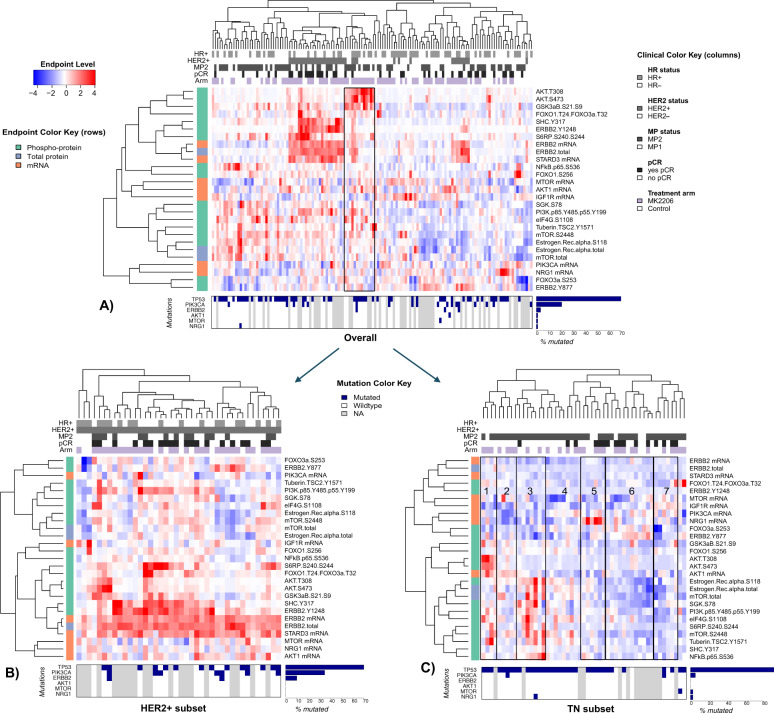
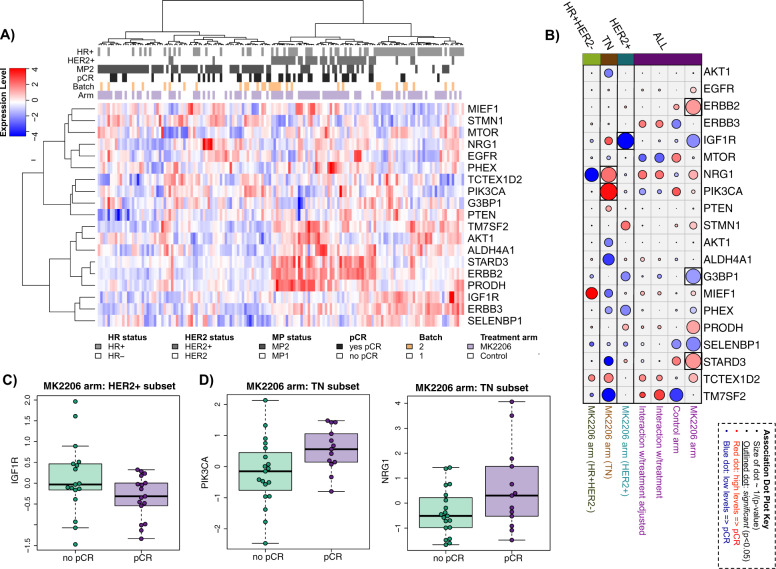
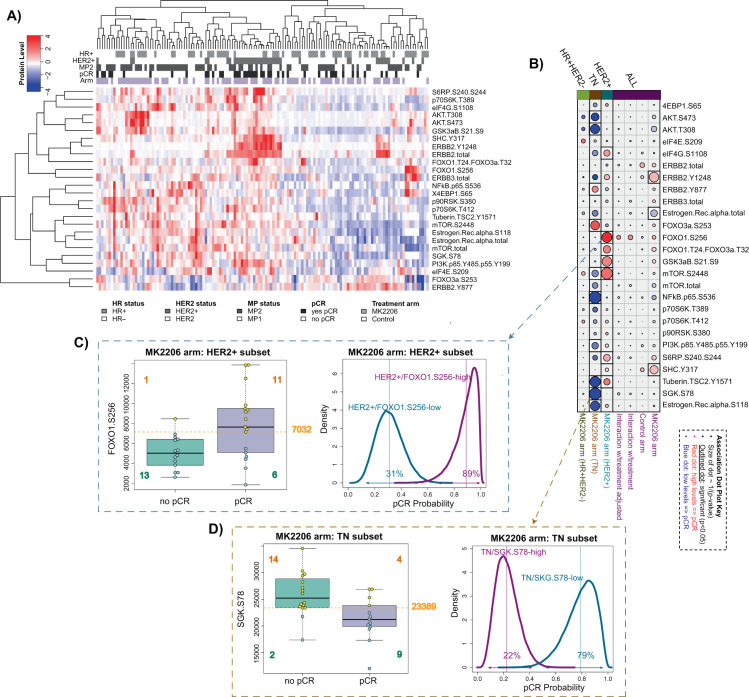
The AKT inhibitor MK2206 (M) was evaluated in I-SPY 2 and graduated in the HER2+, HR-, and HR- HER2+ signatures. We hypothesized that AKT signaling axis proteins/genes may specifically predict response to M and tested 26 phospho-proteins and 10 genes involved in AKT-mTOR-HER signaling; in addition, we tested 9 genes from a previous study in the metastatic setting. One hundred and fifty patients had gene expression data from pretreatment biopsies available for analysis (M: 94, control: 56) and 138 had protein data (M: 87, control: 51). Logistic modeling was used to assess biomarker performance in pre-specified analysis. In general, phospho-protein biomarkers of activity in the AKT-mTOR-HER pathway appeared more predictive of response to M than gene expression or total protein biomarkers in the same pathway; however, the nature of the predictive biomarkers differed in the HER2+ and TN groups. In the HER2+ subset, patients achieving a pCR in M had higher levels of multiple AKT kinase substrate phospho-proteins (e.g., pmTOR, pTSC2). In contrast, in the TN subset responding patients had lower levels of AKT pathway phospho-proteins, such as pAKT, pmTOR, and pTSC2. Pathway mutations did not appear to account for these associations. Additional exploratory whole-transcriptome analysis revealed immune signaling as strongly associated with response to M in the HER2+ subset. While our sample size is small, these results suggest that the measurement of particular AKT kinase substrate phospho-proteins could be predictive of MK2206 efficacy in both HER2+ and TN tumors and that immune signaling may play a role in response in HER2+ patients.
在I-SPY 2试验中对AKT抑制剂MK2206(M)进行了评估,并在HER2阳性、激素受体阴性(HR-)和HR- HER2+特征中取得进展。我们假设AKT信号轴蛋白/基因可能特异性预测对M的反应,并测试了26种磷酸化蛋白和10个参与AKT-mTOR-HER信号传导的基因;此外,我们还测试了先前在转移背景研究中的9个基因。150例患者有预处理活检的基因表达数据可供分析(M组:94例,对照组:56例),138例有蛋白数据(M组:87例,对照组:51例)。在预先指定的分析中使用逻辑建模来评估生物标志物的性能。总体而言,AKT-mTOR-HER途径中活性的磷酸化蛋白生物标志物似乎比同一途径中的基因表达或总蛋白生物标志物更能预测对M的反应;然而,HER2+和三阴(TN)组中预测生物标志物的性质不同。在HER2+亚组中,在M治疗中达到病理完全缓解(pCR)的患者多种AKT激酶底物磷酸化蛋白水平较高(例如,pmTOR、pTSC2)。相反,在TN亚组中,有反应的患者AKT途径磷酸化蛋白水平较低,如pAKT、pmTOR和pTSC2。途径突变似乎不能解释这些关联。额外的探索性全转录组分析显示,免疫信号传导与HER2+亚组中对M的反应密切相关。虽然我们的样本量较小,但这些结果表明,特定AKT激酶底物磷酸化蛋白的检测可能预测MK2206在HER2+和TN肿瘤中的疗效,并且免疫信号传导可能在HER2+患者的反应中起作用。