Pereira S I A, Abreu D, Moreira H, Vega A, Castro P M L
Universidade Católica Portuguesa, CBQF - Centro de Biotecnologia e Química Fina - Laboratório Associado, Escola Superior de Biotecnologia, Rua Diogo Botelho 1327, 4169-005 Porto, Portugal.
Heliyon. 2020 Oct 7;6(10):e05106. doi: 10.1016/j.heliyon.2020.e05106. eCollection 2020 Oct.
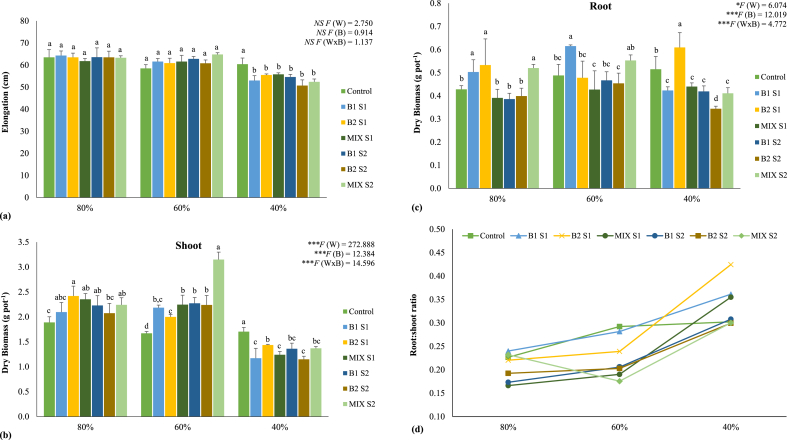
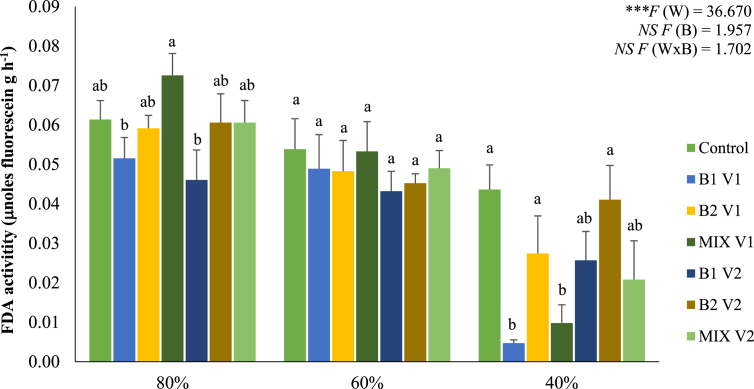
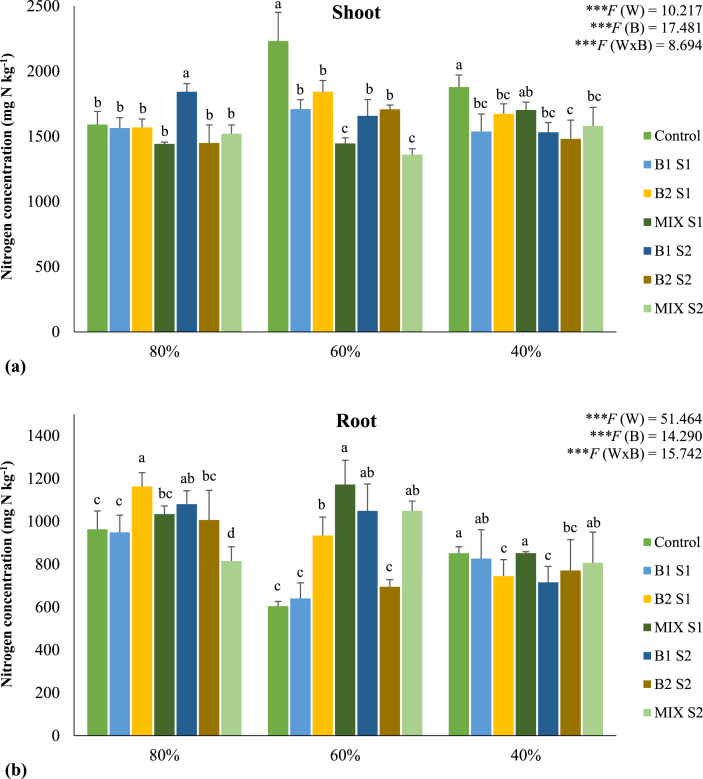
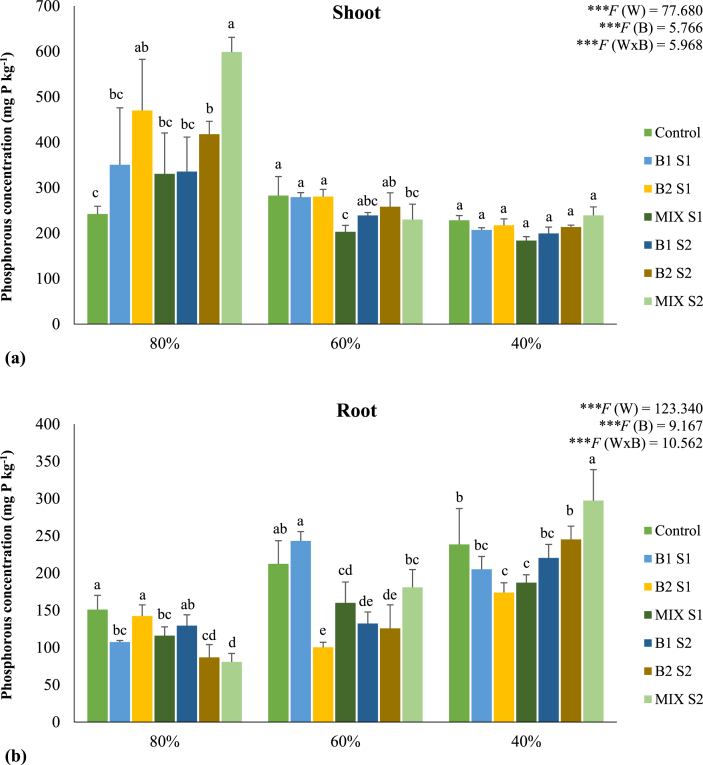
Drought is one of the major abiotic stresses that affects crop yield worldwide. An eco-friendly tool that can broadly improve plants' tolerance to water stress is bioionocula comprising plant growth-promoting rhizobacteria (PGPR). In this study, the effect of two PGPR 1C2 (B1) and S3X (B2), singly and/or co-inoculated at two inocula sizes (S1 - 3 × 10 cells g dry weight (dw) soil and S2 - 3 × 10 cells g dw soil), on growth, nutrient uptake, and use efficiency was assessed in maize ( L.) plants grown at three levels of irrigation (80% of water holding capacity (WHC) - well-watered, 60% of WHC - moderate water deficit stress, and 40% of WHC - severe water deficit stress) in a greenhouse experiment. The impact of water deficit and bioinoculants on soil microbial activity (fluorescein diacetate hydrolysis) was also evaluated. Moderate and severe water deficit negatively affected soil microbial activity, as well as, maize growth, by reducing plants' shoot biomass and increasing root/shoot ratio at 60 and 40% of WHC. Bioinoculants mitigated the negative effects on shoot biomass, especially when PGPR were co-inoculated, increasing up to 89% the aerial biomass of plants exposed to moderate water deficit. Bioinoculation also increased nitrogen (N) and phosphorous (P) use efficiency, which may have led to higher maize growth under water deficit conditions. The size of the inocula applied had marginal influence on biometric and nutrient parameters, although the higher concentration of the mixture of PGPR was the most effective in improving shoot biomass under moderate water deficit. This study shows that rhizobacterial strains are able to increase nutrient use efficiency and to alleviate water stress effects in crops with high water demands and have potential applications to keep up with productivity in water stress scenarios.
干旱是影响全球作物产量的主要非生物胁迫之一。一种能够广泛提高植物对水分胁迫耐受性的环保工具是包含促植物生长根际细菌(PGPR)的生物菌剂。在本研究中,在温室试验中,评估了两种PGPR菌株1C2(B1)和S3X(B2),以两种接种量(S1 - 3×10⁸个细胞/克干重土壤和S2 - 3×10⁹个细胞/克干重土壤)单独和/或共同接种,对生长在三种灌溉水平(田间持水量的80% - 充分浇水、田间持水量的60% - 中度水分亏缺胁迫、田间持水量的40% - 重度水分亏缺胁迫)下的玉米(Zea mays L.)植株的生长、养分吸收和利用效率的影响。还评估了水分亏缺和生物菌剂对土壤微生物活性(荧光素二乙酸酯水解)的影响。中度和重度水分亏缺通过降低植株地上部生物量并在田间持水量的60%和40%时增加根冠比,对土壤微生物活性以及玉米生长产生负面影响。生物菌剂减轻了对地上部生物量的负面影响,特别是当PGPR共同接种时,使遭受中度水分亏缺的植株地上部生物量增加了89%。生物接种还提高了氮(N)和磷(P)的利用效率,这可能导致在水分亏缺条件下玉米生长更好。接种量的大小对生物特征和养分参数的影响很小,尽管PGPR混合物的较高浓度在改善中度水分亏缺下的地上部生物量方面最有效。本研究表明,根际细菌菌株能够提高养分利用效率并减轻对需水量大的作物的水分胁迫影响,并且在水分胁迫情况下保持生产力方面具有潜在应用价值。