Department of Pediatrics, Hiroshima University Graduate School of Biomedical and Health Science, 1-2-3 Kasumi, Minami-Ku, Hiroshima-Shi, Hiroshima, 734-8551, Japan.
Department of Pediatrics, Graduate school of Medicine, Gifu University, Gifu, Japan.
J Clin Immunol. 2021 Jan;41(1):125-135. doi: 10.1007/s10875-020-00885-5. Epub 2020 Oct 20.
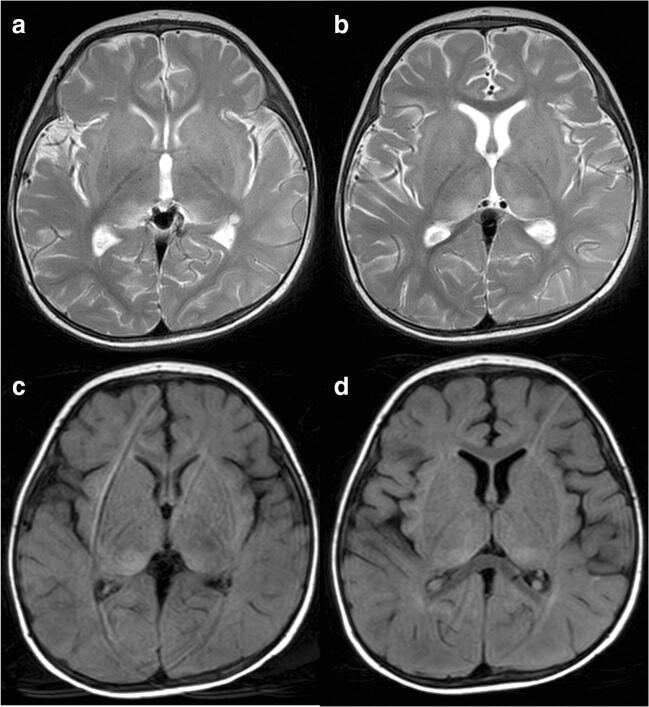
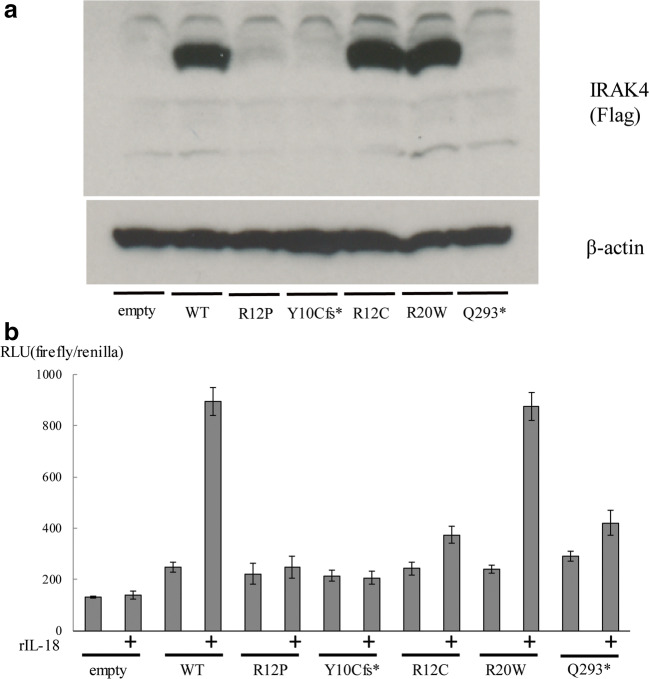
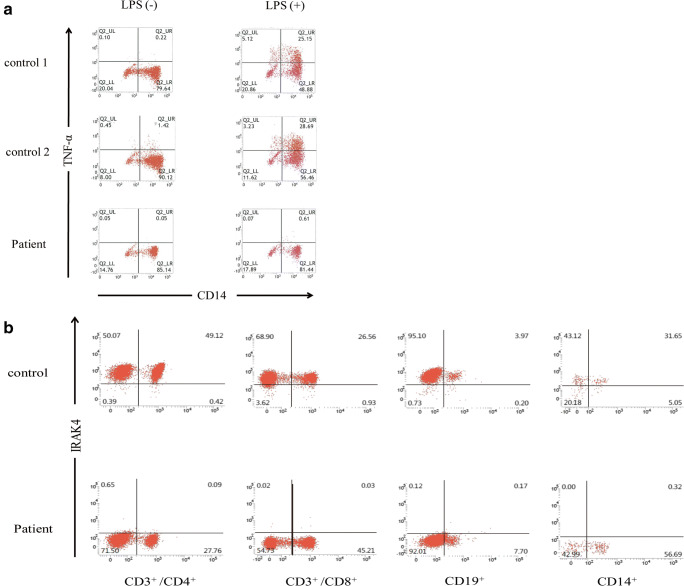
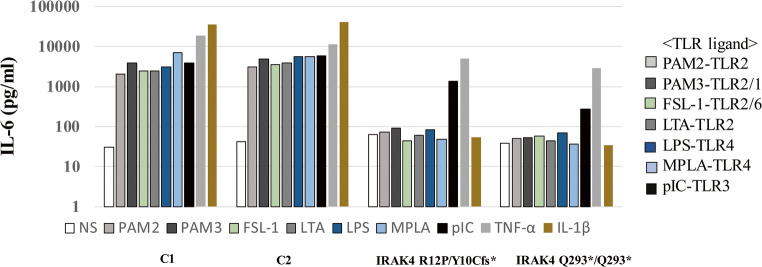
IRAK4 deficiency is an inborn error of immunity predisposing patients to invasive pyogenic infections. Currently, there is no established simple assay that enables precise characterization of IRAK4 mutant alleles in isolation. Anti-N-methyl-D-aspartate receptor (NMDAR) encephalitis is an autoimmune condition that is characterized by psychiatric symptoms, involuntary movement, seizures, autonomic dysfunction, and central hypoventilation. It typically occurs in adult females associated with tumors. Only a few infantile cases with anti-NMDAR encephalitis have been so far reported. We identified a 10-month-old boy with IRAK4 deficiency presenting with anti-NMDAR encephalitis and human herpes virus 6 (HHV6) reactivation. The diagnosis of IRAK4 deficiency was confirmed by the identification of compound heterozygous mutations c.29_30delAT (p.Y10Cfs*9) and c.35G>C (p.R12P) in the IRAK4 gene, low levels of IRAK4 protein expression in peripheral blood, and defective fibroblastic cell responses to TLR and IL-1 (TIR) agonist. We established a novel NF-κB reporter assay using IRAK4-null HEK293T, which enabled the precise evaluation of IRAK4 mutations. Using this system, we confirmed that both novel mutations identified in the patient are deleterious. Our study provides a new simple and reliable method to analyze IRAK4 mutant alleles. It also suggests the possible link between inborn errors of immunity and early onset anti-NMDAR encephalitis.
IRAK4 缺陷是一种先天性免疫缺陷病,使患者易患侵袭性化脓性感染。目前,尚无能够单独精确鉴定 IRAK4 突变等位基因的既定简单检测方法。抗 N-甲基-D-天冬氨酸受体(NMDAR)脑炎是一种自身免疫性疾病,其特征为精神症状、不自主运动、癫痫发作、自主神经功能障碍和中枢性通气不足。它通常发生在与肿瘤相关的成年女性中。迄今为止,仅有少数婴儿抗 NMDAR 脑炎病例被报道。我们鉴定了一名 10 月龄的 IRAK4 缺陷男婴,其表现为抗 NMDAR 脑炎和人类疱疹病毒 6(HHV6)再激活。通过鉴定 IRAK4 基因中的复合杂合突变 c.29_30delAT(p.Y10Cfs*9)和 c.35G>C(p.R12P)、外周血中 IRAK4 蛋白表达水平降低以及成纤维细胞对 TLR 和 IL-1(TIR)激动剂的反应缺陷,确定了 IRAK4 缺陷的诊断。我们使用 IRAK4 缺陷型 HEK293T 细胞建立了一种新的 NF-κB 报告基因检测方法,该方法能够精确评估 IRAK4 突变。使用该系统,我们证实了患者中鉴定出的两种新突变均具有致病变异。我们的研究提供了一种新的简单可靠的方法来分析 IRAK4 突变等位基因。它还提示了先天性免疫缺陷与早发性抗 NMDAR 脑炎之间的可能联系。