Department of Neurology, West China Hospital, Sichuan University, Chengdu, China.
Department of Laboratory Medicine, West China Hospital of Sichuan University, Chengdu, China.
Front Immunol. 2022 Apr 22;13:799454. doi: 10.3389/fimmu.2022.799454. eCollection 2022.
This study reported a case of overlapping anti-N-methyl-D-aspartate receptor (NMDAR) encephalitis and myelin oligodendrocyte glycoprotein (MOG) inflammatory demyelinating disease with human herpesviruses 7 (HHV-7) infection.
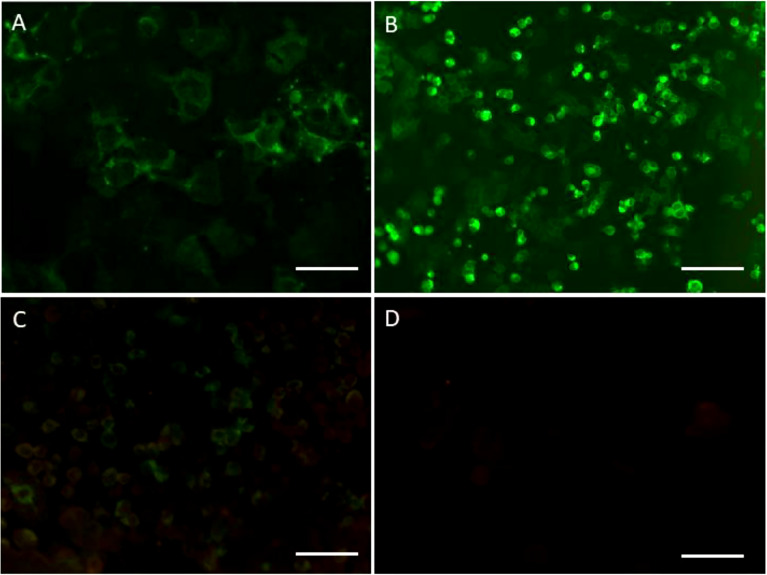
The detailed clinical characteristics, neuroimaging features, and outcomes of the patient were collected. Polymerase chain reaction (PCR), cell-based assay (CBA) and the tissue-based indirect immunofluorescence assay (TBA) were used for diagnosis.
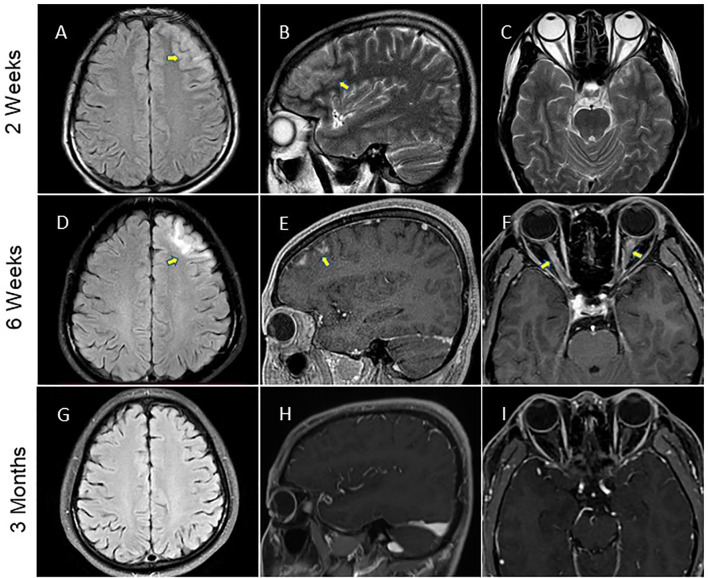
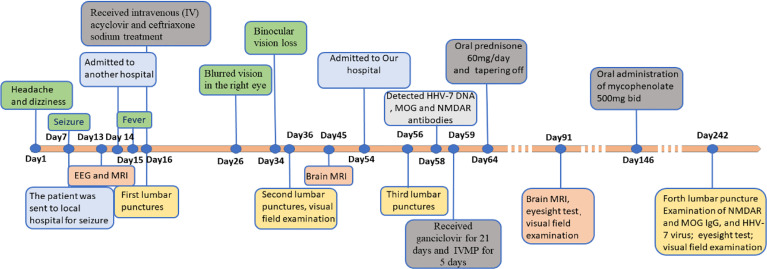
The clinical manifestations included headache, dizziness, fever, optic neuritis, and epileptic-seizures. Brain magnetic resonance imaging (MRI) showed hyperintensities involving the left frontal, orbital gyrus and bilateral optic nerve with substantial contrast enhancement. Moreover, test for HHV-7 DNA by using the next generation sequencing metagenomics and polymerase chain reaction showed positive result in CSF but not in the serum samples. Anti-HHV-7 IgM and IgG antibodies were detected in both the serum and cerebrospinal fluid. NMDAR antibodies (1:10) were found positive in the patient's CSF by a cell-based assay, and MOG antibodies were positive in the serum (1:10) and CSF (1:32). The patient appeared to respond well to immune therapy and it was found that the clinical symptoms including epileptic-seizure as well as headache were relieved and cerebral lesions almost disappeared after the treatment. However, his vision was not completely restored even at the 8-month follow-up, especially the vision in his right eye which was more seriously damaged.
We report a rare case of MOG antibodies and anti-NMDAR encephalitis overlapping syndrome (MNOS) with HHV-7 infection for the first time. The possibility of MNOS needs be considered when optic neuritis occurs in the patients diagnosed with anti-NMDAR encephalitis. Besides, immunotherapy should be initiated as early as possible to improve the treatment outcomes and facilitate complete cure.
本研究报告了一例重叠性抗 N-甲基-D-天冬氨酸受体(NMDAR)脑炎和髓鞘少突胶质细胞糖蛋白(MOG)炎症性脱髓鞘疾病合并人类疱疹病毒 7(HHV-7)感染。
收集患者的详细临床特征、神经影像学特征和结局。采用聚合酶链反应(PCR)、细胞检测(CBA)和组织间接免疫荧光检测(TBA)进行诊断。
临床表现包括头痛、头晕、发热、视神经炎和癫痫发作。脑磁共振成像(MRI)显示左额、眶回和双侧视神经高信号,伴有明显对比增强。此外,采用下一代测序宏基因组学和聚合酶链反应检测脑脊液中 HHV-7 DNA 显示阳性结果,但血清样本未显示阳性。血清和脑脊液中均检测到抗 HHV-7 IgM 和 IgG 抗体。患者的脑脊液通过细胞检测发现 NMDAR 抗体(1:10)阳性,血清和脑脊液中均检测到 MOG 抗体阳性(血清 1:10,脑脊液 1:32)。患者对免疫治疗反应良好,治疗后头痛和癫痫发作等临床症状缓解,脑部病变几乎消失。然而,即使在 8 个月的随访时,他的视力仍未完全恢复,尤其是右眼视力受损更严重。
我们首次报告了一例罕见的 MOG 抗体和抗 NMDAR 脑炎重叠综合征(MNOS)合并 HHV-7 感染。当诊断为抗 NMDAR 脑炎的患者发生视神经炎时,需要考虑 MNOS 的可能性。此外,应尽早开始免疫治疗,以改善治疗结局并促进完全治愈。