Czech Matthew, Demanuele Charmaine, Erb Michael Kelley, Ramos Vesper, Zhang Hao, Ho Bryan, Patel Shyamal
Digital Medicine & Translational Imaging, Early Clinical Development, Pfizer Inc, Cambridge, MA, United States.
Tufts Medical Center, Boston, MA, United States.
JMIR Rehabil Assist Technol. 2020 Oct 21;7(2):e17986. doi: 10.2196/17986.
Measuring free-living gait using wearable devices may offer higher granularity and temporal resolution than the current clinical assessments for patients with Parkinson disease (PD). However, increasing the number of devices worn on the body adds to the patient burden and impacts the compliance.
This study aimed to investigate the impact of reducing the number of wearable devices on the ability to assess gait impairments in patients with PD.
A total of 35 volunteers with PD and 60 healthy volunteers performed a gait task during 2 clinic visits. Participants with PD were assessed in the On and Off medication state using the Movement Disorder Society version of the Unified Parkinson Disease Rating Scale (MDS-UPDRS). Gait features derived from a single lumbar-mounted accelerometer were compared with those derived using 3 and 6 wearable devices for both participants with PD and healthy participants.
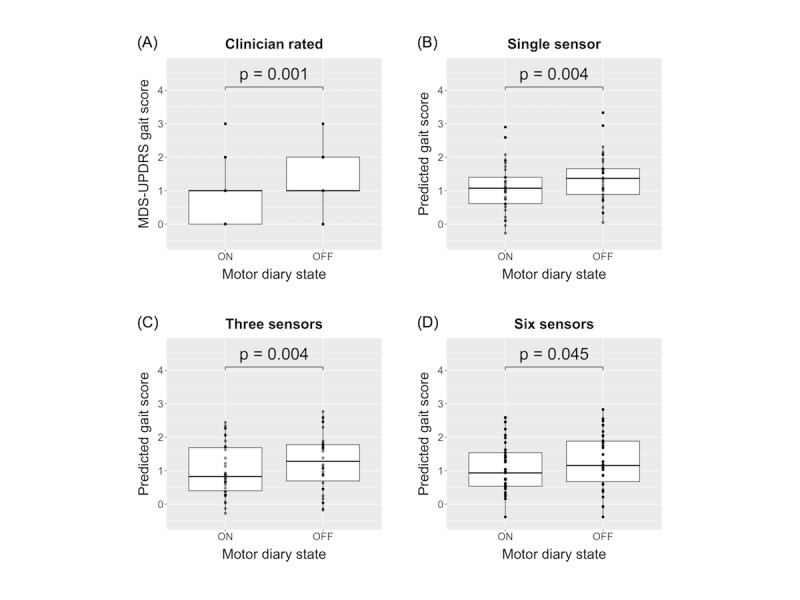
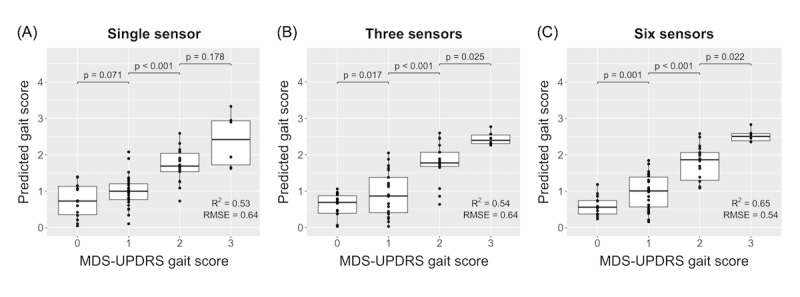
A comparable performance was observed for predicting the MDS-UPDRS gait score using longitudinal mixed-effects model fit with gait features derived from a single (root mean square error [RMSE]=0.64; R2=0.53), 3 (RMSE=0.64; R2=0.54), and 6 devices (RMSE=0.54; R2=0.65). In addition, MDS-UPDRS gait scores predicted using all 3 models differed significantly between On and Off motor states (single device, P=.004; 3 devices, P=.004; 6 devices, P=.045).
We observed a marginal benefit in using multiple devices for assessing gait impairments in patients with PD when compared with gait features derived using a single lumbar-mounted accelerometer. The wearability burden associated with the use of multiple devices may offset gains in accuracy for monitoring gait under free-living conditions.
与目前用于帕金森病(PD)患者的临床评估相比,使用可穿戴设备测量自由生活状态下的步态可能具有更高的粒度和时间分辨率。然而,增加身体上佩戴的设备数量会加重患者负担并影响依从性。
本研究旨在调查减少可穿戴设备数量对评估PD患者步态障碍能力的影响。
35名PD志愿者和60名健康志愿者在2次门诊就诊期间完成了一项步态任务。使用运动障碍协会统一帕金森病评定量表(MDS-UPDRS)对处于服药和未服药状态的PD参与者进行评估。将来自单个腰部佩戴式加速度计的步态特征与使用3个和6个可穿戴设备得出的步态特征进行比较,比较对象包括PD参与者和健康参与者。
使用纵向混合效应模型拟合来自单个(均方根误差[RMSE]=0.64;R2=0.53)、3个(RMSE=0.64;R2=0.54)和6个设备(RMSE=0.54;R2=0.65)得出的步态特征,在预测MDS-UPDRS步态评分方面观察到了相当的表现。此外,使用所有3种模型预测的MDS-UPDRS步态评分在运动开启和关闭状态之间存在显著差异(单个设备,P=0.004;3个设备,P=0.004;6个设备,P=0.045)。
与使用单个腰部佩戴式加速度计得出的步态特征相比,我们观察到使用多个设备评估PD患者步态障碍有一定的益处。与使用多个设备相关的可穿戴负担可能会抵消在自由生活条件下监测步态时准确性的提高。