Department of Bio-Industry Communication and Development, National Taiwan University, Taipei 10617, Taiwan.
Int J Environ Res Public Health. 2020 Oct 19;17(20):7593. doi: 10.3390/ijerph17207593.
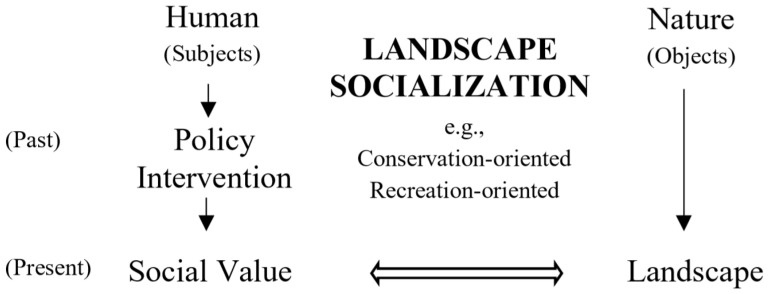
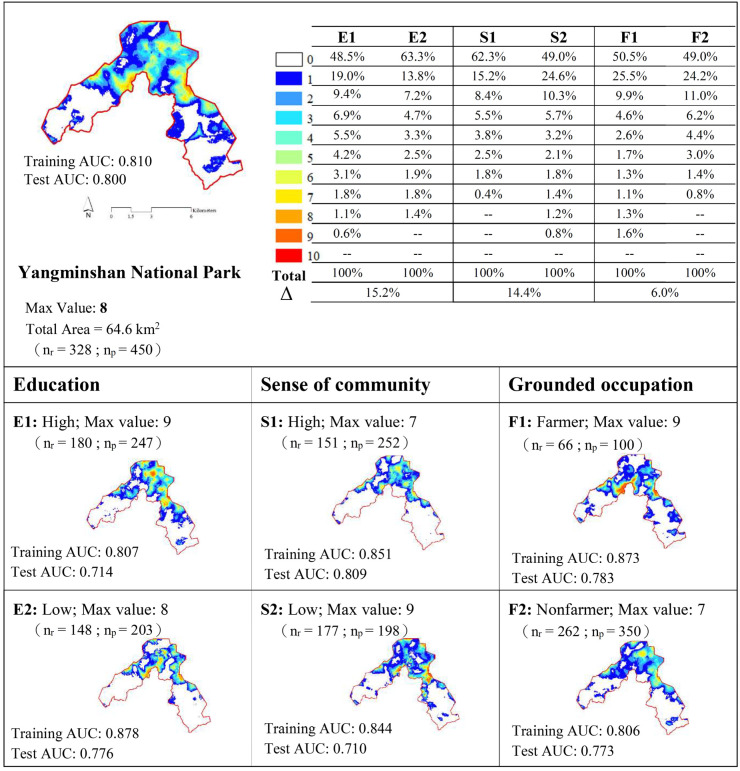
Understanding the landscape socialization underpinning the human-nature relationship is essential because it can contribute to assisting us to reconnect with nature. Reconnecting to nature is increasingly recognized as positively contributing to health and well-being. This study aimed to understand people's connections with nature through landscape socialization under different land use policies. The study assumed that social values, as perceived by residents, facilitates their landscape socialization. Using a questionnaire measuring sense of community and the Social Values for Ecosystem Services application as analytical tools, the study assessed how residents with varying educational attainment, sense of community, and grounded occupation differ in identifying with conservation- and recreation-oriented policy interventions. The results demonstrated the role of landscape socialization in how people connect with nature, and the landscape socialization as a result of long-term policy interventions may exert substantial effects on residents' social values across various spatial scales. The results deepen the general understanding of system leverage points for creating inner connections to nature which can aid sustainability transformation.
理解人与自然关系的景观社会化至关重要,因为它可以帮助我们重新与自然建立联系。重新与自然建立联系已被越来越多地认为对健康和幸福有积极的贡献。本研究旨在通过不同的土地利用政策下的景观社会化来了解人们与自然的联系。该研究假设,居民所感知的社会价值观有助于他们的景观社会化。本研究使用问卷调查社区意识和生态系统服务的社会价值,作为分析工具,评估了具有不同教育程度、社区意识和扎根职业的居民在识别保护和娱乐导向的政策干预方面的差异。结果表明,景观社会化在人们与自然建立联系方面发挥了作用,而且长期政策干预的景观社会化可能会对不同空间尺度上居民的社会价值观产生实质性影响。结果加深了对创造与自然内在联系的系统杠杆点的一般理解,这有助于可持续性转型。