Sessa Lucia, Concilio Simona, Walde Peter, Robinson Tom, Dittrich Petra S, Porta Amalia, Panunzi Barbara, Caruso Ugo, Piotto Stefano
Department of Pharmacy, University of Salerno, 84084 Fisciano (SA), Italy.
Research Centre for Biomaterials BIONAM, University of Salerno, Via Giovanni Paolo II 132, 84084 Fisciano (SA), Italy.
Membranes (Basel). 2020 Oct 19;10(10):294. doi: 10.3390/membranes10100294.
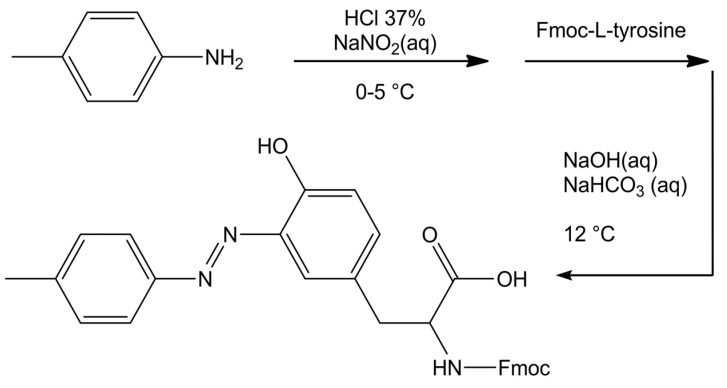
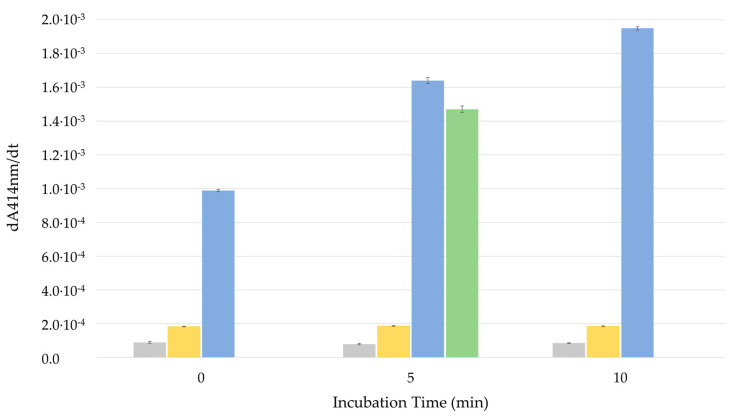
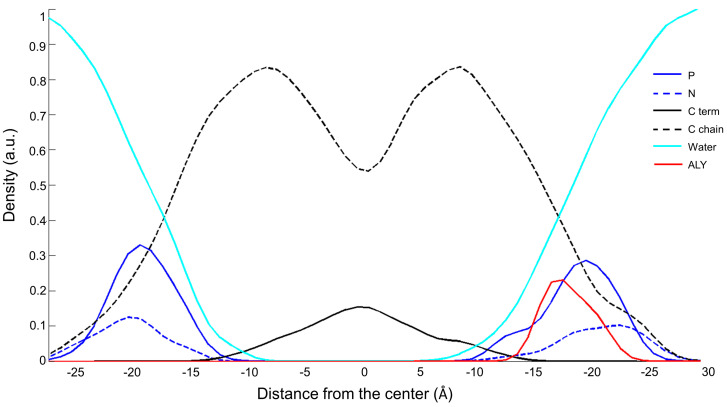
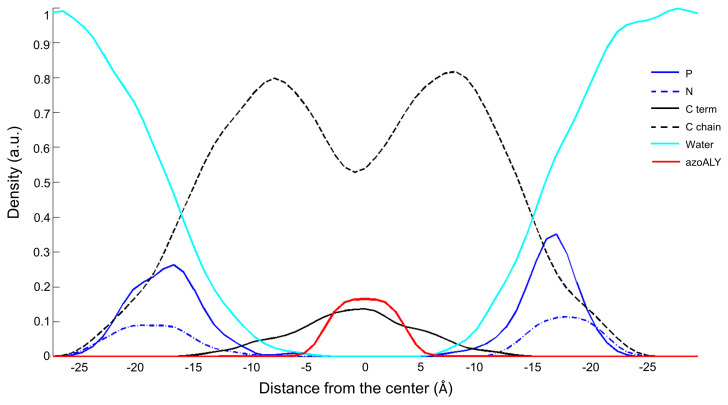
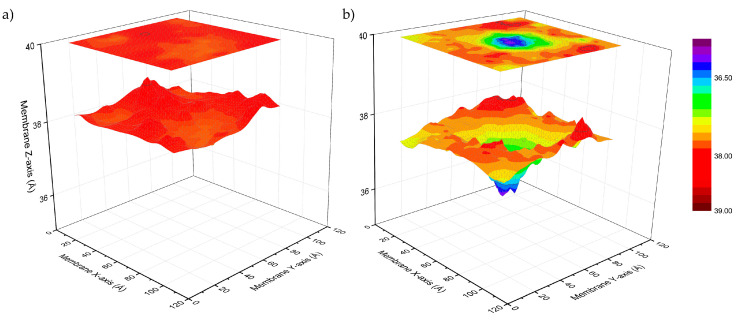
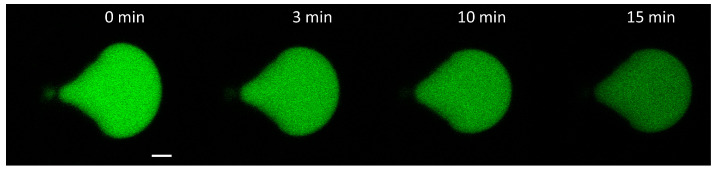
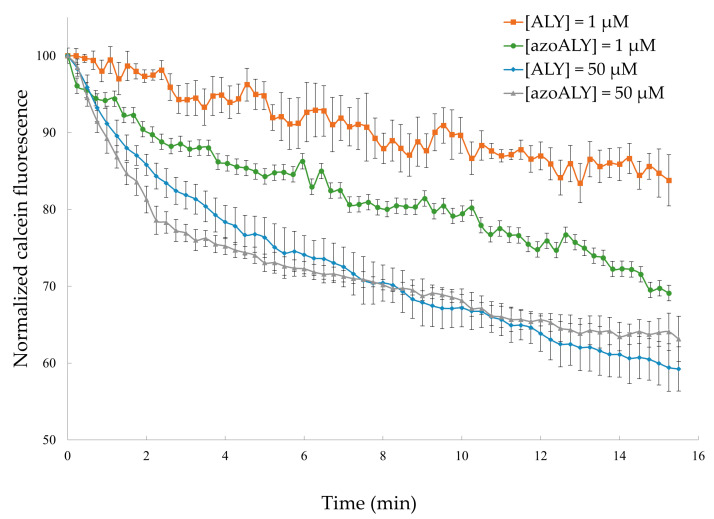
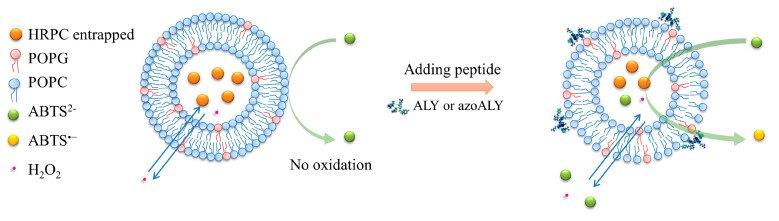
Most linear peptides directly interact with membranes, but the mechanisms of interaction are far from being completely understood. Here, we present an investigation of the membrane interactions of a designed peptide containing a non-natural, synthetic amino acid. We selected a nonapeptide that is reported to interact with phospholipid membranes, ALYLAIRKR, abbreviated as ALY. We designed a modified peptide (azoALY) by substituting the tyrosine residue of ALY with an antimicrobial azobenzene-bearing amino acid. Both of the peptides were examined for their ability to interact with model membranes, assessing the penetration of phospholipid monolayers, and leakage across the bilayer of large unilamellar vesicles (LUVs) and giant unilamellar vesicles (GUVs). The latter was performed in a microfluidic device in order to study the kinetics of leakage of entrapped calcein from the vesicles at the single vesicle level. Both types of vesicles were prepared from a 9:1 (mol/mol) mixture of POPC (1-palmitoyl-2-oleoyl--glycero-3-phosphocholine) and POPG (1-palmitoyl-2-oleoyl--glycero-3-phospho(1'--glycerol). Calcein leakage from the vesicles was more pronounced at a low concentration in the case of azoALY than for ALY. Increased vesicle membrane disturbance in the presence of azoALY was also evident from an enzymatic assay with LUVs and entrapped horseradish peroxidase. Molecular dynamics simulations of ALY and azoALY in an anionic POPC/POPG model bilayer showed that ALY peptide only interacts with the lipid head groups. In contrast, azoALY penetrates the hydrophobic core of the bilayers causing a stronger membrane perturbation as compared to ALY, in qualitative agreement with the experimental results from the leakage assays.
大多数线性肽直接与膜相互作用,但其相互作用机制远未被完全理解。在此,我们展示了对一种含有非天然合成氨基酸的设计肽与膜相互作用的研究。我们选择了一种据报道可与磷脂膜相互作用的九肽ALYLAIRKR,简称为ALY。我们通过用含抗菌偶氮苯的氨基酸取代ALY的酪氨酸残基设计了一种修饰肽(偶氮ALY)。研究了这两种肽与模型膜相互作用的能力,评估了磷脂单层的穿透情况以及大单层囊泡(LUVs)和巨型单层囊泡(GUVs)双层膜的泄漏情况。后者在微流控装置中进行,以便在单个囊泡水平研究被困钙黄绿素从囊泡中泄漏的动力学。两种类型的囊泡均由1 - 棕榈酰 - 2 - 油酰 - sn -甘油 - 3 -磷酸胆碱(POPC)和1 - 棕榈酰 - 2 - 油酰 - sn -甘油 - 3 -磷酸(1' - 甘油)(POPG)的9:1(摩尔/摩尔)混合物制备。在低浓度下,偶氮ALY导致的囊泡钙黄绿素泄漏比ALY更明显。用LUVs和被困辣根过氧化物酶进行的酶促测定也表明,在偶氮ALY存在下囊泡膜干扰增加。在阴离子POPC/POPG模型双层中对ALY和偶氮ALY进行的分子动力学模拟表明,ALY肽仅与脂质头部基团相互作用。相比之下,偶氮ALY穿透双层膜的疏水核心,与ALY相比引起更强的膜扰动,这与泄漏测定的实验结果在定性上一致。