Matthews Ian, Lu Xiaoyan, Xia Qian, Black Wynona, Nozad Bayad
Merck, Sharp & Dohme Ltd., Hertford Road, Hoddesdon, EN11 9BU, UK.
MSD, Lyon, France.
BMC Public Health. 2020 Oct 21;20(1):1584. doi: 10.1186/s12889-020-09613-5.
In the UK certain groups with pre-disposing conditions are eligible for vaccination with the pneumococcal polysaccharide vaccine (PPV23). Uptake of the vaccine in these individuals has not been reported for 10 years. Hence this study investigated the rates of pneumococcal vaccination, the time to vaccination since diagnosis, and factors associated with vaccination in individuals aged 18-64 years with certain underlying medical conditions.
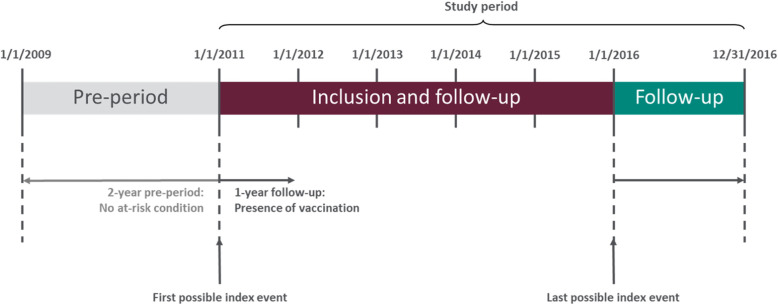
A retrospective database analysis was conducted using the Clinical Practice Research Datalink (CPRD). Individuals aged 18 to 64 years who had a diagnosis for underlying medical conditions of interest at the index date (January 1, 2011 to December 31, 2015) were included in this study. Both underlying conditions and pneumococcal vaccination were identified using Read codes. A multivariable logistic regression model was used to identify factors associated with pneumococcal vaccination.
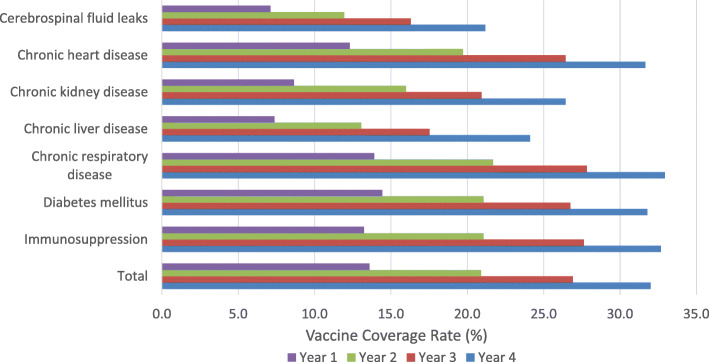
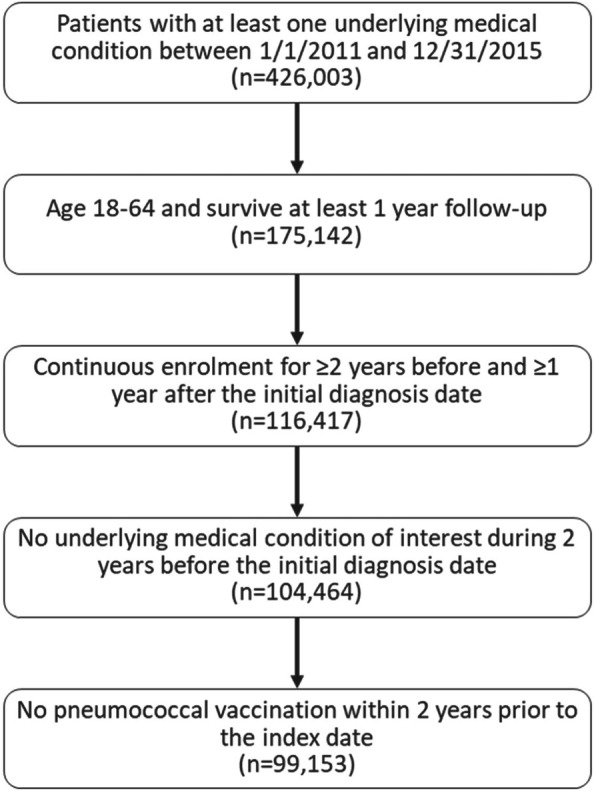
A total of 99,153 individuals with underlying medical conditions were included in this study. Within 1 year of follow-up, 13.6% had received pneumococcal vaccination. This figure rose to 32.0% after 4 years of follow-up. The mean time between diagnosis and vaccination was 148.7 days across the overall cohort. Based on multivariate analysis of results, individuals with chronic heart disease, chronic kidney disease, chronic liver disease, chronic respiratory disease or diabetes mellitus were significantly less likely (P < 0.0001) to be vaccinated than those with immunosuppression. Individuals were significantly more likely to receive a pneumococcal vaccination if they received an influenza vaccination in the first year of follow-up than those who did not (P < 0.001).
Despite the Joint Committee on Vaccination and Immunisation (JCVI) recommendations for pneumococcal vaccination in clinical risk groups, rates of pneumococcal vaccination are suboptimal in the UK for individuals aged 18-64 with underlying medical conditions. Further emphasis should be made on the importance of increased pneumococcal vaccination coverage in the UK, given the increased risk of morbidity and mortality associated with indicative underlying medical conditions.
在英国,某些具有易感条件的人群有资格接种肺炎球菌多糖疫苗(PPV23)。这些个体的疫苗接种率已有10年未被报道。因此,本研究调查了18至64岁患有某些基础疾病的个体的肺炎球菌疫苗接种率、诊断后至接种疫苗的时间以及与疫苗接种相关的因素。
使用临床实践研究数据链(CPRD)进行回顾性数据库分析。本研究纳入了在索引日期(2011年1月1日至2015年12月31日)被诊断患有相关基础疾病的18至64岁个体。基础疾病和肺炎球菌疫苗接种均使用Read编码进行识别。采用多变量逻辑回归模型来识别与肺炎球菌疫苗接种相关的因素。
本研究共纳入了99153名患有基础疾病的个体。在随访的1年内,13.6%的人接种了肺炎球菌疫苗。随访4年后,这一数字升至32.0%。整个队列中,诊断与接种疫苗之间的平均时间为148.7天。基于结果的多变量分析,与免疫抑制患者相比,患有慢性心脏病、慢性肾病、慢性肝病、慢性呼吸道疾病或糖尿病的个体接种疫苗的可能性显著降低(P<0.0001)。在随访的第一年接受流感疫苗接种的个体比未接种的个体更有可能接种肺炎球菌疫苗(P<0.001)。
尽管疫苗接种和免疫联合委员会(JCVI)对临床风险人群的肺炎球菌疫苗接种有建议,但在英国,18至64岁患有基础疾病的个体的肺炎球菌疫苗接种率仍不理想。鉴于与相关基础疾病相关的发病和死亡风险增加,应进一步强调提高英国肺炎球菌疫苗接种覆盖率的重要性。