Department of Orthopaedic Surgery, The First Affiliated Hospital of Zhengzhou University, Zhengzhou, 450052, Henan, People's Republic of China.
J Orthop Surg Res. 2020 Oct 21;15(1):485. doi: 10.1186/s13018-020-02015-8.
This is the first systematic review and meta-analysis on the overall incidence of intraspinal abnormalities in patients with congenital scoliosis (CS) and potential influencing factors.
We searched three large electronic databases (PubMed, EMBASE, and Cochrane Library) for potentially relevant studies. The quality of the included studies was assessed independently by two authors using the Methodological Index for Non-Randomized Studies (MINORS) criteria. Data on the number of CS patients, number of CS patients with intraspinal abnormalities, sex of the patients, and CS types were extracted from the included studies. R software was used to pool and analyze all the extracted data.
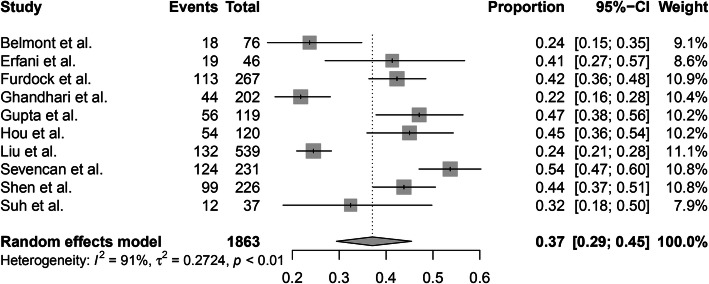
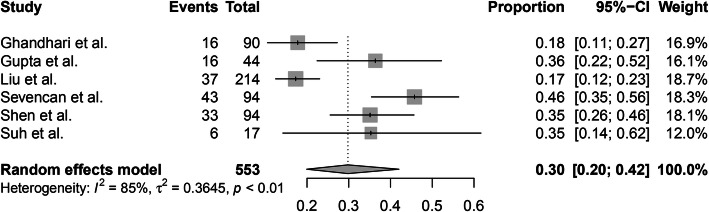
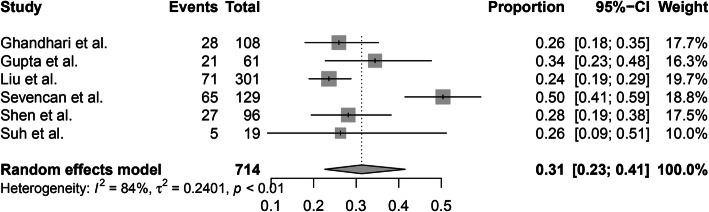
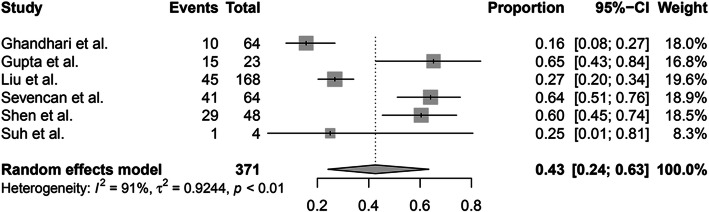
This meta-analysis included 10 articles, and 671 of 1863 CS patients undergoing magnetic resonance imaging (MRI) examinations were identified to have intraspinal abnormalities. The overall incidence of intraspinal abnormalities in the patients with CS was 37% (95% CI, 29-45%). Diastematomyelia was the most common intraspinal abnormality and was detected in 45.60% of the patients with intraspinal abnormalities (306/671). The remaining intraspinal abnormalities included syringomyelia (273/671, 40.69%), tethered cord (190/671, 28.32%), low conus (58/671, 8.64%), intraspinal mass (39/671, 5.81%), Chiari malformation (32/671, 4.77%), fatty filum (27/671, 4.02%), spina bifida (occulta excluded) (17/671, 2.53%), tumor (17/671, 2.53%), cyst (12/671, 1.79%), syringomyelus (4/671, 0.60%), dural ectasia (1/671, 0.15%), and undiagnosed cord MRI hyperintensity (1/671, 0.15%). The patient's sex and CS type were not factors that affected the incidence of intraspinal abnormalities in CS patients (all P > 0.05).
This meta-analysis revealed that the overall incidence of intraspinal abnormalities detected by MRI in CS patients was 37%. Diastematomyelia was the most common intraspinal abnormality. The patient's sex and CS type were not factors that affected the incidence of intraspinal abnormalities in CS patients.
这是首次对先天性脊柱侧凸(CS)患者椎管内异常的总体发生率及潜在影响因素进行的系统评价和荟萃分析。
我们在三个大型电子数据库(PubMed、EMBASE 和 Cochrane Library)中检索了可能相关的研究。两位作者独立使用非随机研究方法学指数(MINORS)标准评估纳入研究的质量。从纳入的研究中提取 CS 患者人数、椎管内异常 CS 患者人数、患者性别和 CS 类型的数据。使用 R 软件对所有提取的数据进行合并和分析。
这项荟萃分析纳入了 10 篇文章,共纳入 1863 例行磁共振成像(MRI)检查的 CS 患者,其中 671 例患者存在椎管内异常。CS 患者椎管内异常的总体发生率为 37%(95%CI,29-45%)。脊髓纵裂是最常见的椎管内异常,在 371 例椎管内异常患者中占 45.60%(306/671)。其他椎管内异常包括脊髓空洞症(273/671,40.69%)、脊髓栓系(190/671,28.32%)、圆锥低位(58/671,8.64%)、椎管内肿块(39/671,5.81%)、小脑扁桃体下疝畸形(32/671,4.77%)、脂肪脊索(27/671,4.02%)、隐性脊柱裂(17/671,2.53%)、肿瘤(17/671,2.53%)、囊肿(12/671,1.79%)、脊髓空洞症(4/671,0.60%)、硬脊膜扩张(1/671,0.15%)和未诊断的脊髓 MRI 高信号(1/671,0.15%)。患者性别和 CS 类型均不是影响 CS 患者椎管内异常发生率的因素(均 P>0.05)。
本荟萃分析显示,CS 患者 MRI 检出的椎管内异常总体发生率为 37%。脊髓纵裂是最常见的椎管内异常。患者性别和 CS 类型不是影响 CS 患者椎管内异常发生率的因素。