Division of Comprehensive Musculoskeletal Medicine, Niigata University Graduate School of Medical and Dental Sciences, 1-757, Asahimachi-dori, Chuo ku, Niigata City, Niigata Prefecture, 951-8510, Japan.
Division of Orthopedic Surgery, Department of Regenerative and Transplant Medicine, Niigata University Graduate School of Medical and Dental Sciences, 1-757, Asahimachi-dori, Chuo ku, Niigata City, Niigata Prefecture, 951-8510, Japan.
J Orthop Surg Res. 2020 Oct 21;15(1):486. doi: 10.1186/s13018-020-02022-9.
The anatomical sacral slope is considered as an anatomical pelvic parameter independent of femoral head centers for measurement of anatomical sacral slope and was previously described to strongly correlate with pelvic incidence on a two-dimensional examination of healthy subjects. However, the correlation between anatomical sacral slope and pelvic incidence was unclear in patients with developmental dysplasia of the hip. This study aimed to examine the correlation between anatomical sacral slope and other spinopelvic parameters by analyzing plain radiographs of female patients with developmental dysplasia of the hip.
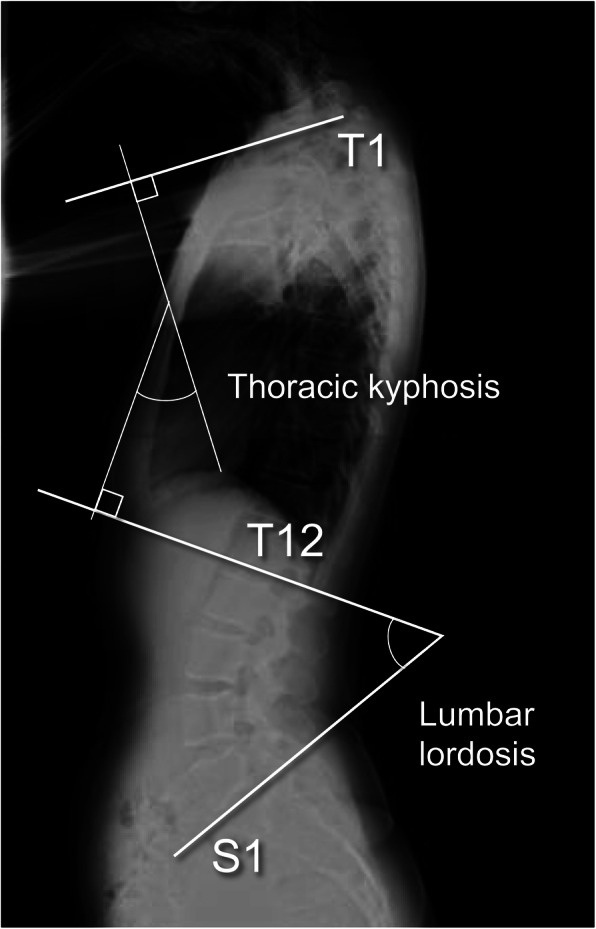
Eighty-four women with developmental dysplasia of the hip were examined. Lumbar lordosis, thoracic kyphosis, pelvic incidence, sacral slope, and anatomical sacral slope (the angle formed by the straight line of the S1 superior endplate and a line at a right angle to the anterior pelvic plane) were determined by analyzing plain radiographs. The correlations were examined by Pearson's correlation coefficients, and intra- and inter-rater intraclass correlation coefficients were evaluated for reliability.
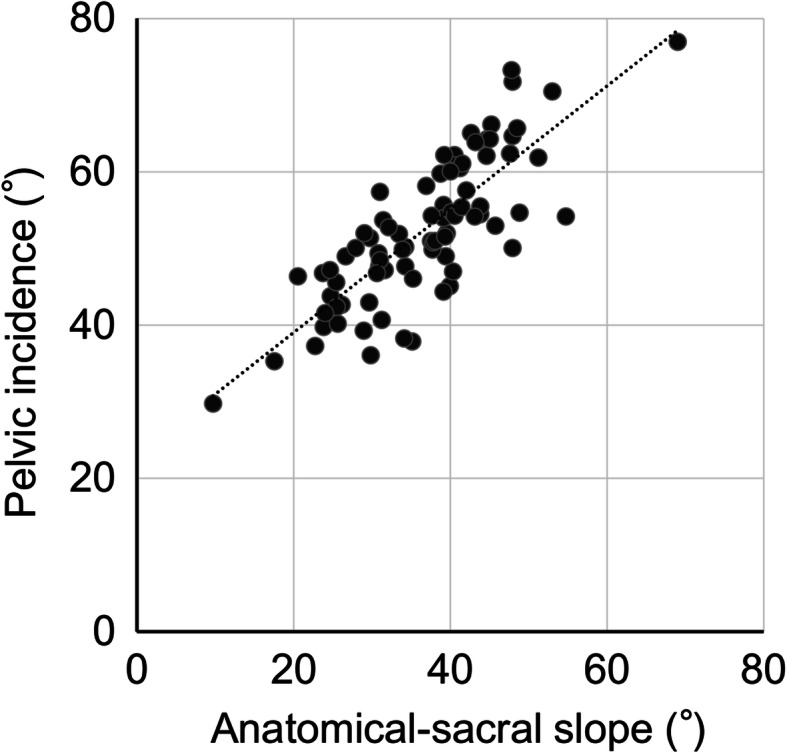
A strong correlation was observed between pelvic incidence and anatomical sacral slope (r = 0.725, p < 0.001). In addition, the correlation between anatomical sacral slope and lumbar lordosis was similar to that between pelvic incidence and lumbar lordosis (r = 0.661, p < 0.001, and r = 0.554, p < 0.001, respectively). The intra-rater intraclass correlation coefficient values were 0.869 and 0.824 for anatomical sacral slope and pelvic incidence, respectively. Furthermore, the inter-rater intraclass correlation coefficient values were 0.83 and 0.685 for anatomical sacral slope and pelvic incidence, respectively.
We observed that the strong correlation between anatomical sacral slope and pelvic incidence in patients with developmental dysplasia of the hip was equal to that in normal healthy subjects. The correlation between anatomical sacral slope and lumbar lordosis was equal to that between pelvic incidence and lumbar lordosis. Additionally, the intraclass correlation coefficient values for the anatomical sacral slope were slightly higher than those for pelvic incidence. Thus, we conclude that anatomical sacral slope can be considered as a helpful anatomical pelvic parameter that is a substitute for pelvic incidence not only in normal healthy subjects, but also in patients with developmental dysplasia of the hip.
解剖学骶骨倾斜度被认为是独立于股骨头中心的解剖学骨盆参数,用于测量解剖学骶骨倾斜度,先前已被描述为与健康受试者的二维检查中的骨盆入射角强烈相关。然而,在发育性髋关节发育不良患者中,解剖学骶骨倾斜度与骨盆入射角之间的相关性尚不清楚。本研究旨在通过分析发育性髋关节发育不良女性患者的平片,检查解剖学骶骨倾斜度与其他脊柱骨盆参数之间的相关性。
检查了 84 名发育性髋关节发育不良的女性患者。通过分析平片确定腰椎前凸角、胸椎后凸角、骨盆入射角、骶骨倾斜度和解剖学骶骨倾斜度(S1 上终板的直线和垂直于骨盆前平面的直线之间形成的角度)。采用 Pearson 相关系数检验相关性,并评价内、外观察者的组内相关系数。
骨盆入射角与解剖学骶骨倾斜度之间存在很强的相关性(r = 0.725,p < 0.001)。此外,解剖学骶骨倾斜度与腰椎前凸角之间的相关性与骨盆入射角与腰椎前凸角之间的相关性相似(r = 0.661,p < 0.001,r = 0.554,p < 0.001)。解剖学骶骨倾斜度和骨盆入射角的内观察者组内相关系数值分别为 0.869 和 0.824。此外,解剖学骶骨倾斜度和骨盆入射角的外观察者组内相关系数值分别为 0.83 和 0.685。
我们观察到发育性髋关节发育不良患者解剖学骶骨倾斜度与骨盆入射角之间的强相关性与正常健康受试者相同。解剖学骶骨倾斜度与腰椎前凸角之间的相关性与骨盆入射角与腰椎前凸角之间的相关性相同。此外,解剖学骶骨倾斜度的组内相关系数值略高于骨盆入射角。因此,我们得出结论,解剖学骶骨倾斜度不仅在正常健康受试者中,而且在发育性髋关节发育不良患者中,都可以作为一个有用的解剖学骨盆参数,替代骨盆入射角。